



 Certifiedunder the RAG-Based AI Assistant module in the Agentic AI Essentials program.
This project implements a beginner-friendly, reproducible Retrieval-Augmented Generation (RAG) assistant built entirely in Jupyter Notebook.
The assistant ingests plain-text documents, splits them into overlapping chunks, computes sentence-level embeddings with sentence-transformers (all-MiniLM-L6-v2), stores vectors in a local ChromaDB collection, and answers natural language queries using a compact local LLM (google/flan-t5-small).
Key outcomes:
Sources: for traceability.rag_notebook.ipynb, data/*.txt (knowledge base), output_demo.txt (sample Q&A log), and requirements.txt.This submission demonstrates how an entry-level developer can build a traceable, testable RAG assistant and package it for evaluation in the AAIDC Module 1 review cycle.!
rag_proj/
├── rag_notebook.ipynb # Main notebook (ingest → embed → retrieve → generate)
├── data/ # Text documents used as knowledge base (publication*.txt)
├── output_demo.txt # Demo Q&A log (generated by the notebook)
├── README.md
├── requirements.txt
└── .gitignore
.txt files placed in data/.Embeddings and vector store
Retrieval + Answer generation
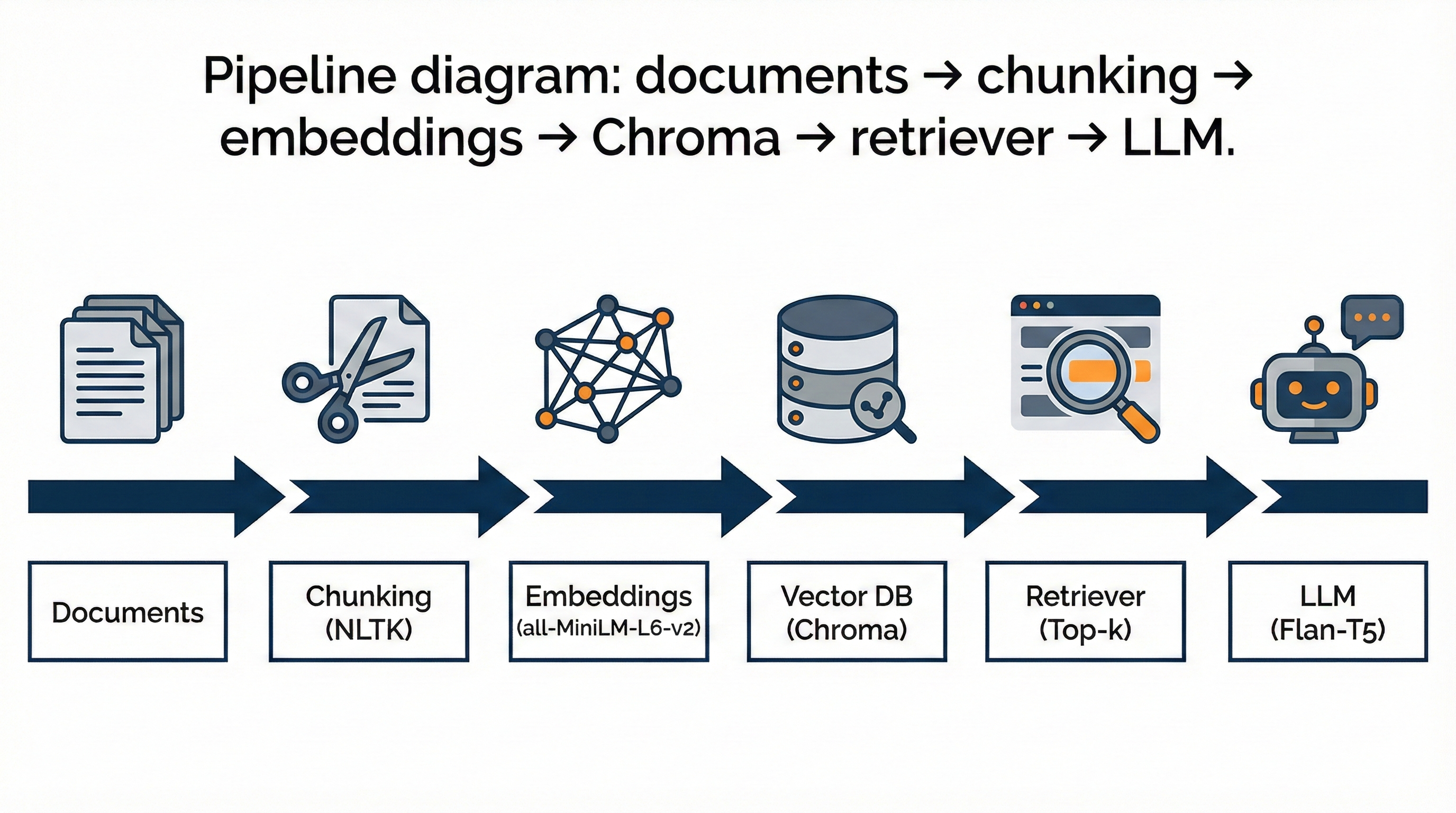
.txt files placed in data/.Chunking code (snippet used in notebook):
from nltk.tokenize import sent_tokenize

def chunk_text(text, max_words=300, overlap_words=50):
    sents = sent_tokenize(text)
    chunks, cur, cur_count = [], [], 0
    for sent in sents:
        w = len(sent.split())
        if cur_count + w <= max_words or not cur:
            cur.append(sent); cur_count += w
        else:
            chunks.append(" ".join(cur))
            overlap = " ".join(" ".join(cur).split()[-overlap_words:]) if overlap_words>0 else ""
            cur = [overlap] if overlap else []
            cur.append(sent); cur_count = len(" ".join(cur).split())
    if cur: chunks.append(" ".join(cur))
    return chunks

<!-- RT_DIVIDER -->
# Results
Demo Q&A (selected excerpts)

The full demo log is in rag_proj/output_demo.txt. Example outputs captured during the demo:

Q: What is this publication about?
A: This publication explains how to build a Retrieval-Augmented Generation (RAG) assistant using local embeddings and ChromaDB, covering chunking, embeddings, retrieval, and answer generation.
Sources: publication1.txt

Q: Which tools are recommended in the documents?
A: The documents list Chroma (vector DB), sentence-transformers (embeddings), and Flan-T5 (local generation).
Sources: publication2.txt

Q: What limitation is mentioned?
A: The demo notes that the dataset is small and that retrieval accuracy depends on chunking and embedding quality.
Sources: publication1.txt
