



 Certifiedunder the Multi-Agent System module in the Mastering AI Agents program.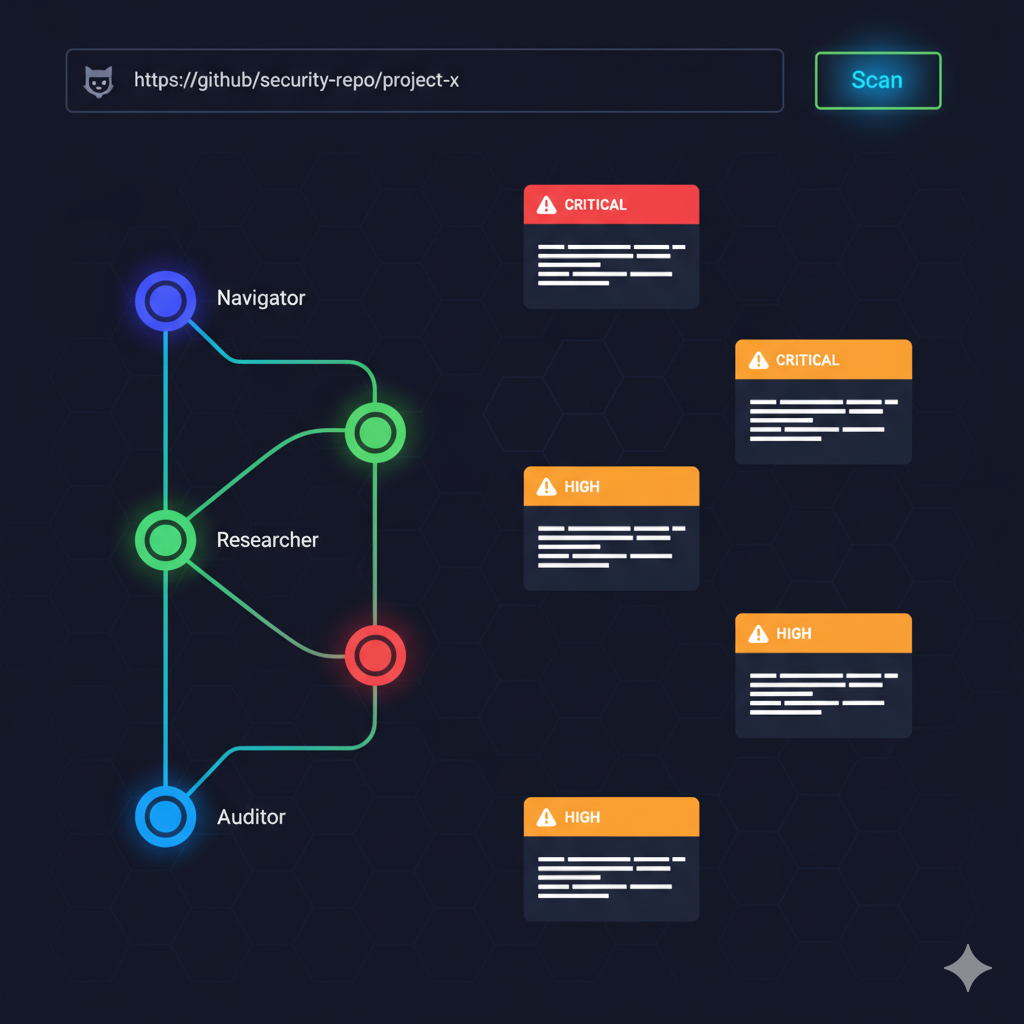
SwiftAudit is a multi-agent security analysis system that combines deterministic scanning tools with LLM-powered reasoning to audit any public GitHub repository. Built on LangGraph, the system uses four specialised agents — Navigator, Researcher, Exploiter, and Auditor — that coordinate through shared state to detect vulnerabilities ranging from SQL injection and hardcoded secrets to broken authentication flows and business logic flaws that pattern-matching tools alone cannot find. Results stream to a React dashboard in real time via Server-Sent Events, typically completing a full audit in under two minutes.
Security auditing is one of the most cognitively demanding tasks in software development. A skilled penetration tester must simultaneously understand code logic, track data flows across files, reason about attacker goals, and produce actionable remediation advice. It is also repetitive at scale — the same classes of vulnerabilities appear in codebase after codebase.
This combination makes it a strong candidate for multi-agent AI: decompose the task into specialist roles, run the expensive parts in parallel, and let deterministic tools handle what they are good at while LLM reasoning handles what they cannot.
SwiftAudit was built to answer one question: can a multi-agent system perform a useful security audit of an unfamiliar codebase in under two minutes, producing findings a developer can act on immediately?
The answer, in practice, is yes — with caveats worth discussing honestly.
SwiftAudit uses LangGraph as its orchestration framework. The pipeline is a compiled StateGraph with four agent nodes connected by directed edges and one conditional routing step.
Navigator → Researcher → [conditional] → Exploiter → Auditor
                                    ↘ (no HIGH/CRITICAL) → Auditor
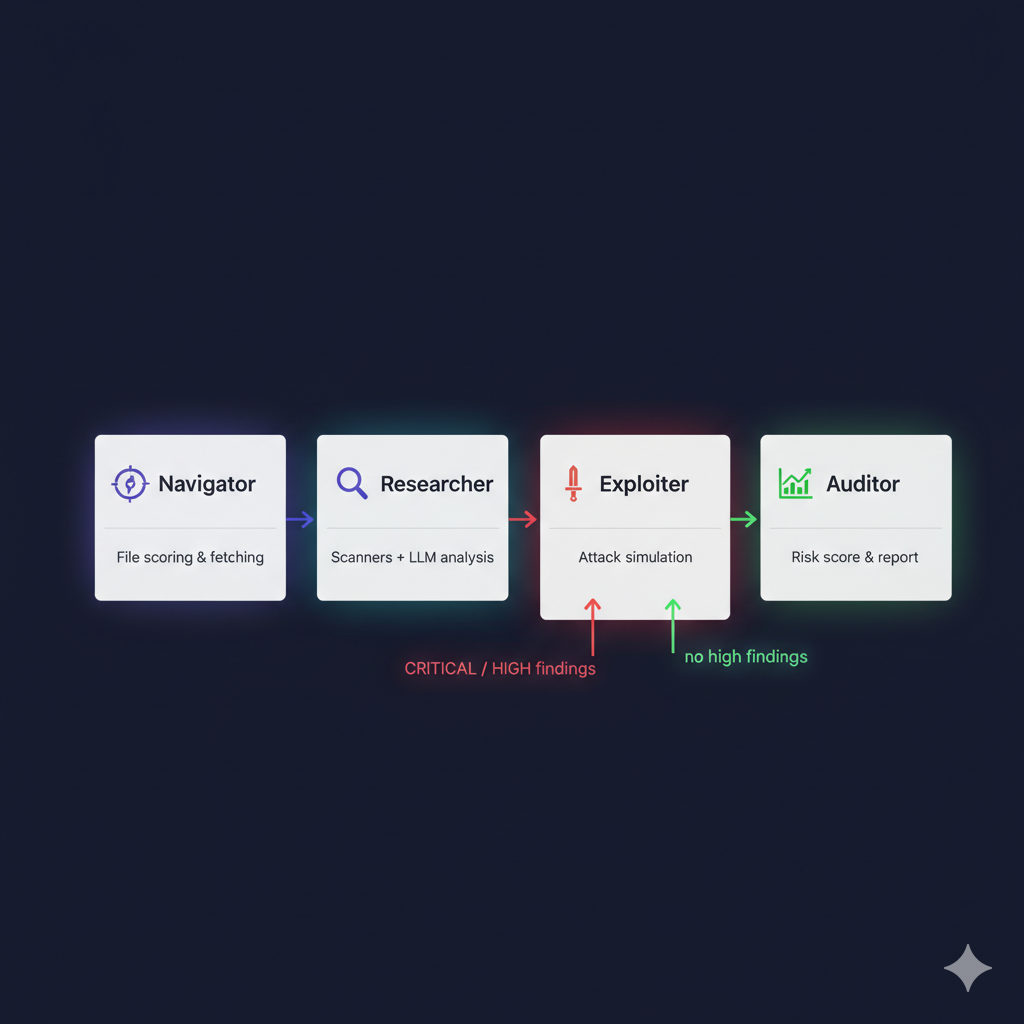
LangGraph was chosen over alternatives (CrewAI, AutoGen) for three reasons. First, its explicit graph model makes the data flow easy to reason about and debug. Second, the TypedDict-based ScanState with Annotated[List, operator.add] reducers lets multiple nodes append to shared lists without race conditions. Third, conditional edges allow routing decisions based on runtime data — in SwiftAudit's case, skipping the Exploiter entirely when no high-severity findings justify the LLM cost.
All four agents communicate through a single ScanState TypedDict. Fields are either:
metadata, files, overall_risk_score (plain types, last write wins)findings, agent_logs, errors (declared with operator.add so each node appends without overwriting)This design means each node is a pure function that reads what it needs and returns only the fields it updated. Nodes have no shared mutable state outside of ScanState.
A custom in-process SSE bus (core/events.py) lets any agent thread push events to the browser with ~50ms latency. Each scan ID has its own list of per-connection queues. Pipeline threads call emit(scan_id, event_type, data) which is non-blocking and thread-safe. A history buffer of 300 events supports late-joining clients (e.g. page refresh mid-scan).
Role: Repository intake, file selection, parallel content fetching
The Navigator fetches the full recursive file tree from the GitHub API, then scores every file on a 0–100 priority scale using the score_file_priority LangChain tool. The scoring function is fully deterministic — it awards points for security-relevant filenames (auth, login, config, .env), path keywords (sql, password, token, upload, admin), source code extensions, and IaC files (Dockerfiles, Terraform, Kubernetes manifests).
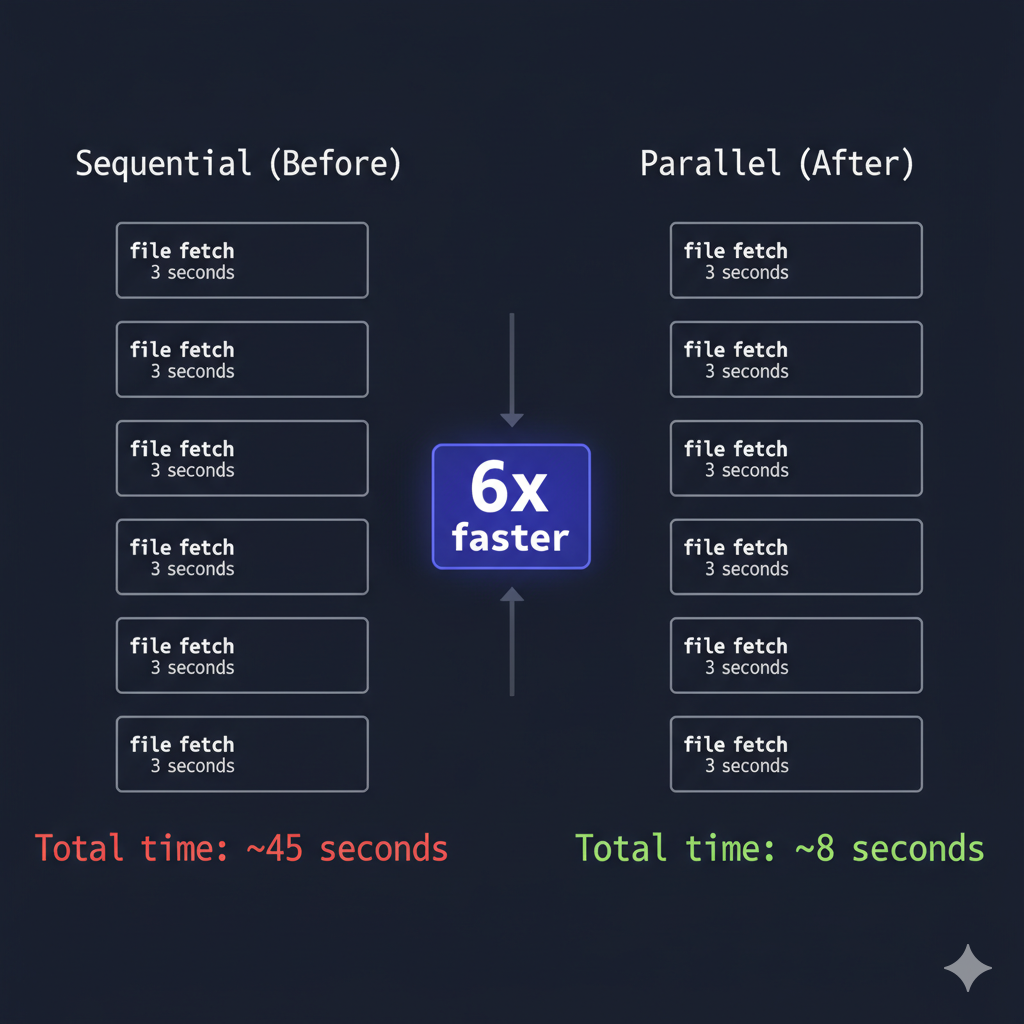
The top-scoring files are fetched in parallel using a ThreadPoolExecutor with 6 workers. In sequential form (v9), fetching 15 files took 30–45 seconds. Parallel fetching reduced this to 5–8 seconds — a 6× improvement for a pipeline where every second matters.
Key design decision: Scoring is deterministic rather than LLM-driven. An LLM-based file scorer was prototyped but discarded — it was slower, occasionally made poor choices, and added an LLM call to a phase that doesn't benefit from reasoning.
Role: Tool scanning + LLM analysis, finding normalisation and deduplication
The Researcher is the most complex agent. It runs two workstreams concurrently:
Tool workstream (parallel subprocesses):
--scanners vuln,secret,misconfiggit log -p and computes Shannon entropy on every string literal in deleted diff lines. Strings with entropy > 4.5 that are not git SHAs, UUIDs, or MD5s are reported as "zombie secrets" — credentials that were committed and then deleted but remain permanently accessible in git history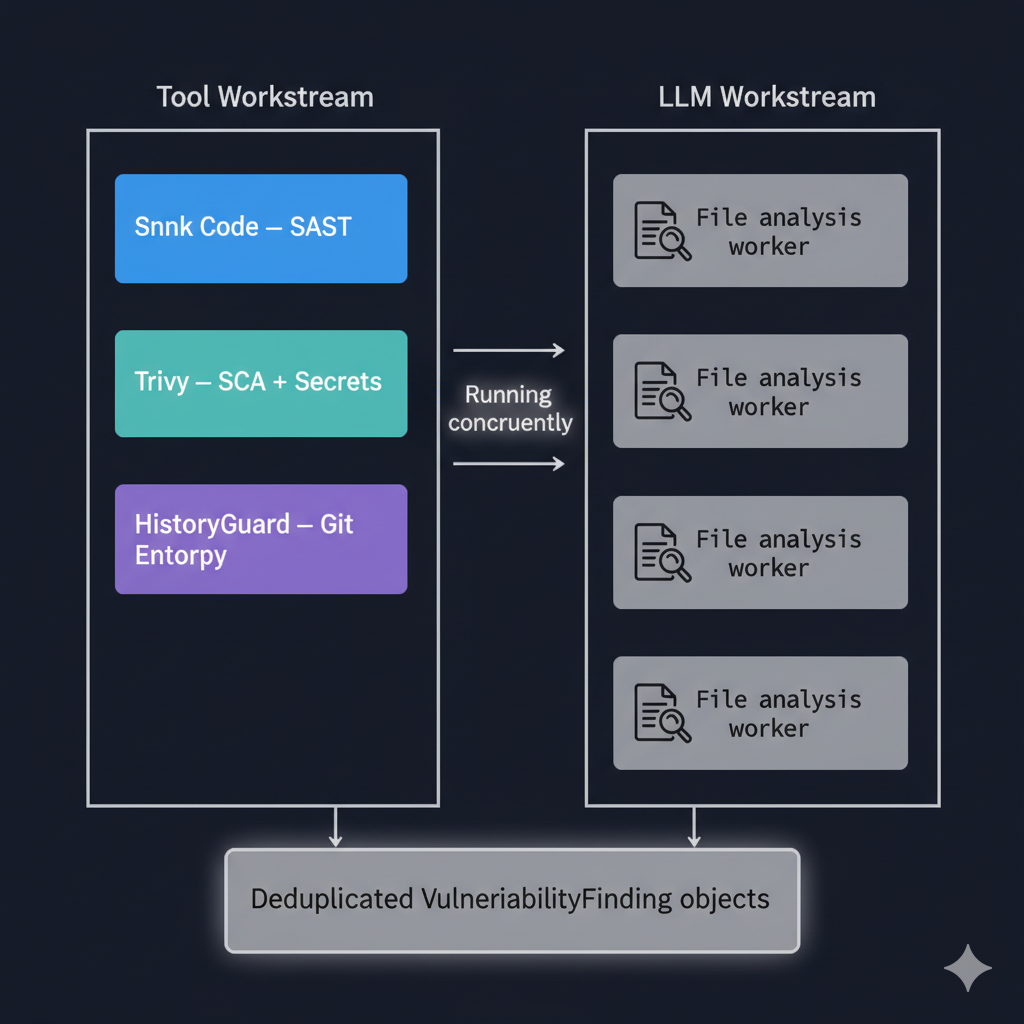
All findings from both workstreams are normalised into VulnerabilityFinding Pydantic models and deduplicated. Deduplication uses a combination of file path, line number range, and category matching — the same vulnerability found by both Snyk and the LLM is merged into a single finding with the tool source preferred.
Key design decision: Running tool and LLM workstreams concurrently rather than sequentially was the single largest latency improvement. On a 15-file repository, this reduced Researcher time from ~90 seconds to ~45 seconds.
Role: Attacker simulation for high-severity findings
The Exploiter only activates when CRITICAL or HIGH findings exist (enforced by LangGraph's conditional edge). For each qualifying finding it calls generate_exploit_path, which prompts the LLM to write a realistic red-team simulation: prerequisites, numbered attack steps with target and result, impact statement, attacker profile (Script Kiddie to Nation-State), and a proof-of-concept.
Python PoC code is validated with ast.parse() before being included in the output. Syntactically invalid PoC is marked poc_verified: false so the UI can warn users clearly.
Key design decision: The Exploiter was intentionally scoped to CRITICAL and HIGH findings only. Running it on all findings would triple the LLM cost and produce exploit paths for low-severity issues where the attack surface is not interesting enough to warrant detailed simulation.
Role: Deterministic risk scoring, radar calculation, executive summary, report assembly
The Auditor calculates the risk score using pure Python math with no LLM involvement. Severity weights (CRITICAL=25, HIGH=15, MEDIUM=8, LOW=3, INFO=1) are summed and normalised to 0–100. This deterministic approach was chosen deliberately — an earlier version used an LLM to generate the score, which produced inconsistent results (the same finding set could score 45 on one run and 62 on another).
A six-dimension radar maps each finding category to one of: authentication, input validation, secrets management, API security, dependency safety, or configuration. Each dimension starts at 100 and loses points proportional to the severity of findings in that category.
The executive summary is the one place in the Auditor where an LLM is used — it is genuinely a writing task where model quality matters.
| Tool | Integration Type | Phase | What It Finds |
|---|---|---|---|
score_file_priority | Custom LangChain @tool | Navigator | Security-relevant files in repo |
| Snyk Code CLI | External subprocess | Researcher | Injection, XSS, path traversal, secrets |
| Trivy CLI | External subprocess | Researcher | CVEs, secrets, Dockerfile misconfiguration |
| HistoryGuard | Custom Python class | Researcher | Zombie secrets in git history |
analyze_file_for_vulnerabilities | Custom LangChain @tool | Researcher | Logic flaws, broken auth, IDOR |
generate_exploit_path | Custom LangChain @tool | Exploiter | Attack simulation with PoC code |
calculate_risk_score | Custom LangChain @tool | Auditor | Risk score and radar dimensions |
generate_executive_summary | Custom LangChain @tool | Auditor | Professional summary prose |
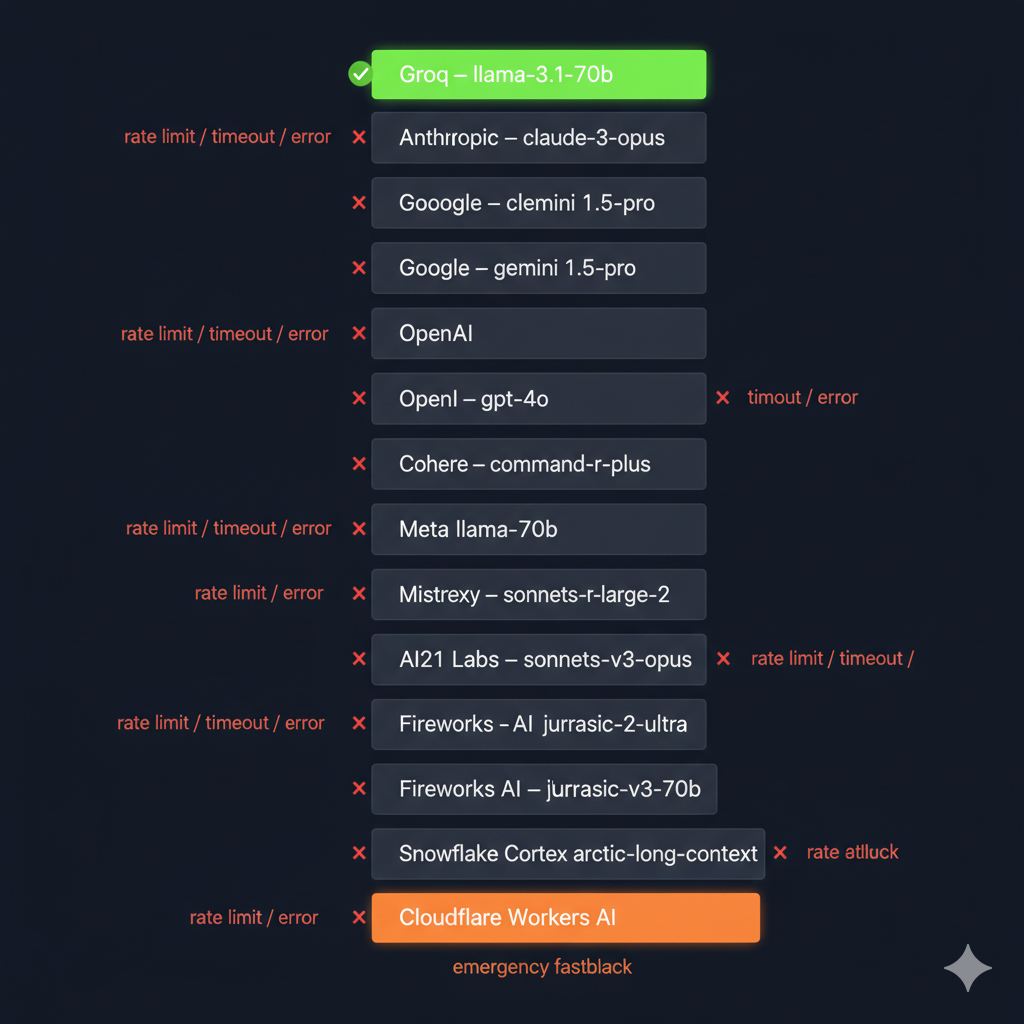
A security scanner that silently fails mid-scan because Groq is rate-limited is not useful. SwiftAudit implements a 12-provider fallback chain managed by utils/llm_client.py.
Every LLM call goes through call_llm() which iterates the provider chain in priority order. On any exception — rate limit (429), auth error (401), server error (500), timeout — it logs the failure and immediately retries with the next provider using the identical prompt. The prompt is stateless so no partial results need to be carried.
Providers are initialised once at module load. Any provider whose API key is missing or whose client fails to initialise is silently excluded from the chain. The chain is logged at startup so it is always clear which providers are available.
Provider priority (fastest/most capable first):
The following is a representative set of findings from scanning DSVW, a deliberately vulnerable Python web application:
| Finding | Severity | Source | CVSS |
|---|---|---|---|
| SQL Injection via unsanitised user input | CRITICAL | Snyk Code | 9.8 |
| OS Command Injection via shell=True | CRITICAL | Snyk Code | 10.0 |
| Reflected XSS — unescaped user input | HIGH | LLM | 7.4 |
| Path Traversal — arbitrary file read | HIGH | Snyk Code | 7.5 |
| Werkzeug 0.9.6 — CVE-2023-25577 | HIGH | Trivy | 7.5 |
For the SQL injection finding, the Exploiter generated a three-step attack simulation showing exactly how an attacker would use a UNION-based payload to exfiltrate the full user database, with a working Python proof-of-concept and a verified ast.parse() result.
The full output for this scan is available in examples/sample_output.json.
Deterministic over LLM where possible. File scoring, risk calculation, and severity weighting are all pure Python. LLMs were used where reasoning genuinely helps (logic vulnerability detection, exploit simulation, summary writing) and avoided where math or rules are sufficient. This improved consistency and reduced latency.
Parallel everything. The single biggest performance gain came from parallelising file fetching, scanner execution, and LLM analysis simultaneously rather than sequentially. A 6× improvement in fetching time and a 2× improvement in analysis time came purely from ThreadPoolExecutor — no architectural changes required.
SSE over polling. An earlier version polled the /status endpoint every two seconds. Switching to SSE cut perceived latency dramatically — the browser now shows findings the instant they are found rather than on the next poll interval.
The Exploiter routing decision. Routing the Exploiter conditionally (only when CRITICAL/HIGH findings exist) was important. In clean repositories, skipping the Exploiter saves 20–40 seconds and several LLM calls on findings that don't warrant detailed attack simulation.
LLM false positives are real. The LLM analysis workstream produces false positives, particularly in well-written code where the model finds theoretical issues that require multiple unlikely conditions to exploit. Tagging every finding with detection_source (snyk_code, trivy, llm_only) and displaying this prominently in the UI lets users apply appropriate skepticism to LLM findings versus deterministic tool findings.
# Snyk Code (SAST scanner)
npm install -g snyk
snyk auth

# Trivy (SCA + secrets scanner)
# macOS:
brew install trivy
# Linux:
curl -sfL https://raw.githubusercontent.com/aquasecurity/trivy/main/contrib/install.sh | sh

# Pre-warm the Trivy CVE database (downloads ~200MB once)
trivy image alpine
git clone https://github.com/10486-JosephMutua/SwiftAudit.git
cd SwiftAudit
pip install -r requirements.txt
cp .env.example .env
Open .env and set your keys. The minimum required configuration is:
GROQ_API_KEY=your_groq_api_key      # free at console.groq.com
GITHUB_TOKEN=your_github_token      # raises rate limit to 5000 req/hr
SNYK_TOKEN=your_snyk_token          # free at app.snyk.io
python app.py
Open http://localhost
in your browser.python -c "from core.config import config; config.validate()" trivy --version snyk --version
SwiftAudit is released under the MIT License.
You are free to use, copy, modify, and distribute this software for any purpose,
including commercial use, provided the original copyright notice is retained.
See the LICENSE file for full terms.
MAX_FILES_TO_ANALYZESwiftAudit demonstrates that a multi-agent architecture can meaningfully augment traditional security scanning. The LangGraph pipeline coordinates four specialised agents cleanly, the fallback chain makes the system resilient to LLM provider failures, and the parallel execution design keeps the end-to-end runtime practical.
The most important lesson from building this system is that multi-agent AI works best when each agent has a genuinely distinct role with a clear boundary — not just a different name. Navigator, Researcher, Exploiter, and Auditor each do something the others cannot, and the coordination overhead of passing state between them is justified by the specialisation.
GitHub: https://github.com/10486-JosephMutua/Swift
The repository contains complete source code, setup instructions, a .env.example with all configuration options, and a sample scan output in examples/sample_output.json.