



 Certifiedunder the Multi-Agent System module in the Mastering AI Agents program.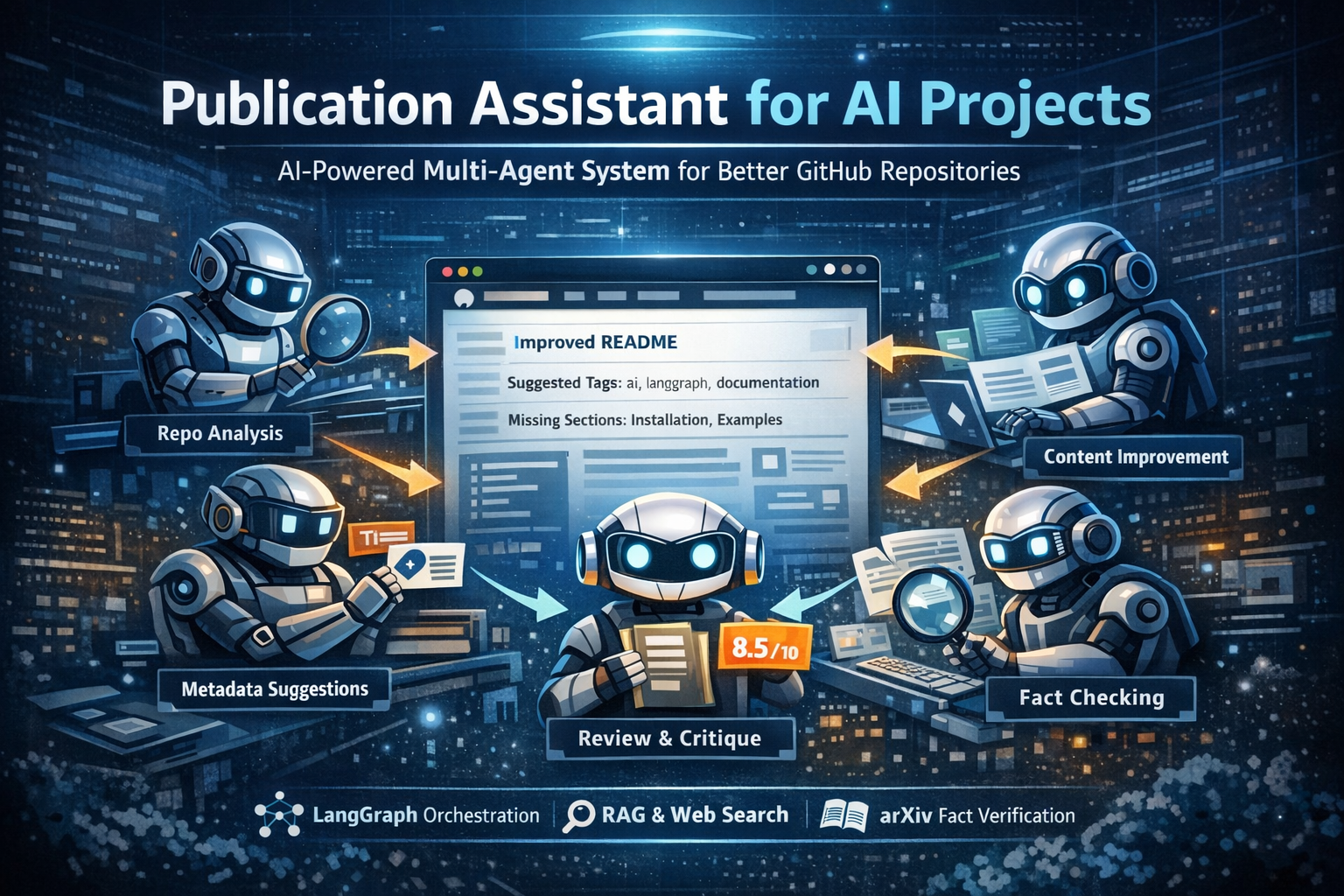
AI and machine learning repositories often contain valuable technical work but fail to communicate their contributions effectively because of incomplete documentation, poor organization, or weak project presentation. This project introduces a tool-augmented multi-agent system that automatically analyzes AI/ML repositories and produces publication-ready documentation tailored to the repository's content and the user's presentation goals.
Rather than relying on a single large language model, the system employs five specialized AI agents that collaboratively analyze repository structure, evaluate documentation quality, generate improvements, validate technical claims, and refine the final publication. The workflow is orchestrated using LangGraph, enabling structured collaboration between agents while integrating external tools such as GitHub repository analysis, web search, retrieval, keyword extraction, and documentation processing.
The resulting documentation is repository-specific, technically grounded, and optimized for discoverability, readability, and public sharing. By combining collaborative reasoning with tool augmentation, the system demonstrates how multi-agent AI can improve the quality and consistency of technical documentation for open-source AI/ML projects.
Open-source AI and machine learning projects continue to grow rapidly, yet many repositories struggle to communicate their value effectively. Excellent implementations frequently remain unnoticed because project documentation lacks clarity, completeness, discoverability, or technical organization.
Creating publication-quality documentation is a time-consuming process requiring technical writing, repository analysis, content organization, verification of claims, and knowledge of documentation best practices. These tasks extend well beyond simple text generation and require understanding the repository itself.
This project presents a multi-agent publication assistant designed specifically for AI and machine learning repositories. Unlike repository-specific documentation generators, this system is designed to generalize across AI and machine learning repositories. By relying on repository analysis, retrieval, and configurable generation goals instead of hardcoded project assumptions, it adapts its recommendations to each project's unique content and audience.
Each agent focuses on a distinct responsibility such as repository analysis, metadata optimization, documentation enhancement, quality review, or factual verification. The complete workflow is orchestrated using LangGraph, enabling coordinated decision-making while integrating external tools that provide repository context and supporting evidence.
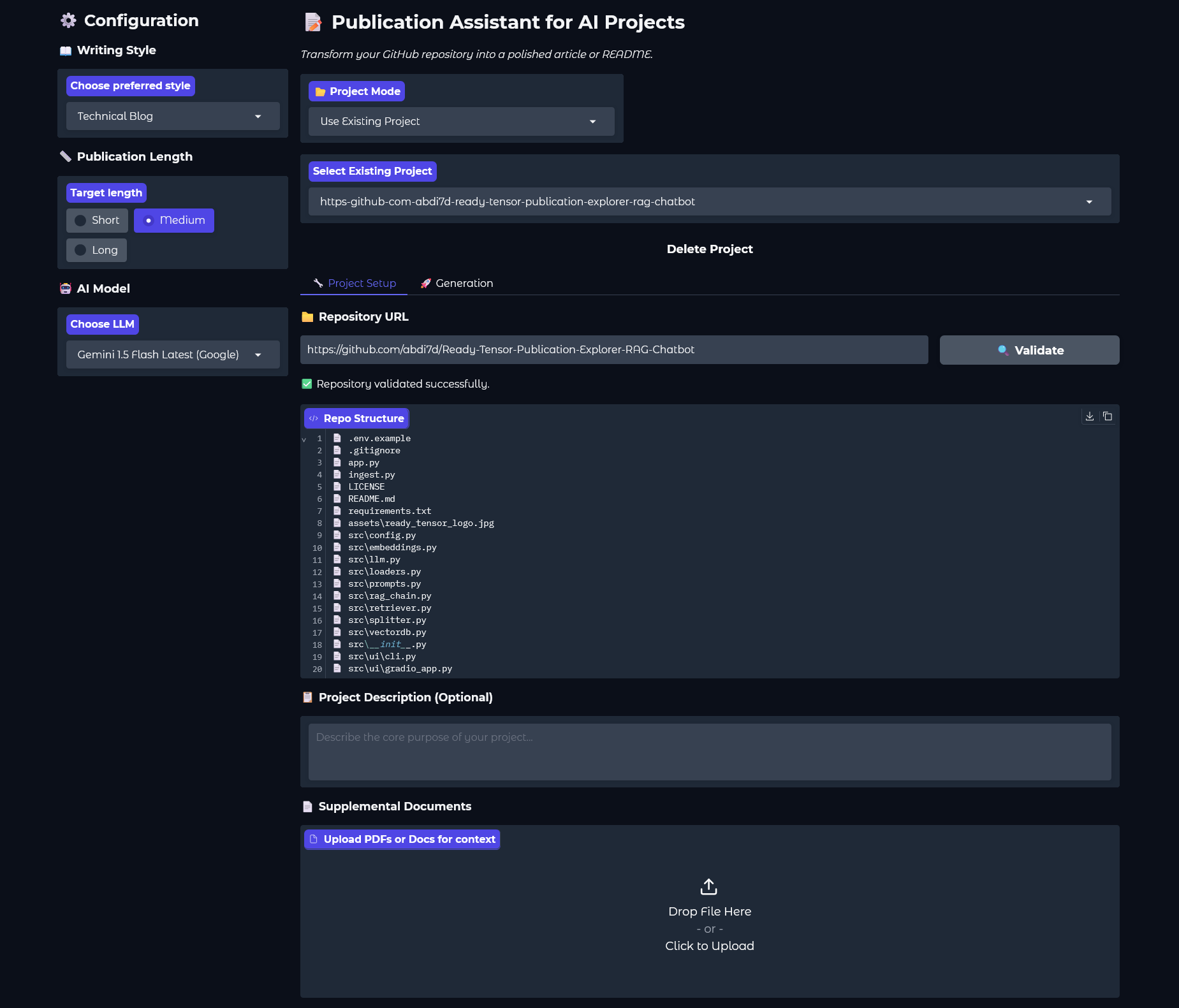
The system accepts a GitHub repository or local repo path together with an optional project description, optional goal, and preferred writing style, then produces documentation tailored to the repository's content, audience, and publication objectives.
This section helps readers know the environment and background needed before using the system.
High-quality documentation increases adoption because it helps developers, researchers, and contributors understand a project quickly and accurately.
This project emphasizes not only what the system generates, but why it is needed to make repository content visible and credible.
Although modern language models can generate documentation, they often produce generic content that is disconnected from the actual repository. Common challenges include:
Single-agent systems frequently struggle to balance repository understanding, technical accuracy, presentation quality, and validation simultaneously.
The primary objectives of this project are:
The Publication Assistant operates as a collaborative multi-agent system where specialized agents work together to transform repository information into publication-ready documentation.
Instead of one model performing every task, responsibilities are distributed among independent agents that exchange structured information throughout the workflow.
The orchestration layer coordinates execution order, information sharing, and decision-making to ensure consistent outputs.
This clarifies the interface and makes the system easier to reproduce.
The system consists of five collaborating agents:
LangGraph enables structured state passing and reproducible execution. It allows each agent to consume and extend shared context rather than forcing all logic into a linear prompt chain.
Each agent handles one distinct concern:
This separation reduces dependency on a single model and improves transparency and maintainability.
RAG retrieval is used when enabled and available. It can ground the content improvement step in best-practice documentation examples and repository evidence, which helps the system avoid generic outputs and stay aligned with real documentation patterns.
Verification is applied after the final draft is generated so the system validates what is actually produced. This avoids spending resources on poor drafts and ensures the final output is checked.
Metadata guides the writing process and improves discoverability independently. By separating these responsibilities, the system can produce better titles, summaries, and tags while still generating rich README content.
The orchestration pipeline is independent of any single LLM provider and can operate with different supported models, allowing users to balance cost, performance, and availability.
The system follows a staged methodology that mirrors how humans prepare technical publications.
Each stage passes structured outputs into shared state so later stages build on the results of earlier analysis.
The agents collaborate through shared state managed by LangGraph. Outputs from one agent become inputs for the next.
flowchart TD
    RepoAnalyzer[Repository Analyzer] --> SharedState1[Shared State]
    SharedState1 --> MetadataAgent[Metadata Agent]
    MetadataAgent --> SharedState2[Shared State]
    SharedState2 --> READMEAgent[Documentation Enhancement Agent]
    READMEAgent --> SharedState3[Shared State]
    SharedState3 --> Reviewer[Quality Review Agent]
    Reviewer --> FactChecker[Verification Agent]
LangGraph’s shared state enables each agent to consume outputs from previous agents instead of operating independently. This ensures the workflow is coherent and avoids repeated analysis.
The project includes defensive behavior for common failure modes:
The system employs LangGraph to orchestrate interactions among agents. Agents do not operate in isolation; they exchange intermediate outputs and build on prior analysis.
This architecture supports:
flowchart TD
    Analyze[Repo Analysis] --> Metadata[Metadata Recommendation]
    Metadata --> Improve[Content Improvement]
    Improve --> Review[Quality Review]
    Review --> Verify[Fact Verification]
    Verify --> Final[Final Output]
The orchestrator is implemented in orchestration/graph.py and uses a StateGraph to compile the pipeline.
This ordered workflow reduces wasted work and reinforces quality at each stage.
| Tool | Purpose |
|---|---|
RepoParser | Provides structural understanding of the repository by reading files, README content, and repository metadata. |
KeywordExtractor | Improves discoverability by extracting relevant technical terms from README text and repository content. |
WebSearchTool | Adds external context from similar repositories and documentation examples when Tavily is available. |
RAGRetriever | Injects best-practice documentation guidance from ChromaDB retrieval results. |
ArxivScholarTool | Validates technical claims against academic literature, reducing unsupported statements. |
These five tools were selected to give each agent strong evidence sources, enabling the system to produce grounded, repository-specific documentation rather than generic text.
| Requirement | Value |
|---|---|
| Python | 3.11+ |
| Framework | LangGraph |
| UI | Gradio |
| LLM | Gemini / Groq / OpenAI (configurable) |
| Vector Store | ChromaDB |
| Supported Input | GitHub URL, Local Folder, ZIP |
The project can be deployed locally or served as a Gradio web interface. Core functionality requires Python 3.11+ and the repository dependencies.
pip install -r requirements.txt
python app.py
python main.py --repo /path/to/repo
GOOGLE_API_KEYGROQ_API_KEYTAVILY_API_KEYExternal services are optional; if API keys are not provided, the pipeline falls back to heuristic behavior and still produces documentation recommendations.
Deployment considerations:
Monitoring and maintenance considerations:
Input
github.com/user/rag-chatbotOutput
This example shows how the system converts repository input into a publication-ready output list.
The repository contains these major components:
| Component | Description |
| ------------------------ | ----------------------------------------------------------------------------------------- | --- |
| agents/ | Five agent modules for analysis, metadata, content improvement, review, and fact checking |
| tools/ | Repository parser, web search, keyword extraction, retrieval, and Arxiv scholar tooling |
| orchestration/graph.py | LangGraph orchestrator that compiles and runs the pipeline |
| app.py | Gradio web UI for interactive publication generation |
| main.py | CLI entrypoint for batch or local repository execution | |
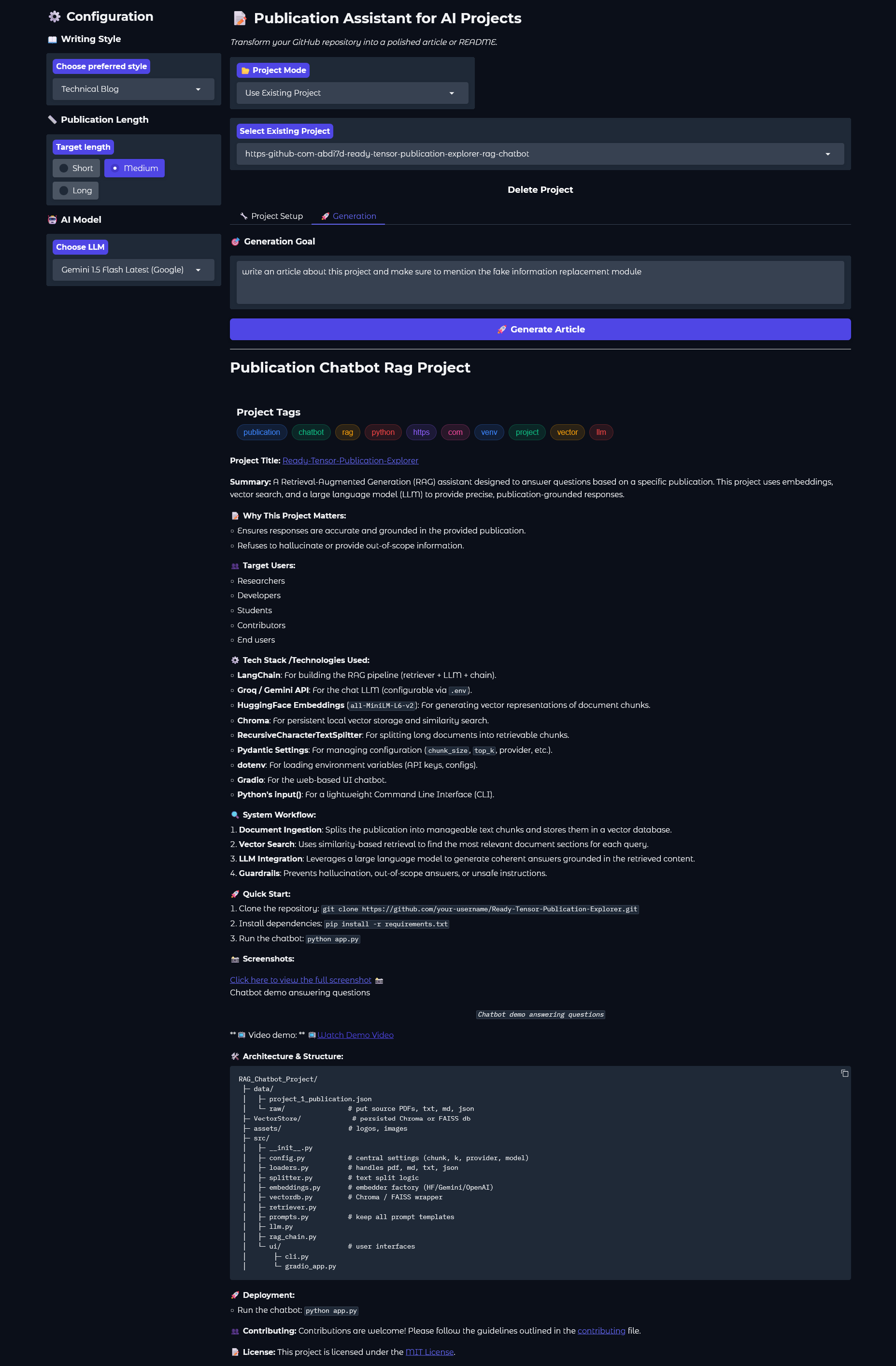
RepoParser.parse() supports local folders, ZIP archives, and remote git URLs.RepoAnalyzerAgent computes file statistics, extracts README content, detects missing sections, and derives a short summary.KeywordExtractor uses Gemini if available, otherwise falls back to frequency-based heuristic extraction.MetadataRecommenderAgent generates title suggestions and short descriptions, using Gemini only when configured.ContentImproverAgent synthesizes improved README content by combining web search examples and retrieved best-practice hints.ReviewerCriticAgent returns a simple review score with issues, strengths, and recommendations.FactCheckerAgent extracts claims from README text and checks them against Arxiv search results.The Gradio app in app.py enables users to:
Output is formatted as a polished title, tag section, and cleaned improved README body.
The Publication Assistant is evaluated relative to several alternative approaches:
Trade-offs:
The Publication Assistant aims to combine evidence grounding, structure generation, and verification in a way that balances automation with repository specificity.
The system has been applied to representative AI/ML repositories with varying documentation quality. Example outcomes include:
Lessons learned:
These case notes provide practical success stories and show how the system behaves in real usage.
This system can assist:
The system is evaluated by running it on multiple AI/ML repositories with varying documentation quality, using a defined framework of metrics and baselines.
Key evaluation metrics:
Comparison baselines:
Evaluation criteria:
Measurement approach:
This evaluation framework gives clear success criteria and a repeatable approach for assessing the tool's effectiveness.
Across representative AI/ML repositories with varying documentation quality, the system consistently:
These results are qualitative and trace the system’s ability to produce better documentation than generic README rewriting.
The observed improvements indicate that structured repository analysis and tool-augmented agent collaboration can produce more coherent and complete documentation than generic rewriting approaches. By focusing on repository-specific evidence, the system is able to preserve technical details while improving clarity.
Key insights:
Unexpected findings and implications:
These interpretations clarify the meaning of the system’s results and what stakeholders can expect when using it.
The design trades off modularity and reliability against added orchestration complexity:
This discussion emphasizes the practical trade-offs in building robust documentation automation.
Future work can extend the system in several ways:
These extensions would make the system more robust for long-term adoption and broader AI/ML repository support.
Success is measured by:
These metrics align with the goals of a publication-ready documentation workflow.
The system is intentionally practical, but it has limitations:
To reproduce this work, the repository includes:
requirements.txt for Python dependenciesapp.py and main.py as execution entry pointsGOOGLE_API_KEY, GROQ_API_KEY, TAVILY_API_KEYThis makes the system easier to run in different environments.
The project is published as an open-source implementation. See the LICENSE file for usage rights, redistribution terms, and license details.
Support and maintenance are provided through the GitHub repository. Users can report issues, request features, and submit contributions via the repository issue tracker.
The project is intended as a practical reference implementation for collaborative AI agent systems rather than a production SaaS offering.
LangChain Inc. LangGraph Documentation. https://langchain-ai.github.io/langgraph/
LangChain Documentation. https://python.langchain.com/
ChromaDB Documentation. https://docs.trychroma.com/
arXiv API Documentation. https://info.arxiv.org/help/api/
Tavily Search API. https://docs.tavily.com/
Google Gemini API Documentation. https://ai.google.dev/
Gradio Documentation. https://www.gradio.app/
Effective documentation is essential for communicating the value of AI and machine learning projects, yet producing high-quality technical publications remains challenging and time intensive. This project shows how specialized AI agents combined with external tools and structured orchestration can automate complex documentation work while preserving technical grounding.
By transforming raw repository information into publication-ready documentation, the Publication Assistant provides a practical example of how multi-agent systems can improve the visibility, accessibility, and impact of open-source AI/ML repositories.
More broadly, the project demonstrates how decomposing complex documentation tasks into specialized, tool-augmented agents can improve both the quality and reliability of AI-assisted technical writing. The architecture is modular, extensible, and applicable to a wide range of AI/ML repositories, making it a practical reference implementation for collaborative AI agent systems.
