



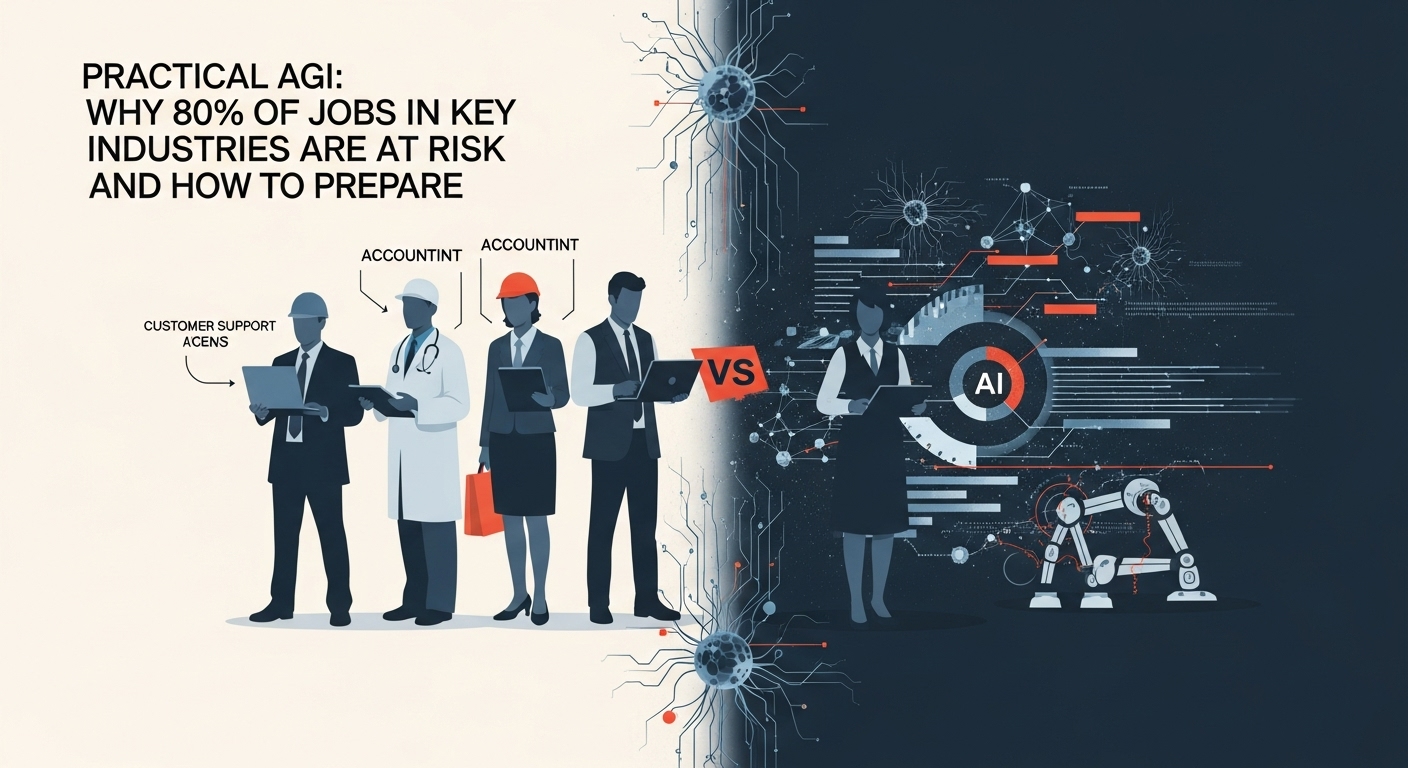
In February 2025, a profound shift began rippling through corporate boardrooms worldwide. IBM laid off 8,000 employees, Microsoft eliminated 6,000 positions, and hundreds of smaller companies followed suit. This is not due to economic recession, but because artificial intelligence systems can now perform their jobs. This isn't a distant dystopian future; it's happening now. As we stand at the threshold of Artificial General Intelligence (AGI), we face an unprecedented transformation that will fundamentally reshape how humans work, earn, and contribute to the economy. The impact of AGI is not a matter of if, but when, and we must prepare for this inevitable disruption.
Artificial General Intelligence (AGI), also known as human-level AI, is a type of artificial intelligence that would match or surpass human cognitive abilities across any domain. It represents a quantum leap beyond today’s narrow AI systems because they would possess reasoning, problem-solving, and adaptability comparable to human intelligence. Rather than viewing AGI as a threat, we can see it as a tool with the potential to enhance our capabilities and lead to a more efficient, productive future.
We are all aware of the remarkable capabilities of AI systems such as ChatGPT and Claude in tasks like writing essays, analyzing data, and generating creative ideas. Now picture a future where ChatGPT can not only write for you but also manage your calendar, plan your meetings, and book your flights. You plug it into your vehicle, and it drives you safely to your destination. You take it into the kitchen, and it prepares any dish you want, learning new recipes instantly from the internet and adjusting them for your personal taste. That is what Artificial General Intelligence (AGI) represents: not just an assistant that follows commands, but a system that can understand context, make decisions, and autonomously perform any intellectual or physical task a human can.
Industry leaders confirm AGI's imminent arrival. OpenAI CEO Sam Altman predicts 2025 as the year "AI agents join the workforce and materially change the output of companies." Anthropic's CEO forecasts that within five years, AI could eliminate 50% of entry-level white-collar jobs and spike unemployment by 10-20%.
This essay argues that AGI will soon replace approximately 80% of jobs in specific industries due to its superior performance in speed, accuracy, cost-efficiency, and 24/7 availability. Industries involving repetitive cognitive tasks, data processing, and predictable decision-making face the most significant risk. We will examine which sectors and jobs are most vulnerable, analyze the economic ramifications, and propose actionable strategies for individuals, companies, and governments to navigate this seismic transition.
The initial wave of AGI disruption will not strike randomly across the economy. Specific industries possess structural characteristics that make them especially vulnerable to automation: high volumes of repetitive tasks, rule-based decision processes, heavy reliance on data analysis, and standardized workflows. These industries are already experiencing significant AI adoption, making them the proving grounds for AGI's transformative power.
The shift to AI-powered customer service is accelerating, driven by powerful data. A Tidio study projects that up to 95% of customer interactions could be handled by AI by 2025, and their research also shows that
3 out of every four companies that introduce AI see sales increase by over 10%. This aligns with Octonomy's findings, which report that 55% of companies already deploy AI in customer service. The economic incentive is undeniable, as Desk365 highlights, noting that labour cost savings of up to 90% are possible when AI automates routine tasks. You can also attest that most of the websites and products you use today use AI for customer service and refer you to a human only when needed. The economics are irresistible for companies because AI never gets tired, never takes breaks, scales instantly, and costs a fraction of what human labor does. While high-touch customer relationships requiring empathy and complex problem-solving may remain human-centered, the vast majority of customer interactions follow predictable patterns that AGI handles more efficiently.
This industry has long been a target for automation, but AGI will take mechanization to an entirely new level. Industrial robots now account for 44% of repetitive manufacturing tasks worldwide, but AGI-powered systems will go beyond physical automation. They will optimize entire supply chains in real-time, predict equipment failures before they occur, coordinate autonomous vehicles and drones, and make complex quality-control decisions that previously required human judgment.
Unlike previous waves of automation that required extensive reprogramming for new tasks, AGI systems are presumed to adapt to changing production requirements, handle exceptions, and continuously optimize processes once the purview of human supervisors.
Financial Services and Banking are experiencing a seismic shift as AGI algorithms handle transaction processing, fraud detection, risk assessment, and investment management with superhuman speed and accuracy. As of 2027, AI is expected to manage over $1.2 trillion in banking assets. Approximately one-third of transaction-handling roles in financial institutions have already been automated. Robo-advisors automatically adjust investment portfolios based on market conditions and client preferences, often outperforming manual fund managers in retail banking. Natural language interfaces are taking over front-desk roles in digital banking, assisting customers with account queries and product discovery. The financial sector is expected to automate 70% of basic operations by 2027, with significant job cuts on Wall Street as algorithms prove more reliable than traders at parsing market signals and executing strategies.
Healthcare Administration and Back-Office Operations represent another vulnerable sector. While doctors and nurses perform irreplaceable human-centered care, the administrative machinery of healthcare is ripe for automation. Medical transcription is expected to reach 99% automation, with 40% of medical coding automated by 2025. Insurance claim processing, appointment scheduling, billing reconciliation, and patient record management tasks that currently employ millions can be performed more accurately and rapidly by AGI systems. The result is a bifurcated healthcare workforce: hands-on caregivers remain essential, while administrative staff face widespread displacement.
The displacement effect of AGI operates at the task level, not just the job level, but certain occupations face near-complete automation within the next five years. Understanding which jobs are most vulnerable and why is crucial for workforce planning.
.png?versionId=3rFqa.Pw5W6MhnbYfwefq2xohHT_xSIO&Expires=1790223714&Key-Pair-Id=K3EVG0QTJR4SK0&Signature=whdKJLqEhX1l24u6xfB-cPCvXxZ5Dk3adaWJ-P2KODqfBpZ4~pIfCzVgEZdaPYTmdqqHX1I2pcXLaxidXta4uRT~DEsbsEJmsHkgDeKDiVpDFGPAvge42umXvS3Wq2x1qmKvQGPZSye7fMJQcTw7Bdo76sY2saq~jP5lILsD4FSMlA~~BtyrF~utLsQHBFzd~mVRrvJx4RXRDanw1Y1pBRRSHWs-ZiaPmAMO~LCl4fiqtyXoyJl3J7tMN-DOOVR9wxNsDwx5dwiaKsJaly73-bEQ4pXEsmIj0dG1fKCIQ-NVVV6AwDM3hmeUe~w7ntsZ4ujiUKLx-KPiR5X69iTBkg__)
.png?versionId=RPLecW7BR_C5nGRSAKPwGqKeqMnS6rup&Expires=1790223714&Key-Pair-Id=K3EVG0QTJR4SK0&Signature=ePUWnF8BtMBd4MCy4k0OMhAg4lipFXrFwj~LmZPATI4X9dEzSfjVcjfANjErbguUAVrh2NyrhcfnD~SoCuPkVHQzJ8oLxvI2jR286TWk85MIt1j-75gxF-Sjh1DNj8tF-xcGjeP43W7cYIWS1fcPldNLNCudLoiZJsXWUbbYUCJQ8XPW-KhFTDNCzULJdVFCgaWKFZpz9h3rf7f0f0uaTkgGDcjiv00BX9wnewd51fpHS~QRW7zsd461JHGneces-WSeoBh-3ai4csHNGi~xJghnLosB3uHE2Zoed8St1CFt8PRWfYT2tJWrwBfhaoT981vphmwKM1RWyXI~EGudag__)
Not all jobs are equally at risk of automation. Positions that require human judgment, creativity, and emotional intelligence, like healthcare providers, skilled tradespeople, and creative professionals, are relatively safe due to their complex nature. However, these roles will still evolve as professionals adopt AGI for tasks such as diagnostics and strategic analysis. The future involves collaboration between humans and machines, which may render some jobs redundant.
The immediate economic effects will be painful and destabilizing. Research from the World Economic Forum predicts that 85 million jobs will be displaced globally by 2025 and beyond, a staggering figure that signals turmoil across entire industries. In the United States specifically, projections suggest 30% of current jobs could be fully automated by 2030, while 60% will experience significant task-level changes. These aren't gradual shifts allowing smooth transitions; they're rapid displacements concentrated in specific sectors.
Entry-level employment faces particularly acute pressure. Anthropic's CEO predicts AI could eliminate 50% of entry-level white-collar jobs within five years, creating a "missing generation" problem in which young workers can't gain the foundational experience that traditionally leads to senior positions. This hollowing out of entry-level roles threatens the entire career pipeline: if companies automate away junior positions, where do future managers and executives come from?
Unemployment will spike, but not uniformly. Projections suggest U.S. unemployment could peak in the high single digits among active labor market participants, with continental Europe potentially hitting low double digits. Workers aged 18-24 are 129% more likely than those over 65 to worry that AI will make their jobs obsolete, and with good reason: entry-level positions face the highest automation rates. Women also face disproportionate risk, with 58.87 million women in the U.S. workforce in occupations highly exposed to AI automation compared to 48.62 million men.
Income inequality will likely widen dramatically in the short term. The wage gap between highly educated workers and others could explode as AI-literate professionals commanding premium salaries work alongside displaced workers competing for shrinking opportunities in low-skill service roles. One scenario envisions incomes for workers at the 90th percentile increasing by 15%, median wages staying flat, and bottom-quartile wages decreasing. This exacerbates existing wealth concentration, with capital owners who control AGI systems capturing disproportionate gains while labor's share of national income declines.
If we successfully navigate the transition, the long-term economic picture brightens considerably. Goldman Sachs projects that full AI adoption could boost U.S. labor productivity by 15% and global GDP by 7%, a permanent increase in economic output equivalent to adding trillions of dollars to the global economy each year. More optimistic projections suggest AI could add $19.9 trillion to the global economy by 2030, with compound effects raising GDP by 1.5% by 2035, nearly 3% by 2055, and 3.7% by 2075.
This productivity revolution operates through multiple channels: AGI eliminates wasteful inefficiencies, optimizes resource allocation, accelerates innovation through AI-assisted research and development, and enables entirely new products and services that would be impossible without machine intelligence. Banks could increase pretax profits by 12-17% by 2027, totaling $180 billion. Industries exposed to AI experienced productivity growth, jumping from 7% to 27% between 2018 and 2024.
Crucially, the [World Economic Forum predicts that while 85 million jobs will disappear by 2025, 97 million new roles will emergehttps://www.weforum.org/press/2020/10/recession-and-automation-changes-our-future-of-work-but-there-are-jobs-coming-report-says-52c5162fce/], a net gain of 12 million positions globally. These new jobs cluster in areas such as AI development and maintenance, AI ethics and governance, human-AI interaction design, data curation and management, and complex problem-solving that require human creativity and judgment. The question is whether displaced workers can transition to these new roles, which often require advanced education and technical skills.
The economic gains from AGI won't be distributed evenly. Advanced economies with strong education systems, technological infrastructure, and adaptive institutions are positioned to capture disproportionate benefits. Developing nations risk being left behind if they lack the resources to implement AI or retrain their workforces. Within countries, geographic disparities will emerge: tech hubs like Silicon Valley, Boston, and Seattle will thrive as AI centers while regions dependent on automatable industries face decline.
Age-based divides will intensify. Older workers approaching retirement may ride out the transition, while young workers face careers requiring continuous reinvention. Gender disparities could widen given women's concentration in administrative and clerical roles, facing high automation risk. Educational attainment becomes increasingly determinant of economic outcomes: 77% of AI-related jobs require master's degrees and 18% require doctoral degrees, locking out workers without access to advanced education.
The central economic question is whether AGI leads to broadly shared prosperity or extreme concentration of wealth and power. Without intervention, market dynamics favor the latter: capital owners and highly skilled workers capture gains while everyone else faces declining opportunities. However, with appropriate policies, progressive taxation of AI profits, funded retraining programs, strengthened social safety nets, and a universal basic income, the productivity gains could be distributed more equitably.
Historical precedents provide mixed guidance. Previous technological revolutions, such as steam power, electricity, and computers, ultimately dramatically increased living standards, but the transitions involved decades of disruption, with winners and losers. AGI differs in speed (measured in years, not decades) and scope (affecting cognitive work, not just physical labor). The question is whether society can manage an exponentially faster transition with exponentially higher stakes.
The AGI transformation is not a distant threat to be addressed eventually. It's an immediate challenge requiring urgent action from individuals, companies, and governments. Those who adapt proactively will thrive, but those who delay face obsolescence.
The half-life of professional skills is shrinking rapidly. What you learned in college five years ago is increasingly irrelevant; what you'll need five years from now doesn't exist yet. Adopt a lifelong learning mindset and set aside time each week for skill development. This doesn't necessarily mean returning to formal education. Micro-learning platforms like Coursera, LinkedIn Learning, and Google Career Certificates offer targeted, credential-bearing programs that take months, not years. The World Economic Forum projects that over 40% of workers will require significant upskilling by 2030; being in the vanguard of that transition provides a competitive advantage.
You don't need to become a programmer, but you must understand how AI works, what it can and cannot do, and how to leverage it in your work. Familiarize yourself with tools like ChatGPT, Claude, GitHub Copilot, and industry-specific AI applications. The workers who remain valuable aren't those who compete against AI but those who use AI better than others. As one executive observed, "We're not replacing workers with AI; we're replacing workers who don't use AI with workers who do."
The traditional model, which climbs a hierarchical ladder within one company or industry, is obsolete. Instead, develop a portfolio of complementary skills allowing lateral moves across functions and industries. Employers increasingly hire based on demonstrated capabilities rather than years of experience or specific degree credentials. Leverage digital credentials, maintain an updated portfolio showcasing projects, and cultivate a professional network providing access to opportunities.
If your current role faces high automation risk, begin planning a transition now rather than waiting for displacement. Identify adjacent roles that require similar foundational skills but pose lower automation risk. For example, data entry clerks might pivot to data quality management or customer success roles, and retail cashiers might transition to personal shopping advisory or e-commerce coordination. Employers and community colleges increasingly offer reskilling programs, so take advantage while you're still employed.
Companies that view employees as disposable costs to be automated away face long-term disadvantages because institutional knowledge evaporates, employer brands suffer, and social license erodes. Forward-thinking organizations invest substantial resources in workforce development. Amazon's $700 million "Upskilling 2025" program aims to provide advanced skill training for 100,000+ employees. IBM's "New Collar" initiative focuses on skills-based hiring and internal mobility. These investments pay dividends through higher retention, greater employee engagement, smoother transitions to AI-augmented workflows, and preservation of institutional knowledge.
Rather than simply replacing humans with machines, reimagine workflows that leverage the comparative advantages of both. AGI handles routine data processing, pattern recognition, and optimization while humans focus on strategic decision-making, relationship management, creative problem-solving, and ethical oversight. Create new roles like AI oversight managers, prompt engineers, and explainability specialists who bridge human and machine capabilities. This approach augments your workforce rather than eliminating it while achieving productivity gains.
Companies deploying AI without consideration for employee welfare and social impact face reputational risks, regulatory challenges, and employee resistance. Implement AI gradually with stakeholder input, provide clear communication about automation plans and support for affected workers, ensure AI systems are transparent and auditable, and establish ethics review boards evaluating AI deployments. Responsible AI adoption builds trust and facilitates smoother transitions.
Organizations must become learning institutions where change is expected, skills development is prioritized, and experimentation is encouraged. This requires leadership commitment demonstrated through resource allocation and role modeling, psychological safety that allows people to fail and learn, incentive systems that reward adaptability and learning, and continuous feedback mechanisms that enable rapid iteration. Companies with adaptive cultures weather technological disruption far better than rigid hierarchies.
Education systems for the industrial economy are outdated. Governments should overhaul curricula to focus on critical thinking, digital literacy, interdisciplinary problem-solving, and soft skills like communication, collaboration, creativity, and emotional intelligence. Countries like Singapore, Germany, and Canada are modernizing education; the U.S. needs similar reforms.
The shift to an AGI economy needs massive investment in adult education and reskilling. Governments should fund accessible, subsidized training for high-risk workers, partner with colleges to develop relevant curricula, offer income support, and create digital skills passports. The Infrastructure Investment and CHIPS Acts allocate billions, but more is required.
During the transition phase, unemployment will spike, and income inequality will widen without interventions. Governments must expand unemployment benefits with longer durations and higher payments, implement portable benefits not tied to specific employers, explore universal basic income pilots providing basic economic security, and strengthen progressive taxation to fund these programs. The Nordic countries offer models for comprehensive social insurance systems that cushion workers during transitions.
Unconstrained AI development risks racing toward AGI without adequate safety measures or societal preparation. Governments should establish AI safety standards and auditing requirements, mandate impact assessments for automation decisions affecting large workforces, protect workers' rights to understand and contest AI decisions affecting them, and fund research on AI safety, alignment, and ethics. The EU's AI Act provides a framework that other jurisdictions should adapt.
Without intervention, AGI's gains accrue primarily to capital owners. Governments can reshape these dynamics through progressive taxation of AI profits, funding social programs, equity ownership models that give workers a stake in AI-driven productivity, data sovereignty laws that ensure individuals control the data used to train AI systems, and antitrust enforcement to prevent AI monopolies. The goal is to ensure AGI benefits broad populations rather than further concentrating wealth.
We stand at an inflection point in human history. Artificial General Intelligence promises to be the most transformative technology of our era. The displacement of jobs in vulnerable industries, such as customer service, manufacturing, financial services, transportation, and healthcare, isn't fearmongering; it's a probable outcome within the next decade. Entry-level positions face particular vulnerability, creating a "missing generation" problem, while economically, AGI presents both tremendous opportunity and serious risks. Without intervention, it risks exacerbating inequality to unprecedented levels.
The imperative for action is urgent. Individuals must embrace continuous learning and develop AI literacy. Companies must invest in workforce development and adopt AI responsibly. Governments must reform education, establish retraining infrastructure, and ensure equitable distribution of benefits. The choices we make now will determine whether AGI creates broadly shared prosperity or deepens societal divisions.
Like every disruptive innovation throughout history, AGI will displace some while enriching others. The mobile phone displaced call booths and telegrams, but it also revolutionized global communication. The automobile displaced horse-drawn carriages but transformed transportation and commerce. The internet displaced traditional retail but created unprecedented access to information and opportunity. In the same way, when managed wisely, AGI will displace many current roles while undoubtedly improving productivity, innovation, and the quality of life. The question is: are you ready, or are you working toward the right direction to avoid obsolescence and position yourself for opportunity? I leave that to you.
