



This project introduces a real-time desktop sentiment analyzer, a user-friendly Python application designed for instant sentiment classification of typed text. Leveraging the powerful cardiffnlp/twitter-roberta-base-sentiment model from Hugging Face Transformers, the analyzer accurately categorizes input into negative, neutral, or positive sentiments. Featuring a sleek Tkinter-based graphical user interface, the application provides immediate visual feedback through a dynamic sentiment bar and a glowing emoji, making real-time emotional tone analysis both intuitive and engaging. This tool offers a practical solution for quickly understanding text sentiment in dynamic environments.
In today's data-rich world, understanding the underlying sentiment in text has become incredibly valuable, whether for social media monitoring, customer feedback analysis, or simply gauging public opinion. Traditional manual analysis is often slow, subjective, and impractical given the sheer volume of text data generated daily. This pressing need for efficient and objective sentiment assessment drives the development of automated solutions.
This project addresses this challenge by presenting a real-time desktop sentiment analyzer. Our application offers an intuitive and immediate way to analyze text sentiment, providing instant feedback as users type. Unlike complex analytical tools, this standalone desktop utility focuses on user-friendliness and real-time visualization. It leverages the robust capabilities of modern Natural Language Processing (NLP) through a pre-trained Hugging Face Transformer model, ensuring high accuracy in classifying text into positive, neutral, or negative categories. The goal of this project is to provide a practical, accessible, and visually engaging tool for anyone needing quick and reliable sentiment insights, making advanced AI readily available on their desktop.
Sentiment Analyzer is built upon a robust and efficient architecture, integrating powerful NLP capabilities with a responsive desktop interface.
Core Technologies:
Python: The primary programming language for the entire application.
Hugging Face Transformers Library: Used for easy access and implementation of pre-trained transformer models for sentiment analysis.
Tkinter: Python's standard GUI toolkit, used to create the desktop application's user interface.
Sentiment Model:
The core of our sentiment analysis is the cardiffnlp/twitter-roberta-base-sentiment model from Hugging Face.
This is a RoBERTa-based model that has been specifically fine-tuned on a massive dataset of Twitter data. This makes it particularly effective at understanding the nuances and informal language often found in social media and everyday text.
The model classifies input text into three distinct sentiment categories: negative, neutral, and positive.
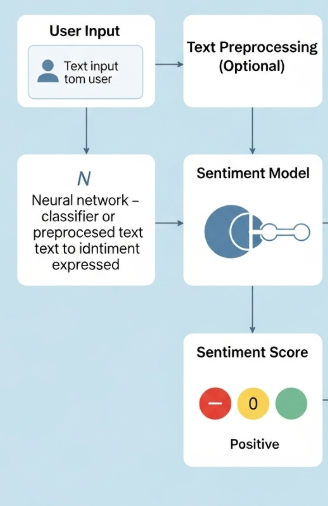
How it Works (Simplified): When text is entered into the application, it is tokenized and fed into the cardiffnlp/twitter-roberta-base-sentiment model. The model then outputs probabilities for each sentiment class (negative, neutral, positive). Our application interprets these probabilities to determine the dominant sentiment and updates the UI accordingly.
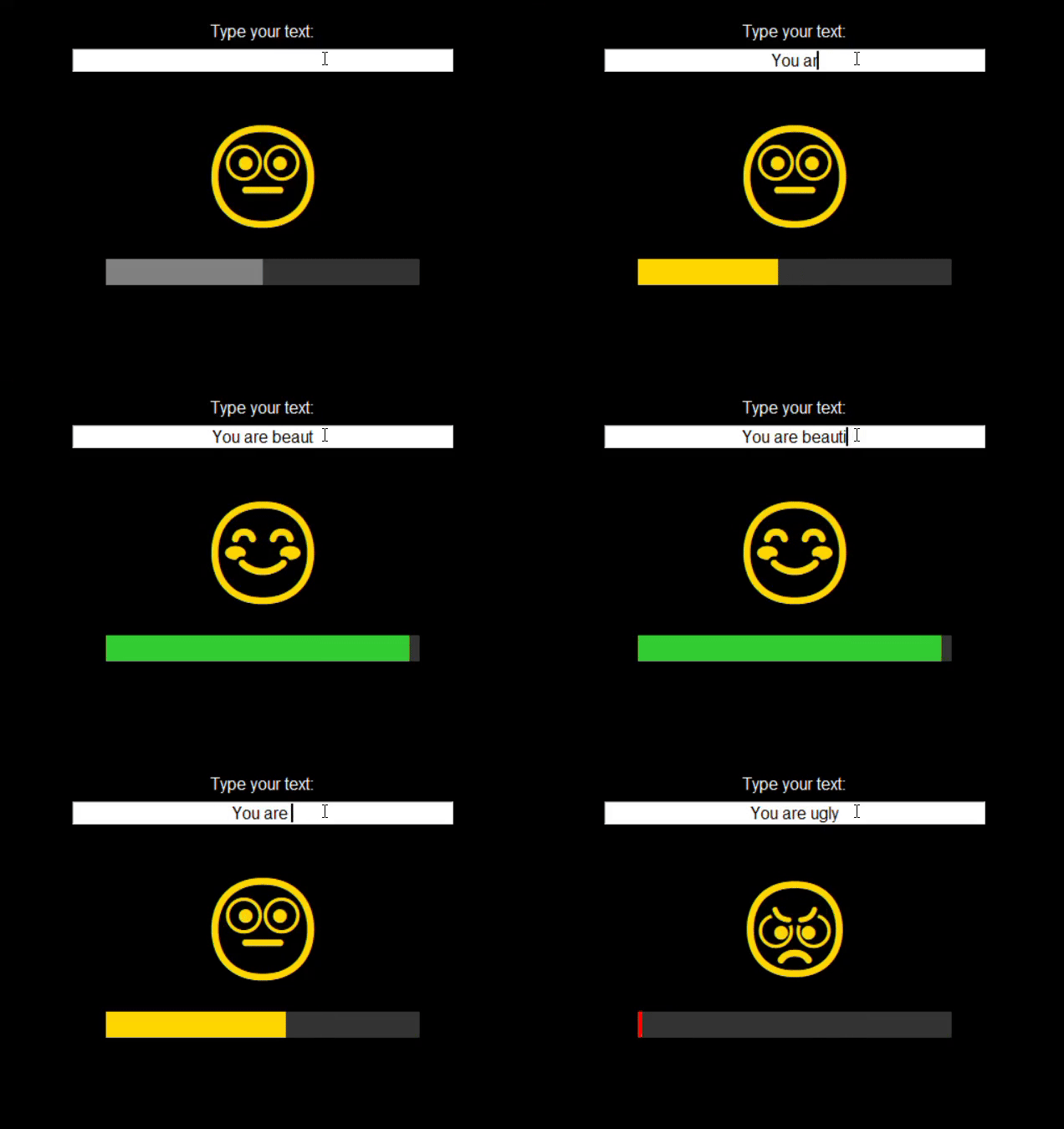
The primary "experiment" in this project is the real-time sentiment analysis provided by the desktop application. By typing various phrases and sentences, users can observe the immediate feedback in the form of:
Dynamic Sentiment Bar: The color and extent of the bar shift in real-time to reflect the prevailing sentiment (green for positive, red for negative, and yellow for neutral).
Glowing Emoji: The displayed emoji updates instantly to visually represent the detected sentiment (e.g., a smiling face for positive, a frowning face for negative, or a neutral face for neutral).
This section presents the observed outcomes from the experiments, showcasing the performance of the Real-Time Desktop Sentiment Analyzer through visual examples and, if available, quantitative metrics.
7.1 Real-Time Analysis Demonstration
The most compelling results come from the live demonstration of the application's real-time capabilities. As text is typed, the sentiment is instantly conveyed through the dynamic Sentiment Bar: Changes color and fill based on the detected sentiment (green for positive, red for negative, yellow for neutral).
Glowing Emoji: Updates immediately to visually represent the overall sentiment (e.g., happy, sad, or neutral faces).
Here are visual examples of the application's response to different sentiments:
Example 1 (Positive):
Input Text: "This is a fantastic and very useful application!"
Observed Output: The sentiment bar quickly turns predominantly green, and a happy/smiling emoji is displayed.
Example 2 (Negative):
Input Text: "I am extremely disappointed with the performance and constant errors."
Observed Output: The sentiment bar becomes largely red, and a sad/frowning emoji appears.
Example 3 (Neutral):
Input Text: "The weather today is partly cloudy with a chance of rain."
Observed Output: The sentiment bar remains mostly yellow/gray, and a neutral emoji is shown.
Example 4 (Mixed Sentiment):
Input Text: "While the design is great, the functionality needs a lot of improvement."
Observed Output: The sentiment bar might show a mix or lean towards a slightly negative or neutral state, and the emoji might reflect this nuance.
This Real-Time Desktop Sentiment Analyzer project successfully delivers an intuitive and efficient solution for immediate text sentiment analysis. By integrating the powerful cardiffnlp/twitter-roberta-base-sentiment model from Hugging Face Transformers with a user-friendly Tkinter interface, we have created an accessible tool that provides instant visual feedback through a dynamic sentiment bar and an expressive emoji.
The application effectively demonstrates the practical application of advanced NLP techniques in a real-time desktop environment, offering a valuable utility for anyone seeking quick insights into the emotional tone of text. Its simple setup and clear visualization make sophisticated sentiment analysis capabilities readily available for everyday use.
While this project stands as a robust tool, it also lays the groundwork for exciting future enhancements, including potential multilingual support and deeper contextual analysis, further expanding its utility and impact.