



Wind energy plays a critical role in the transition toward sustainable and renewable power generation. However, wind turbines are susceptible to operational failures and performance inefficiencies due to varying environmental and mechanical conditions. This project develops a machine learning-based predictive framework to analyze wind turbine operational data and identify potential failure patterns. The study involves exploratory data analysis, data preprocessing, feature engineering, and training of machine learning models to classify turbine conditions. Experimental results demonstrate that the trained models can effectively detect patterns associated with turbine performance, enabling early identification of potential issues and supporting predictive maintenance strategies.
Architecture :
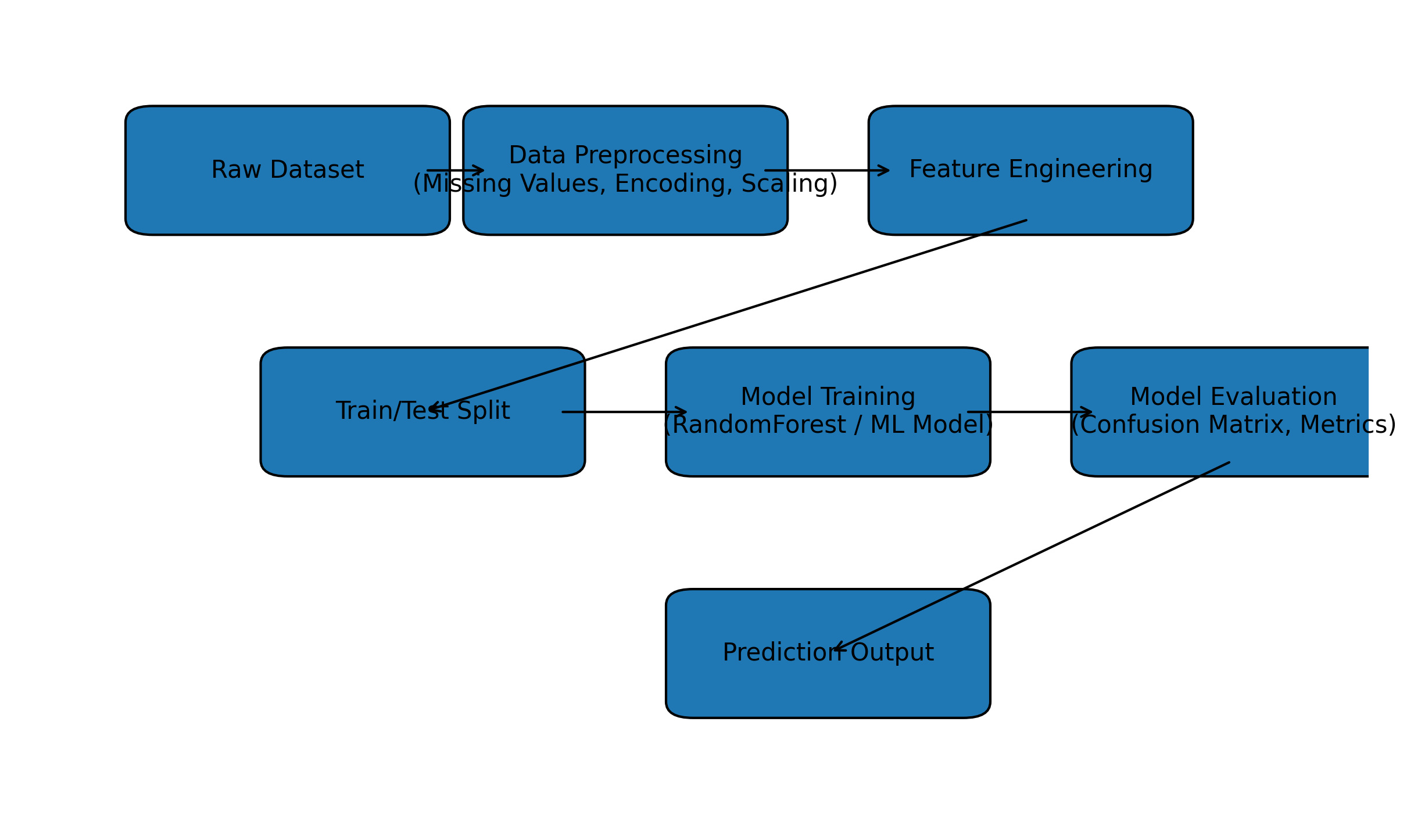
Multiple experiments were conducted to determine the best-performing model configuration.
Experiment 1: Baseline Model
A baseline machine learning model was trained using the default parameters to establish a reference performance.
Experiment 2: Feature Optimization
Different combinations of features were evaluated to determine their impact on model accuracy and predictive capability.
Experiment 3: Model Evaluation
The trained model was tested on the unseen test dataset to measure generalization performance. Performance metrics were computed to assess classification quality.
Visualization tools such as confusion matrices and distribution plots were used to interpret the model predictions.
Model Evaluation
Evaluation includes:
Confusion Matrix
Accuracy Score
Classification Report
#Future Improvements
Deploy using FastAPI
Add ML pipeline automation
Deploy using Docker
This project demonstrates the application of machine learning techniques for analyzing wind turbine operational data and predicting turbine conditions. By combining exploratory data analysis, feature engineering, and model training, the developed pipeline successfully identifies patterns that may indicate potential performance issues.
Predictive analytics in wind energy systems can significantly reduce operational costs by enabling proactive maintenance and reducing downtime. Future work may include integrating real-time sensor data, exploring advanced machine learning algorithms, and deploying the model in a production environment for continuous monitoring of wind turbines.