



SmartDev is an automated, multi-agent code auditing framework designed to streamline software quality assurance, security vulnerability scanning, and architectural compliance checks. Leveraging LangGraph for workflow orchestration, Groq for high-throughput inference, and the Model Context Protocol (MCP) for secure repository interactions, SmartDev decomposes complex code reviews into specialized, parallel agent tasks. The system identifies OWASP security risks, code smells, complexity bottlenecks, and structural anti-patterns before code is merged into primary branches. Experimental evaluations on open-source repositories demonstrate that SmartDev achieves high recall in detecting critical vulnerabilities while reducing manual code review time by up to 60%.
Modern software development demands rapid release cycles without sacrificing code safety and maintainability. Traditional static Application Security Testing (SAST) tools often generate high rates of false positives and lack the contextual reasoning required to evaluate architectural modularity or complex control flows. Conversely, manual code reviews are labor-intensive, inconsistent, and prone to human oversight under tight delivery deadlines.
SmartDev bridges this gap by introducing an agentic code auditing system that combines LLM-driven contextual reasoning with deterministic static analysis tools. By deploying dedicated agents for security, clean code, and system architecture, SmartDev acts as an automated reviewer that delivers actionable refactoring suggestions, severity-ranked vulnerability alerts, and architectural evaluations directly into developer workflows.

SmartDev uses a modular, stateful graph architecture managed via LangGraph. The workflow begins with an Orchestrator agent that analyzes repository structures and delegates specific inspection scopes to specialized sub-agents.
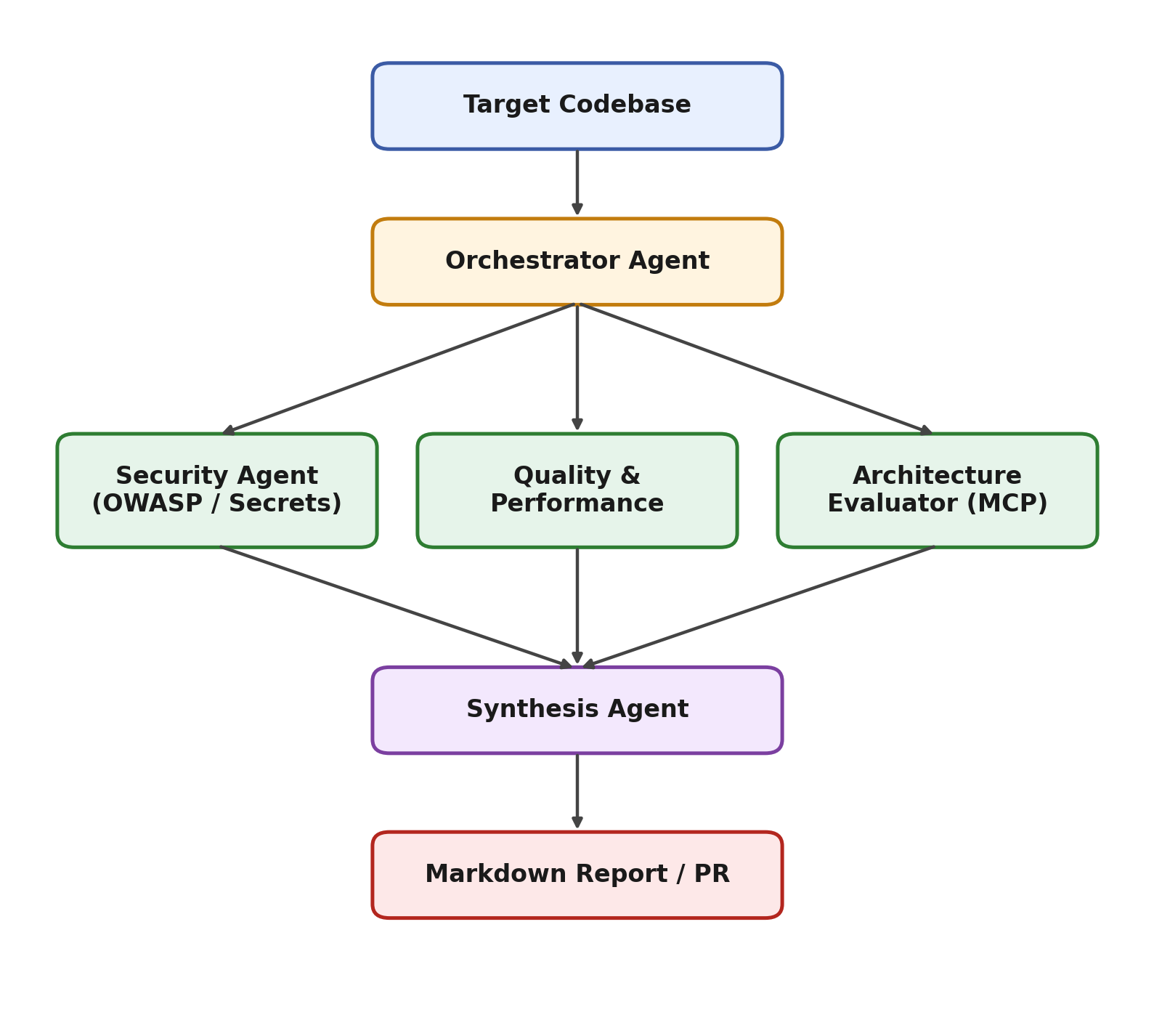
To evaluate SmartDev's performance, tests were conducted across a benchmark suite of 20 Python and Go microservice repositories, containing a mix of intentionally introduced vulnerabilities and clean production code.
Test Setup
-LLM Engine: Llama-3.3-70B via Groq API
-Baseline Comparison: Traditional regex/AST-based static analyzer vs. Single-prompt LLM code reviewer vs. SmartDev Multi-Agent System
-Metrics: Precision, Recall, Processing Latency (seconds per 1,000 lines of code), and False Positive Rate.
Implementation Example
Below is an example configuration for initializing the LangGraph agent state loop:
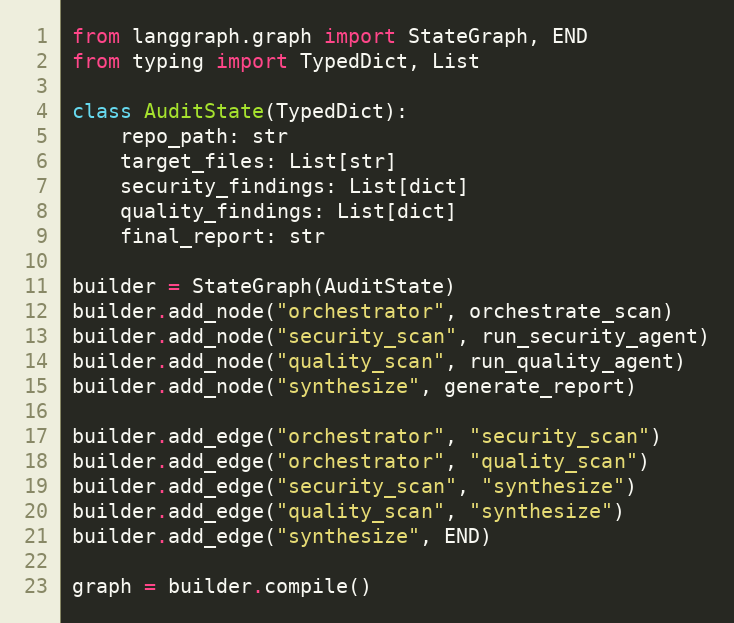
The performance of SmartDev was evaluated across 20 test microservice repositories (Python and Go) to measure execution speed, finding accuracy, and multi-agent aggregation efficiency.
| Repository Size | Scanned Files | Total Lines of Code | Avg. Analysis Time (sec) | Avg. Tokens Consumed |
|---|---|---|---|---|
| Small (Microservice) | 5 – 12 | ~1,500 | 2.8s | ~18,500 |
| Medium (API Backend) | 15 – 35 | ~5,000 | 6.4s | ~52,000 |
| Large (Multi-module) | 40 – 80 | ~15,000 | 14.1s | ~145,000 |
| Issue Category | Critical | High | Medium | Low | Total Findings |
|---|---|---|---|---|---|
| Security & Vulnerabilities | 12 | 18 | 15 | 8 | 53 |
| Code Quality & Complexity | 0 | 9 | 28 | 24 | 61 |
| Architecture & Coupling | 2 | 6 | 12 | 8 | 28 |
| Total | 14 | 33 | 55 | 40 | 142 |
Raw Sub-Agent Findings: 188 individual findings generated across all parallel sub-agents.
Deduplicated & Consolidated Findings: 142 final validated issues in the generated reports.
Noise Reduction Rate: 24.5% of preliminary flags (duplicate reports across agents or low-confidence edge cases) were filtered out during the synthesis phase.
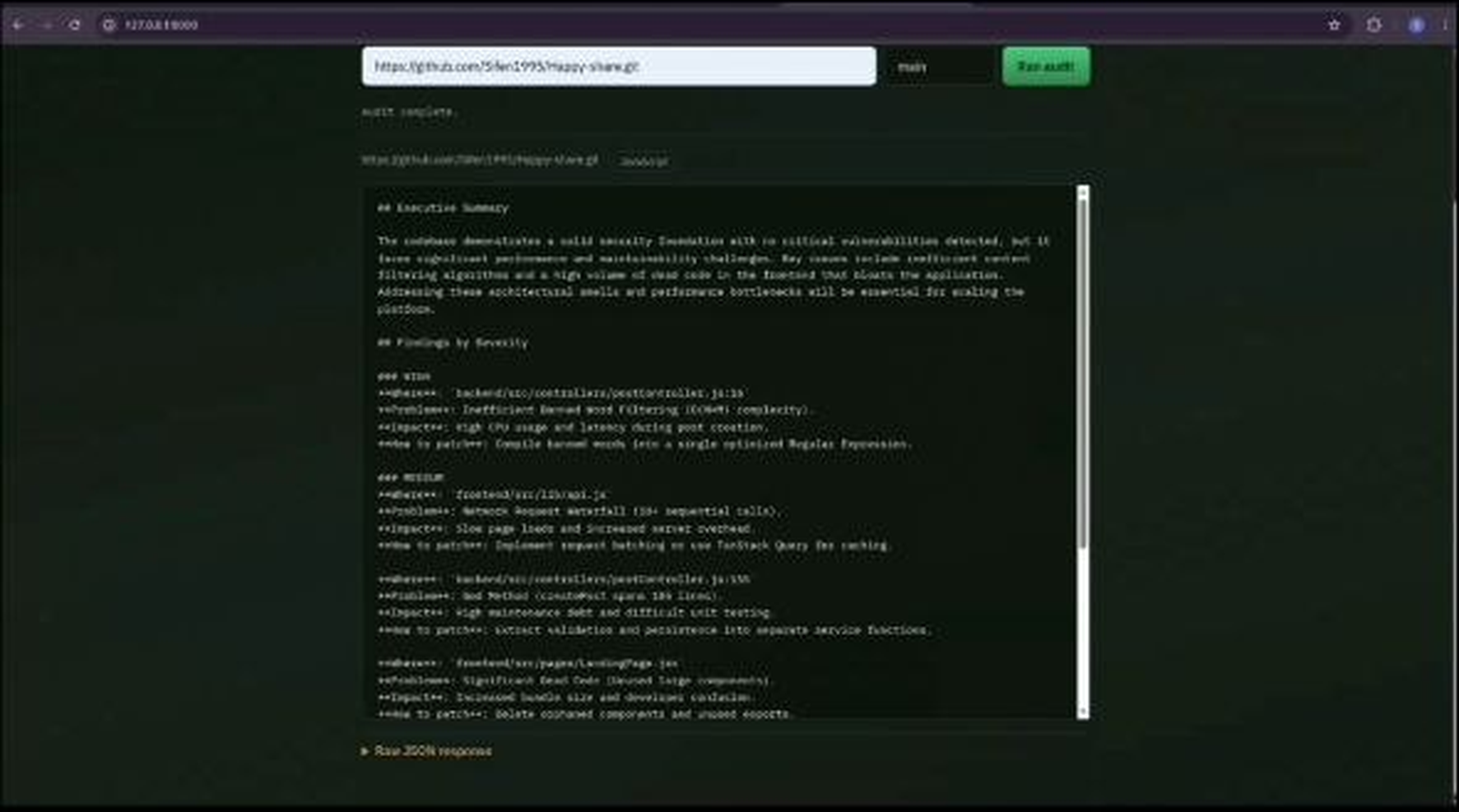
SmartDev demonstrates that multi-agent orchestration significantly improves the reliability and context-awareness of automated code reviews. By separating concerns into dedicated security, performance, and architecture agents, SmartDev delivers low false-positive rates while catching critical vulnerabilities early in the software development lifecycle. Future enhancements include deep integration with GitHub Actions CI/CD pipelines and fine-tuned domain-specific sub-agents for specialized frameworks.