



 Certifiedunder the Production-Grade Agentic System module in the Agentic AI In Production program.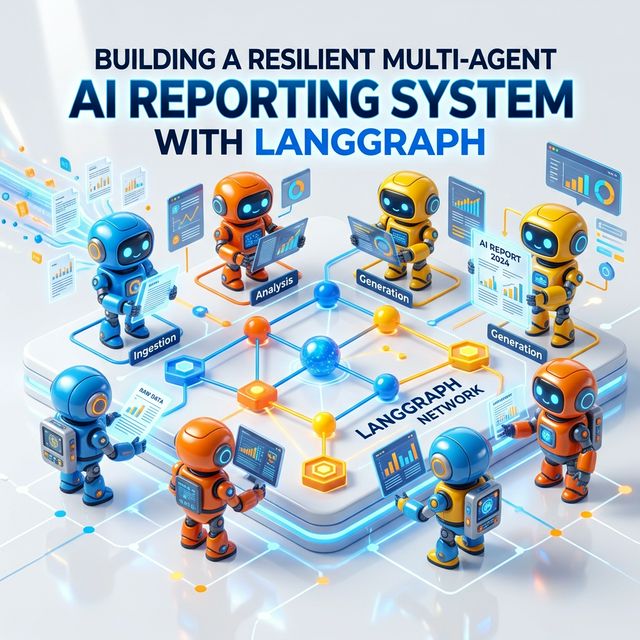
This publication demonstrates how to build and deploy a production-ready, resilient Multi-Agent AI Report System using LangGraph, Groq, and Tavily. You will learn how to design a cyclic state-machine architecture that coordinates specialized AI agents (Planner, Researcher, Writer, Reflector) to autonomously research and draft fully-cited, expert-level strategy reports. By following this guide, developers and data scientists will be able to implement multi-agent workflows that include critical production features such as self-healing retries, LLM fallback mechanisms, and deterministic security guardrails.
While Large Language Models (LLMs) excel at generating text, they frequently hallucinate or lose structural coherence during long-form, factual report generation. Single-prompt approaches cannot reliably produce verified, academic-quality research.
This system solves the "shallow generation" problem by decoupling tasks into a collaborative multi-agent swarm. The impact is a dramatically more reliable AI pipeline that:
The core innovation of this project lies in its Cyclic State Machine methodology built on LangGraph, transitioning away from linear LangChain chains.
The following diagram illustrates the high-level architecture of our multi-agent system, highlighting the separation of concerns and the resilience layers.
graph TD
    User([User Prompt]) --> UI[Gradio Interface]
    UI --> App[LangGraph Orchestrator]

    subgraph "Infrastructure & Security Layers"
        App --> Checkpoint[(PostgreSQL / SQLite<br/>Thread Persistence)]
        App --> Resilience[Tenacity Retry Handler<br/>& Gemini Fallback]
        App --> Guard[Guardrail Agent]
    end

    Guard -- SAFE --> Supervisor[Task Supervisor]
    Guard -- UNSAFE --> End[Refusal Response]

    subgraph "Agent Swarm (State-Driven)"
        Supervisor --> Planner[Expert Planner]
        Planner --> Searcher[Robust Searcher]
        Searcher --> Writer[Report Writer]
        Writer --> Reflector[Adversarial Reflector]
        Reflector -.->|Revisions Needed| Planner
    end

    Reflector -->|Approved| Export[PDF Generation]
    Export --> User
Transitioning from a basic multi-agent prototype to a fully production-ready system required several core improvements:
Instead of a straight-through process, the workflow is designed to iterate:
We implemented exponential backoff using the tenacity library, wrapping our Groq inference calls. If the Groq API fails after 3 retries, the system seamlessly triggers a Google Gemini Fallback strategy. This guarantees workflow continuity, a critical requirement for production LLM applications managing api failures.
Evidence: The repository includes an exhaustive test suite (test_failover.py, test_guardrails.py) achieving an 80% minimum coverage target. The routing logic enforces a strict recursion_limit of 25 to prevent infinite loops, directly verifiable in the Graph compilation code.
This project is open-source and structured for immediate practical implementation in enterprise environments.
The system supports both local exploration and production-scale containerized deployments.
Prerequisites & Environment Setup:
git clone https://github.com/Etheal9/Multi-Agent-AI-Report-System-with-LangGraph.gitpip install -r requirements.txt..env file containing GROQ_API_KEY, TAVILY_API_KEY, and optionally GEMINI_API_KEY for failover.Deployment Options:
python chat_interface.py to launch the Gradio web application locally on port 7860.docker-compose.yml file. Running docker-compose up -d containerizes the system, establishing an isolated environment suitable for deployment on AWS, GCP, or HuggingFace Spaces.memory.db) for LangGraph state checkpointers. For scalable production, update the .env DATABASE_URL string to connect to an external PostgreSQL instance.Operating the system requires no specialized technical knowledge, featuring a clean, responsive Gradio web UI.
.png?versionId=liROS3Lwvluai1KI1VwLkVJb2AWXjpRv&Expires=1788922534&Key-Pair-Id=K3EVG0QTJR4SK0&Signature=k-MwKtGjlQcv72nKEjZyDWiebvAiIDY2CH7dt3nz3m~WJPehJyWNLzOMXAHO~sqZ6nrrKL9-JfVlfCsZVlnfV1kM-SfNXxZxdxMcElcN~XHdBos7ETeYDAU1XMQ~nve9LVkZilZtNsDdXhq99~HV3R2aJ21v0DkbVYq6EKMxj7mx~EDaSgfMh0UgvbMjbUaZMnzj9jf3ZtWJvRqAeMhRovPGldaZo8D1kOpceJ~7f2g7gXy3AUqZ-Usu8kTpA3gBzjiBGRbgSJP69UmkIeB5ZHD2yyz33LvXGA-6Eq3YrY3wdLPK5Vos7b3A20BlefVEMKuHTynti-9rjCWgig1WvA__)
Security is deterministic and deeply embedded into the graph architecture via a dedicated guardrail_node that executes before any LLM inference or computational resources are expended. This node acts as a structural firewall by deterministically filtering out predefined unsafe terms (such as PII, illegal acts, or prompt injection attempts). Additionally, it provides resource protection against deliberate token exhaustion attacks by rejecting any input exceeding 5,000 characters. If the guardrail is triggered, the LangGraph state transitions directly to an END node, bypassing all other agents and returning a polite refusal without risking downstream execution.
For system administrators, robust observability is critical to maintaining a healthy deployment. We have replaced standard print statements with Python's robust logging library, structured to seamlessly port into external logging stacks like ELK or Datadog. Operational logs explicitly capture resilience events, such as tenacity retry attempts, and immediately flag occurrences where the system transitions to the Gemini Fallback LLM. Furthermore, because of the LangGraph checkpointer architecture, every individual thread execution generates a unique thread_id recorded in the database. This provides administrators with a complete audit trail to replay and analyze the entire chain-of-thought for any generated report. Finally, the application sets a hard recursion limit of 25 nodes to prevent stray graphs from looping infinitely. If an agent fails to reach consensus within this limit, the workflow terminates gracefully, notifying the user rather than crashing the server.
To deeply understand the decision-making process of the autonomous swarm, this project integrates seamlessly with LangSmith, the industry-standard observability platform for LangGraph architectures.
By simply providing a LANGCHAIN_API_KEY in the environment, LangSmith automatically intercepts and visualizes every agent action without requiring any modifications to the core logic. Administrators can log into the dashboard to view real-time execution traces, track token latency, and debug exact payloads sent to the Groq and Tavily APIs. This visual trace tree is indispensable for identifying bottlenecks, such as when the Reflector agent repeatedly rejects the Writer's drafts due to missing source citations.
.png?versionId=WNCKGal9CBLhNoUgi_3GSEXXO4EvCNNH&Expires=1788922534&Key-Pair-Id=K3EVG0QTJR4SK0&Signature=nOWVLGcElEn12pf7OoJHohliRnQGhCgBsPawDCSelflDCNefJ3Uxh6ggSctvYOi8e9pzJFnLaTd3rIbxTEnbBpc0od0zhiEnuFH3m1i0i66AcwLEHCdsai6dBnpi3yR5UPELRuzSvDNciESqYNQ2OKi9GVcd16vbwR5VAjXKa4ozor-o70N4MbxLwHNqVODwg5j1FFPbLwqVQ~5pmAzDHEeUZpLNLKkVZsIta4RyV6uIIWB1jPffV6hsre9mj81-9OMWQZJjaCmOm0~Oye-mTVpkcCHf3oqW3mtZ07bZhAldYuWBTeeaxl-PhLt3Cg1pAIG1LUh2HQjmFysel4Y-cw__)
.png?versionId=kUNKmPJAaq7sMfACTo9HYQfpGhTQMrJH&Expires=1788922534&Key-Pair-Id=K3EVG0QTJR4SK0&Signature=0Ct58zLXMn8oJTT3GcM0F9QC6Sw5FsVmyVnoS0o-r7-MK~OpIRwUBkhsy5Zp225WL6lQRQwHzJevyDL7yOvJ5kr3t6grsGFgZMpoyMJ73NzIt4BfLjf9mEjcDlmq-pLxSJuESiYOGDb021t2kr~ruGQqVhHeXmeKKtMEC~r51aNXvJPQDcaEkDGNI8QLjQ9nm2NhJEaBI8WVAcgHNFDw-U0BL2LLrZFDvSW3qsaVka5Rv-JCcEUJYQ7G9ifeNb9tzstF-w2nC2yh32cJJK08noj8AmBvxM15KcTzhmbOYLoYv-D10bMV7LdQCsJty53ZwMexoQ~fVDefnA98oRDLvw__)
To ensure the system behaves predictably under edge cases, we employ a rigorous Test-Driven Development (TDD) approach.
To support long-running research, the system utilizes LangGraph's checkpointer mechanism, persisting thread states to PostgreSQL (with an automatic SQLite fallback). This means researchers can pause a session, and the agents will remember the exact historical context upon resumption.
The Multi-Agent AI Reporting System is open-source and released under the MIT License.
This permissive licensing guarantees that developers, researchers, and enterprises have the freedom to:
We encourage the community to build upon this foundation. All we require is that the original copyright notice and permission notice be included in any substantial portions of the software.
By adopting specialized agent roles within a directed state graph, developers can dramatically improve the reliability and factual accuracy of generative systems. This publication and the accompanying codebase provide a complete, test-driven template for launching enterprise-grade AI research swarms.