



 Certifiedunder the Multi-Agent System module in the Mastering AI Agents program.
Japanese Text Processing System
A Multi-Agent OCR, NLP, and LLM-Powered Visual Understanding Platform
Introduction
The Japanese Text Processing System is a multi-agent platform designed to extract, understand, and visually annotate Japanese text found in images. Japanese text processing presents unique linguistic and technical challenges due to the absence of whitespace, the coexistence of multiple writing systems (Kanji, Hiragana, and Katakana), and the heavy reliance on contextual grammar. This system addresses these challenges by combining classical OCR techniques, modern natural language processing, dictionary-based lexical analysis, and large language model reasoning within a modular and extensible architecture.
The primary goal of the system is to support Japanese language learners by:
• Extracting text accurately from images
• Explaining vocabulary and grammar
• Providing natural translations
• Visually annotating kanji with furigana readings
The system is specifically designed for language learners, educational tools, assistive reading technologies, and research applications that require not only accurate text extraction, but also meaningful linguistic explanations and visual feedback.
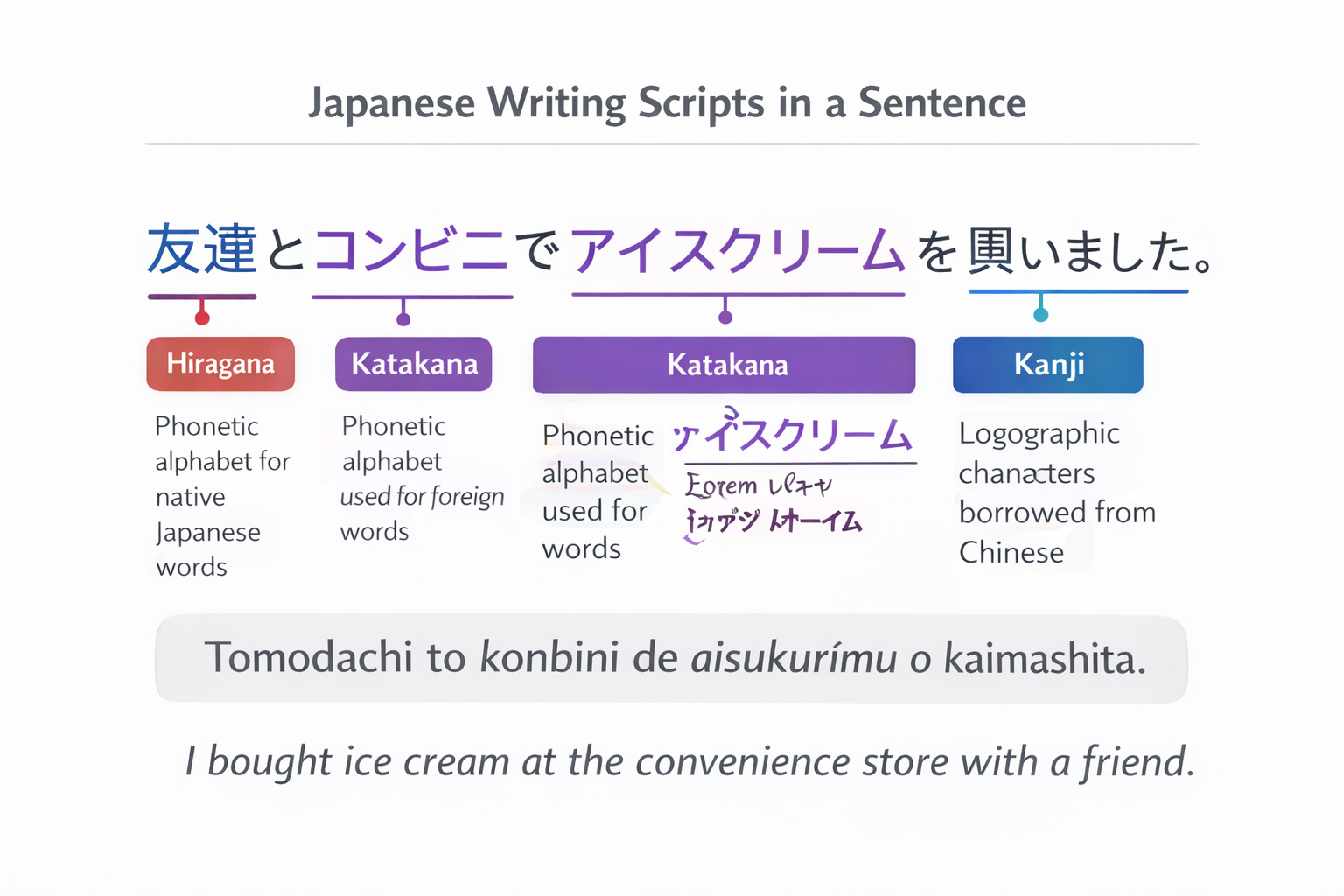
High-Level Architecture
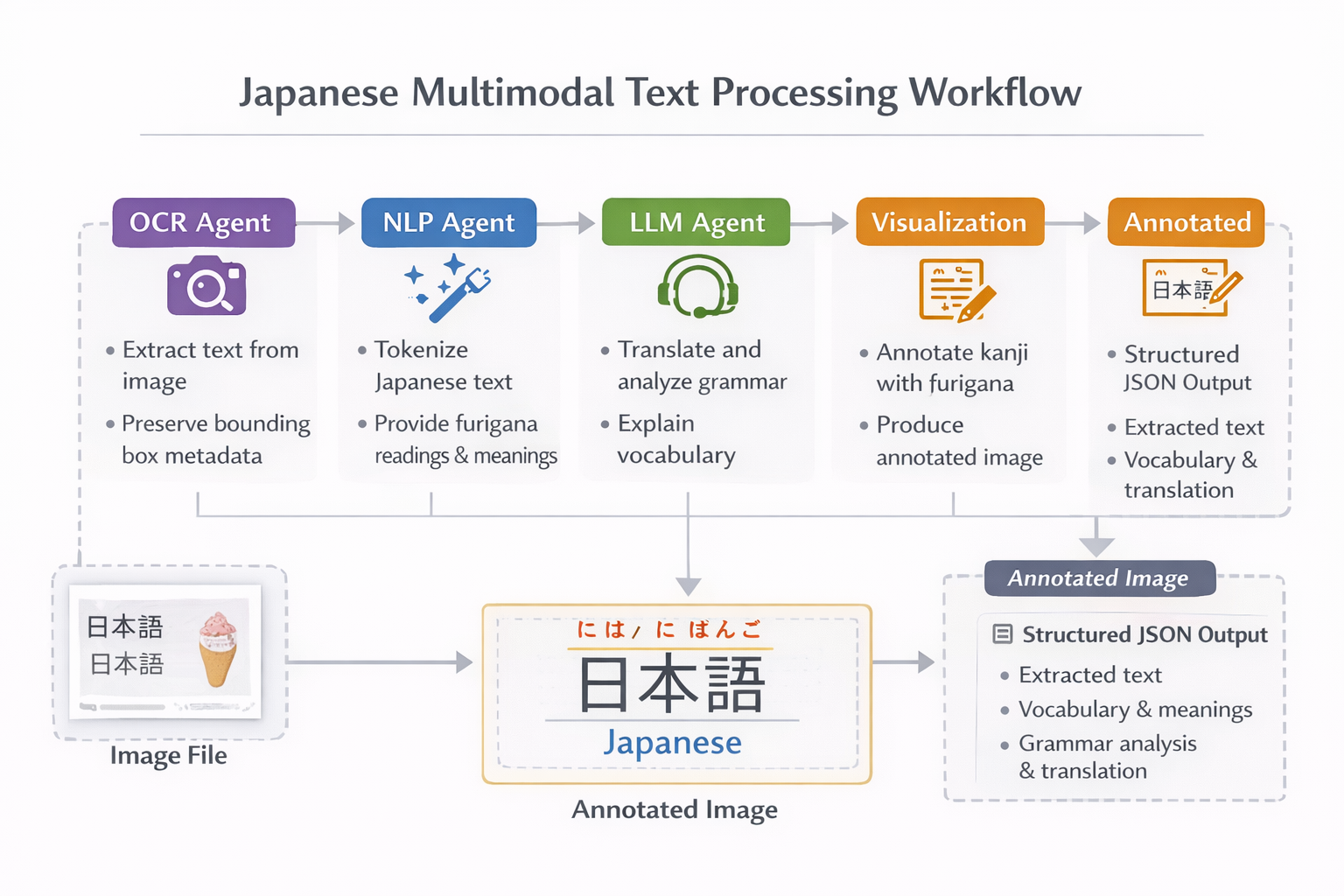
At a high level, the system operates as a FastAPI service that accepts image uploads and processes them through a LangGraph-managed workflow. The workflow coordinates four primary agents: the OCR Agent, the NLP Agent, the LLM Agent, and the Visualization Agent. Each agent contributes specific information to a shared processing state, which is progressively enriched as it flows through the system.
By using LangGraph as the orchestration layer, the system avoids hidden control flow and instead relies on an explicit state machine. This makes execution predictable, debuggable, and easy to extend with additional processing branches in the future.
The processing pipeline consists of four main agents:
OCR Agent: Optical Character Recognition
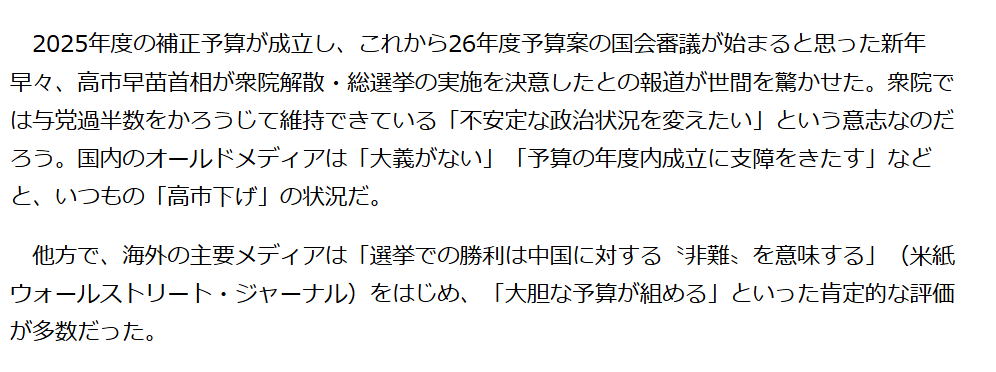
The OCR Agent is responsible for extracting raw Japanese text from input images. It uses Tesseract OCR with Japanese language models enabled. The agent does not simply return plain text; instead, it extracts detailed spatial metadata for each detected text element, including bounding box coordinates and confidence scores.
This spatial information is critical for downstream processing, particularly for visual annotation. The OCR Agent also groups individual text elements into logical lines based on vertical alignment, preserving reading order. Low-confidence OCR results are filtered out to reduce noise and improve the quality of subsequent linguistic analysis.
Processing Steps
example image :
NLP Agent: Japanese Linguistic Processing
The NLP Agent handles the linguistic complexity of Japanese text. Once raw text is extracted, this agent performs morphological analysis using the nagisa tokenizer, which segments Japanese text into words and assigns part-of-speech tags. Because Japanese does not use spaces, this step is essential for meaningful downstream analysis.
After tokenization, the NLP Agent converts each token into Hiragana, Katakana, and Romaji using pykakasi. This provides phonetic readings that are especially valuable for language learners. The agent also detects whether a token contains Kanji characters and, if so, attempts to retrieve dictionary meanings using JMdict via the jamdict library.
Tokenization and POS Tagging
The agent uses Nagisa, a Japanese morphological analyzer, to:
• Segment text into words
• Assign part-of-speech tags
• Handle Japanese text without explicit word boundaries
Reading Generation
Using pykakasi, each token is converted into:
• Hiragana
• Katakana
• Romaji
Dictionary Integration
When available, JMdict (via Jamdict) is used to retrieve English meanings for kanji-containing tokens. Meanings are selectively attached to avoid clutter and improve clarity.
Output
The NLP Agent produces:
• A list of enriched tokens
• A vocabulary dictionary mapping kanji words to meanings
• Metadata indicating kanji presence and linguistic role
example output :
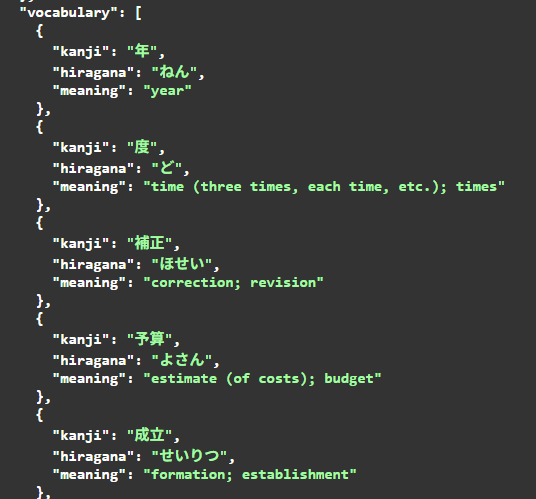
The NLP Agent enriches each token with linguistic metadata while remaining agnostic to grammar interpretation or semantic reasoning. Its output forms the lexical backbone of the system.
LLM Agent: Semantic Understanding and Grammar Analysis
The LLM Agent is responsible for high-level semantic understanding of the Japanese text. It uses the Groq LLM API to generate a natural English translation of the full text and to identify and explain important grammar patterns present in the input.
Rather than performing word-by-word translation, the LLM Agent focuses on producing learner-friendly explanations. It is guided by carefully constructed prompts that request structured output, including a full translation and a list of grammar patterns with explanations. The agent includes robust response parsing logic, as well as fallback mechanisms to ensure usable output even when the LLM response deviates from the expected format.
Analysis Workflow
Output Structure
The LLM Agent returns an LLMAnalysis object containing:
• A natural English translation of the text
• A list of grammar patterns with explanations
example output :
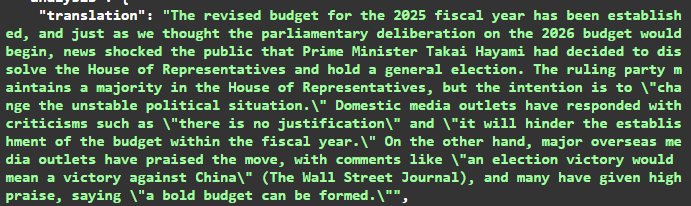
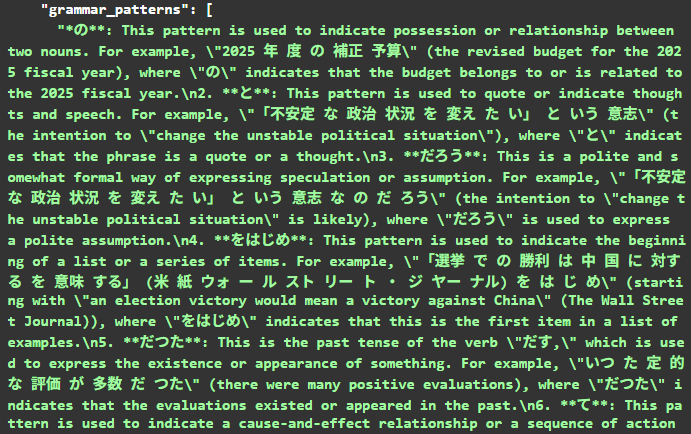
This agent encapsulates all large language model interactions, isolating external dependencies and making it straightforward to switch models or providers in the future.
Visualization Agent: Educational Image Annotation
The Visualization Agent transforms linguistic understanding into visual learning aids. Using the original image and OCR bounding box information, this agent overlays furigana (Hiragana readings) above Kanji characters.
Annotation Strategy
• Furigana is placed above kanji characters
• Text is horizontally centered relative to the kanji
• Vertical placement adapts dynamically based on detected line spacing
• Semi-transparent backgrounds ensure readability
• Font size adjusts automatically to avoid overlap
Font Handling
The agent supports multiple Japanese-compatible fonts across platforms:
• Windows (Meiryo, Yu Gothic, MS Gothic)
• macOS (Hiragino)
• Linux (Noto Sans CJK)
If no suitable font is found, a fallback font is used with a warning.
Output
The Visualization Agent produces:
• A visually annotated image with furigana
• Robust fallback behavior if rendering fails
• Compatibility with OpenCV for saving and further processing
example output :
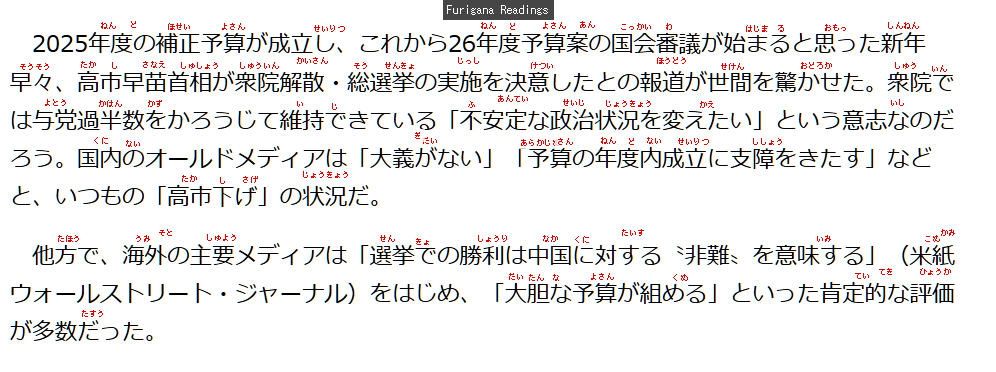
The Visualization Agent produces a final annotated image that visually connects written Japanese text with its pronunciation, significantly enhancing comprehension for learners.
LangGraph Workflow Orchestration
The entire system is orchestrated using LangGraph, which manages execution as a state machine. The workflow begins with OCR processing and proceeds sequentially through NLP analysis, LLM interpretation, and visualization. Each agent receives and updates a shared ProcessingState object, ensuring transparent data flow.
Workflow Nodes
FastAPI Application Layer
The FastAPI layer exposes the system as a RESTful API. It handles file uploads, input validation, error handling, and response formatting. The /process endpoint accepts an image file and returns structured JSON output along with a reference to the annotated image file.
Endpoints
• GET /
Returns system metadata, agent descriptions, and supported features
• POST /process
Accepts an image file and returns:
o Extracted text statistics
o Vocabulary list
o Grammar analysis and translation
o Annotated image path
o Processing metrics
FastAPI’s automatic OpenAPI documentation makes the service easy to explore and integrate with external applications. The API layer is stateless, allowing horizontal scaling and deployment in containerized environments.
Conclusion
This Japanese Text Processing System demonstrates a approach to multimodal language understanding. By combining OCR, NLP, dictionary resources, large language models, and visual annotation within a carefully orchestrated multi-agent architecture, the system delivers both technical robustness and educational value.
The modular design, explicit agent roles, and LangGraph orchestration make the system easy to extend, maintain, and adapt to future requirements. Whether used as a learning aid, a research tool, or a foundation for more advanced language applications, this project provides a solid and professional implementation of Japanese text understanding from images.