



Enterprise AI Operations Control Tower
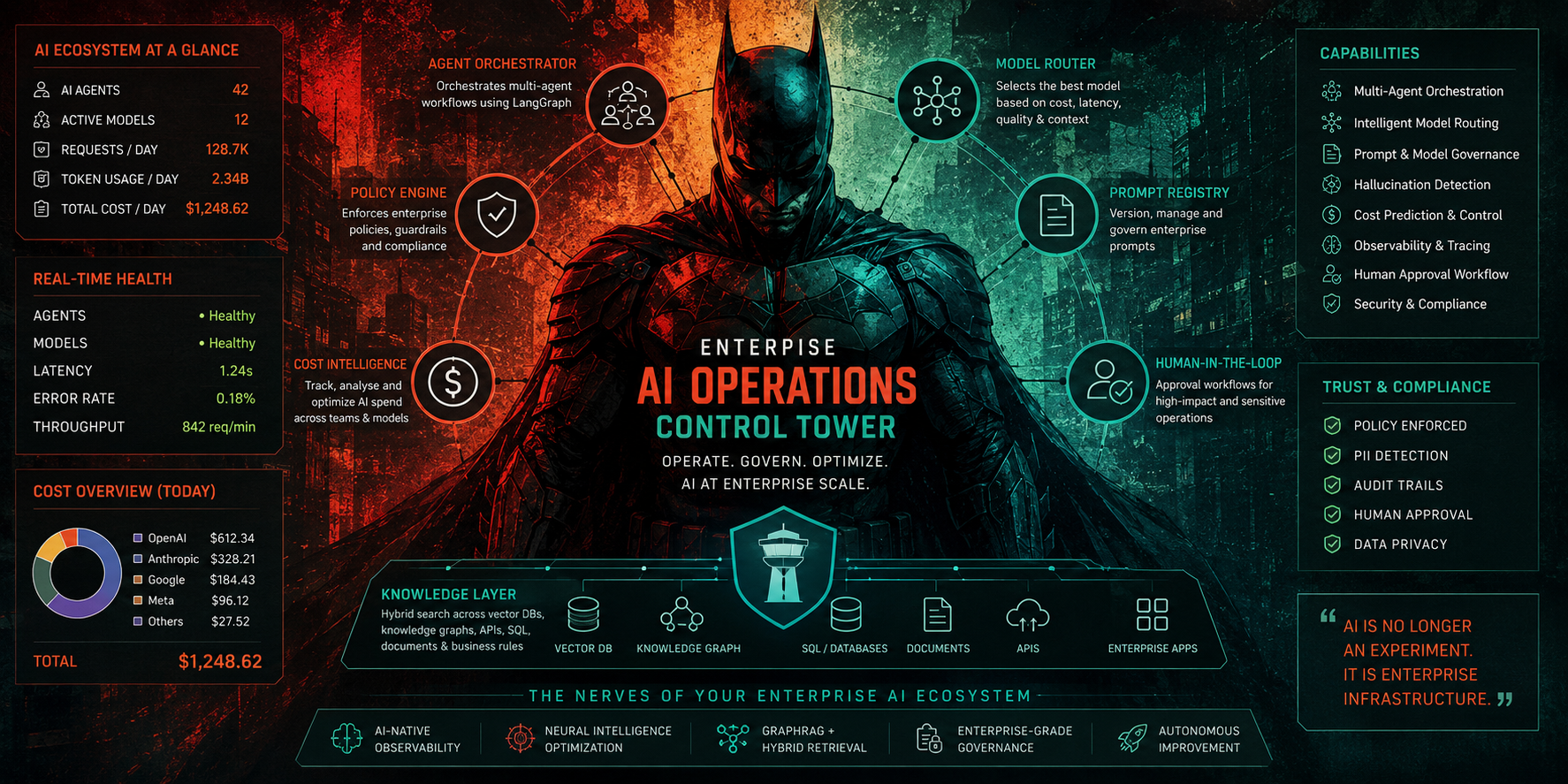
Enterprise AI has entered a new phase.
The challenge is no longer building individual AI applications. Most organisations can already deploy chatbots, Retrieval-Augmented Generation (RAG), copilots, workflow automations and autonomous agents.
The emerging problem is operational.
As AI becomes embedded across HR, Finance, Engineering, Customer Support, Compliance, Legal and Operations, organisations accumulate an increasingly complex ecosystem of models, prompts, vector databases, business rules, APIs and autonomous workflows.
Unlike traditional software, AI systems introduce probabilistic behaviour, continuously evolving prompts, model selection decisions, reasoning chains, tool execution, memory management and governance requirements.
Existing observability platforms were designed for infrastructure.
They were not designed for intelligence.
This repository explores the architecture required to operate enterprise AI as a first-class platform.
Design a unified operational layer capable of governing, orchestrating, monitoring and continuously optimising enterprise AI systems.
The platform is intended to become the operational control plane sitting above enterprise AI workloads.
Instead of deploying independent AI applications, every intelligent workflow becomes part of a centrally managed ecosystem.
Enterprise AI should be treated as infrastructure.
Individual agents are temporary.
Models evolve.
Prompts change.
Knowledge continuously expands.
Governance requirements increase.
The platform therefore separates intelligence from execution.
Applications should consume AI through a managed platform rather than interacting directly with language models.
The architecture follows several guiding principles.
Business applications should not manage AI directly.
Applications submit objectives.
The platform determines:
Every interaction becomes traceable.
Every execution records:
Nothing executes anonymously.
AI responses are evaluated before they are accepted.
Governance becomes a runtime capability rather than an afterthought.
Every workflow passes through:
No application depends upon one vendor.
The platform supports:
Applications remain unchanged when models evolve.
                        Enterprise Applications

                                      │

                                      ▼

                          Enterprise AI Gateway

                                      │

              ┌───────────────────────────────────────┐
              │                                       │
              │        AI Control Plane               │
              │                                                   │
              │  • Model Router                       │
              │  • Agent Registry                     │
              │  • Policy Engine                      │
              │  • Prompt Registry                    │
              │  • Governance                         │
              │  • Cost Intelligence                  │
              │  • Evaluation                         │
              │  • Security                           │
              │                                       │
              └───────────────────────────────────────┘

                                      │

                                      ▼

                         LangGraph Orchestration

                                      │

          ┌─────────────┬──────────────┬───────────────┐

          ▼             ▼              ▼               ▼

      Planner      Retriever      Reasoner      Validator

                                      │

                                      ▼

                    Enterprise Systems & Knowledge
The platform separates responsibilities into independent domains.
Responsible for orchestration.
Includes:
Responsible for decision making.
Includes:
Responsible for enterprise knowledge.
Includes:
Responsible for enterprise trust.
Includes:
Responsible for operational visibility.
Includes:
Every request follows the same lifecycle.
User Request

↓

Authentication

↓

Policy Validation

↓

Model Selection

↓

Knowledge Retrieval

↓

Agent Planning

↓

Reasoning

↓

Tool Execution

↓

Evaluation

↓

Approval (optional)

↓

Business Action

↓

Observability

↓

Continuous Learning
The platform introduces several dedicated AI services.
Predicts the most appropriate language model for each request.
Inputs include:
Evaluates response quality using neural classification.
Outputs include:
Estimates:
before execution begins.
Learns from:
Routing decisions continuously improve over time.
Retrieval combines multiple information sources.
The objective is not semantic similarity alone.
The objective is contextual reasoning.
The platform measures intelligence rather than infrastructure.
Examples include:
Model Utilisation
Prompt Drift
Retrieval Quality
Groundedness
Hallucination Rate
Cost per Department
Latency Distribution
Agent Reliability
Human Approval Ratio
Knowledge Freshness
Policy Violations
Several deliberate architectural decisions guide implementation.
| Decision | Rationale |
|---|---|
| LangGraph | Deterministic multi-agent orchestration |
| MCP | Standardised model interoperability |
| Neo4j | Relationship-aware enterprise knowledge |
| PyTorch | Neural optimisation models |
| FastAPI | Lightweight orchestration APIs |
| PostgreSQL | Operational metadata |
| Redis | Runtime memory |
| Qdrant | Vector retrieval |
| Kubernetes | Platform deployment |
| OpenTelemetry | End-to-end tracing |
enterprise-ai-operations-control-tower/

docs/
architecture/
adr/
backend/
frontend/
gateway/
orchestrator/
agents/
evaluation/
governance/
knowledge/
monitoring/
security/
infrastructure/
deployment/
experiments/
benchmarks/
research/
This repository currently focuses on architecture and platform design.
Implementation will progress incrementally through independent domains rather than as a monolithic application.
The objective is to establish a reusable enterprise AI platform capable of supporting multiple business products.
Areas under active investigation include:
Architecture & Research Repository
Design Phase
Not intended for production deployment.
"Enterprise AI does not require more intelligent applications. It requires intelligent infrastructure."