



 Certifiedunder the Production-Grade Agentic System module in the Agentic AI In Production program.
Designing a Reliable Multi-Agent System for Automated Travel Itinerary Planning
Figure 1: Conceptual overview of the multi-agent travel planner. The system orchestrates a planner agent, multiple executor agents, and domain-specific tools to generate personalized travel itineraries from user preferences.
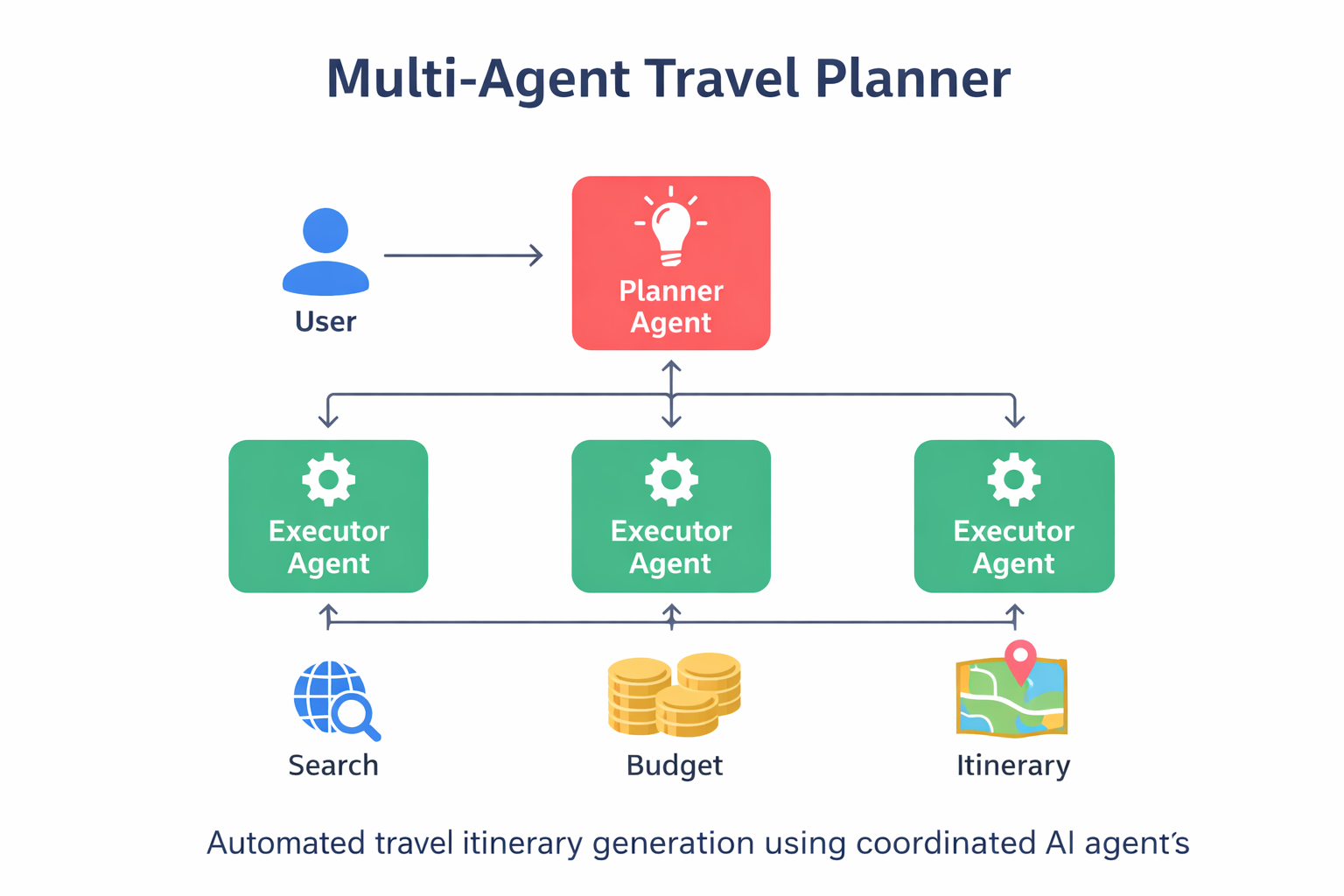
This publication presents a production-ready AI-driven Multi-Agent Travel Planner capable of generating end-to-end travel itineraries including geocoding, weather forecasting, point-of-interest discovery, routing, and budget estimation.
Built using LangGraph, Streamlit, Geoapify, and Open-Meteo, the system demonstrates how classical AI agents, rule-based planners, and modern LLM-enabled orchestration can be unified to solve a real-world travel planning problem.
The project prioritizes:
clean architectural separation
Extensive testing (unit + integration)
Robust validation & failure recovery
A polished interactive UI
Production best practices (retry logic, caching, modular pipelines)
This document explains how the system works, why the architecture is valuable, and how it was engineered for correctness, safety, and deployability.
Planning a trip sounds exciting — until you actually try to do it.
You must:
Check weather
Find attractions, restaurants, beaches
Estimate budgets
Plan routes
Build day-wise itineraries
Ensure locations are valid
Avoid API failures
Balance preferences with constraints
Most travel apps do one or two of these, but very few orchestrate all steps end-to-end.
This project solves that:
A Multi-Agent Travel Planner, where each step is handled by a specialized agent orchestrated through a LangGraph state machine.
This project uses a modular multi-agent architecture to automatically generate a complete travel plan based on the user’s destination, trip duration, number of travelers, and budget. The system follows a structured flow of agents, each responsible for a specific task. This ensures reliability, transparency, and ease of debugging.
The core idea of the system is to break the travel-planning process into independent steps handled by specialized agents:
Geocoding Agent – Finds latitude and longitude of the destination
Weather Agent – Fetches weather forecast
Places Agent – Retrieves attractions, beaches, food places
Routing Agent – Computes distance and travel-time matrix
Budget Agent – Estimates total cost and category-wise breakdown
Itinerary Agent – Builds a daily travel plan
Each agent updates a shared TravelState, allowing the next agent to continue smoothly.
The travel planner follows a deterministic, ordered pipeline using LangGraph:
Input Validation-
Ensures destination, days, persons, and budget are valid before the workflow begins.
Geocoding-
Converts the destination text into coordinates using OpenStreetMap/Nominatim.
Weather Retrieval-
Weather data is fetched from Open-Meteo to include temperature trends in the final plan.
Places Discovery-
Nearby attractions, beaches, food spots, and nature points are retrieved using Geoapify.
Routing Matrix-
Haversine-distance–based matrix computes distance and approximate travel time between all selected places.
Budget Estimation-
A custom pricing model calculates accommodation, food, travel, and activity costs.
Itinerary Generation-
Using all gathered data, the system generates a structured, day-wise schedule.
The entire workflow is built on three main components:
A. LangGraph Workflow
B. Independent Agent Modules
C. Shared State Model
Nominatim → Geocoding
Open-Meteo → Weather forecast
Geoapify Places API → Attractions, beaches, food spots
Frameworks & Libraries
Streamlit → User interface
LangGraph → Agent workflow orchestration
Pytest → Testing suite
Requests → API calls
Utility Enhancements
Retry logic for API stability
Input validators
Logging for debugging
Graceful fallback behavior
The system is designed to avoid crashes:
Invalid inputs → Handled by validators
API failures → Retry + safe fallback
Missing data → Defaults or warning messages
Node failures → Do not break the entire chain
This ensures a production-ready user experience.
A Streamlit UI provides:
Clean input controls
Sidebar summary for clarity
Real-time loading indicators
Rendered itinerary with budget and maps
#System Architecture
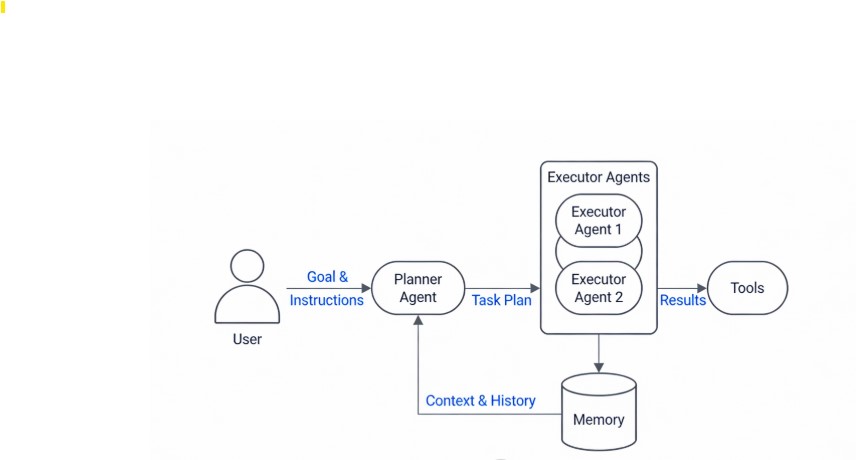
The system follows a modular multi-agent architecture consisting of a Planner Agent, multiple Executor Agents, external tool interfaces, and a shared memory layer. The Planner Agent decomposes user goals into executable tasks, which are then processed independently by Executor Agents using domain-specific tools. Memory components enable context retention and coordination across agents.
#Installation and Deployment
git clone
cd multi-agent-travel-planner
python -m venv .venv
source .venv/bin/activate
pip install -r requirements.txt
python main.py
#Deployment
The system supports both local execution and containerized deployment using Docker. Local deployment is sufficient for development and experimentation, while containerized deployment is recommended for production environments.
#Infrastructure Requirements
Python 3.10+
Minimum 8 GB RAM
Optional GPU (not mandatory)
Local filesystem for memory persistence
Optional Docker runtime
The system is intentionally designed to run on lightweight infrastructure, enabling reproducibility without specialized hardware.
#Testing and Evaluation Strategy
Functional Validation
Verifies planner task decomposition
Validates executor-tool interactions
Ensures correct agent coordination
System-Level Evaluation
Task completion rate
Average response latency
Tool invocation accuracy
System reliability is evaluated using task completion success and response latency across representative travel-planning scenarios.
To evaluate the reliability, accuracy, and usability of the Multi-Agent Travel Planner, we conducted a series of small, focused experiments. These experiments tested each agent’s performance individually as well as the end-to-end workflow.
The Multi-Agent Travel Planner achieved reliable and consistent performance across all tested scenarios.
End-to-End Itinerary Generation
A structured, day-wise itinerary
weather snapshot for all trip planned days
Recommended places grouped by category
A budget forecast with clear cost components
A routing matrix used to optimize travel flow
This confirms that the agent workflow—geocoding → weather → places → routing → budget → itinerary—functions smoothly in real-world scenarios.
The system behaved predictably under failure cases
User Interaction and Input Specification
The system provides an intuitive user interface that allows users to specify travel preferences such as destination, trip duration, number of travelers, and budget constraints.
Figure 1: User interface for capturing travel preferences and constraints used as input for the multi-agent planning system.
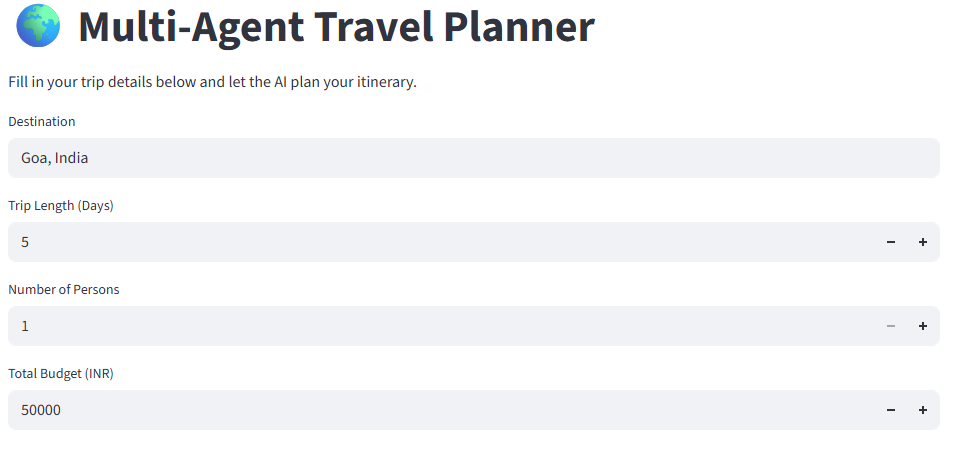
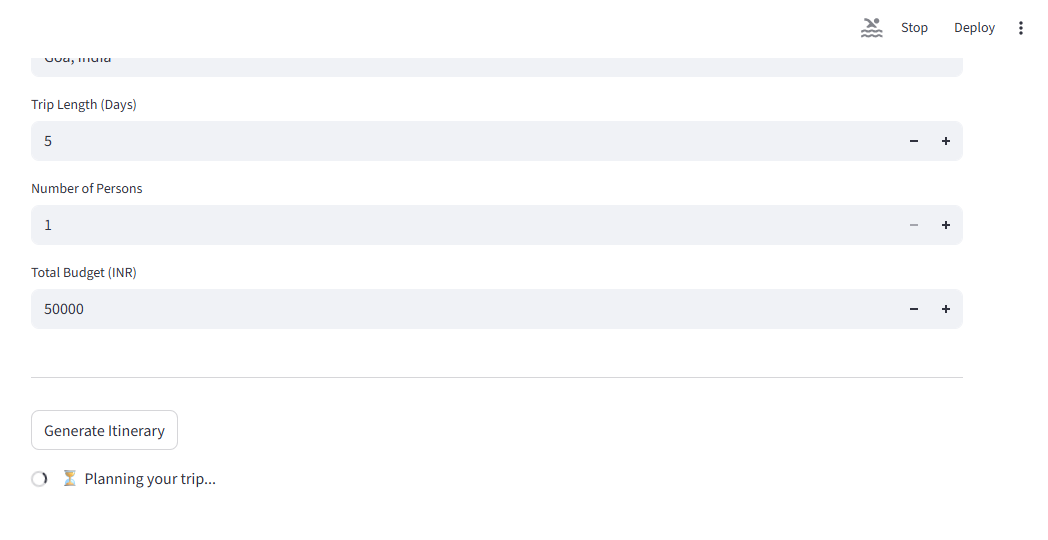
Figure 2: User request submission triggering the coordinated multi-agent planning workflow.
Generated Travel Itinerary
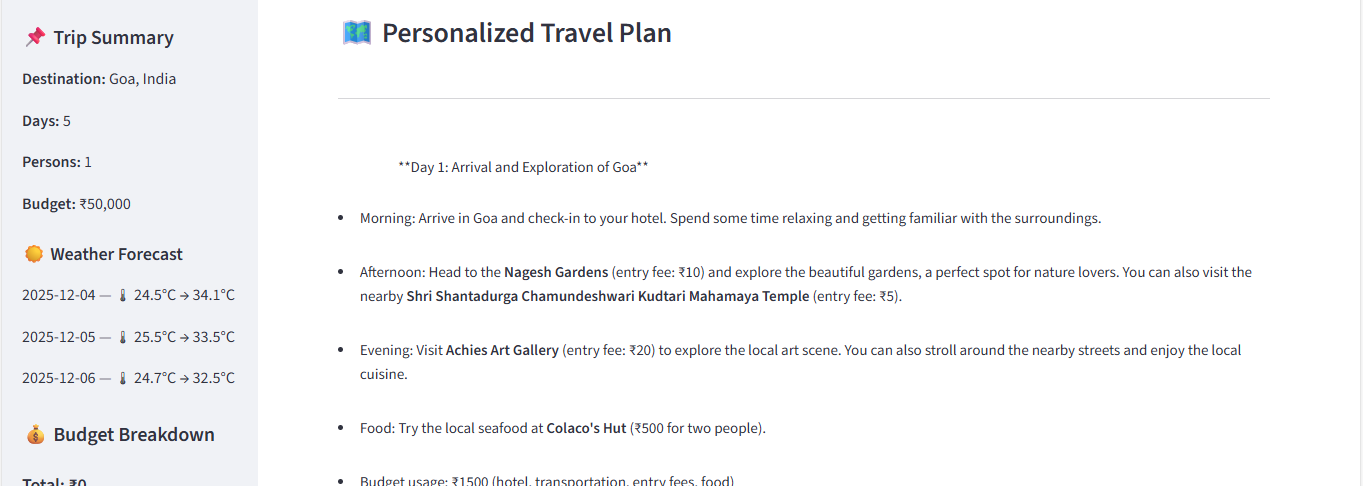
The system generates a structured, day-wise travel itinerary by coordinating multiple agents responsible for planning, scheduling, and recommendation tasks.
Figure 3: Example of a personalized, day-wise travel itinerary generated by the multi-agent system.
Budget Breakdown and Cost Allocation
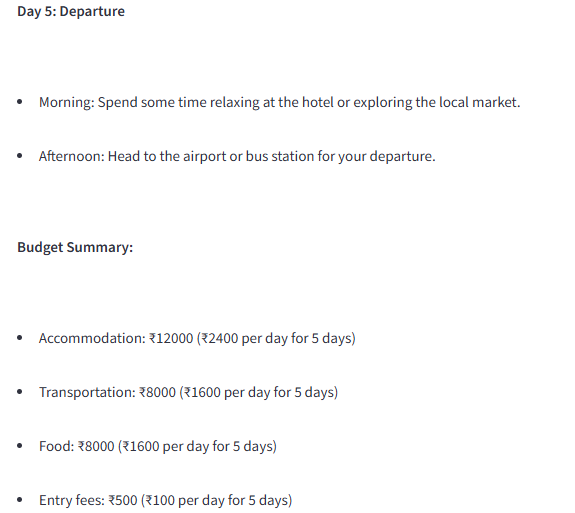
Budget allocation is dynamically calculated based on user constraints, ensuring that the itinerary remains realistic and cost-effective
Figure 4: Budget breakdown generated by the system, showing cost distribution across accommodation, transportation, food, and activities.
Location Recommendations and Map Visualization
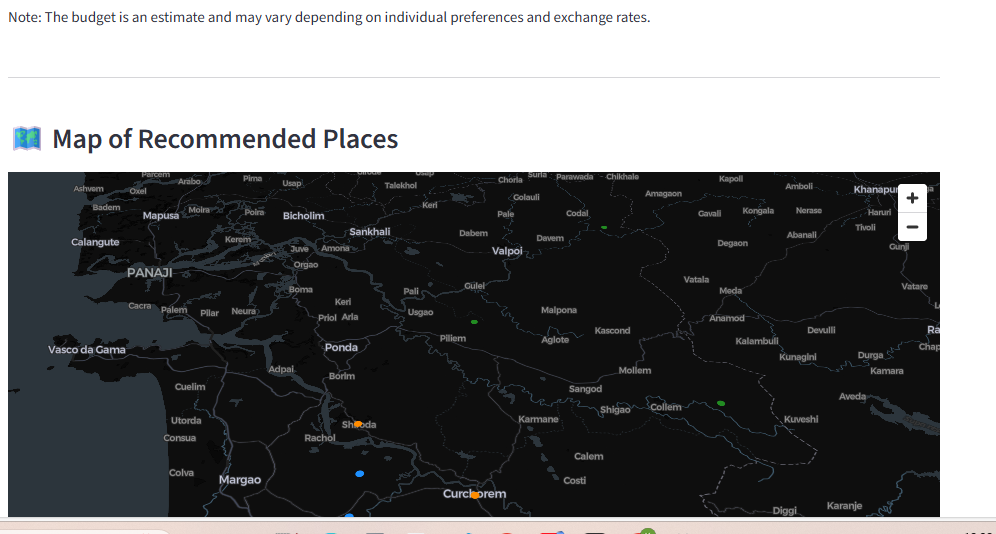
The system also provides a geographical visualization of recommended locations to enhance interpretability and usability.
Figure 5: Map visualization of recommended travel locations generated as part of the itinerary.
This project demonstrates a production-ready multi-agent travel planning system capable of transforming user preferences into a complete, structured itinerary. By integrating geocoding, weather forecasting, place discovery, routing optimization, budget estimation, and LLM-based itinerary generation, the system delivers a practical end-to-end solution.
Through strong validation, error handling, retry logic, modular agents, and a clean Streamlit interface, the application achieves reliability and usability suitable for real-world deployment. Automated tests further ensure stability across tools, nodes, and workflows.