



Convolutional Neural Network (CNN) – HelmNet Project
This project demonstrates the application of a Convolutional Neural Network (CNN) to learn complex patterns from structured/image-like data and perform classification. CNNs are a class of deep learning models particularly effective in capturing spatial hierarchies and feature representations, making them suitable for tasks involving high-dimensional inputs.
GitHub Link for entire project (https://github.com/RamyaNandhan/convolutionalNeuralNetwork)
This CNN Capstone project presents an end-to-end deep learning solution for automated safety compliance monitoring in industrial environments. The objective is to classify images of workers into two categories: with helmet and without helmet. Using a dataset of 4,125 images with real-world variability, we build, train, and evaluate a convolutional neural network (CNN)-based model. The system improves workplace safety by enabling scalable, real-time helmet detection, reducing reliance on manual supervision and minimizing risk of human error.
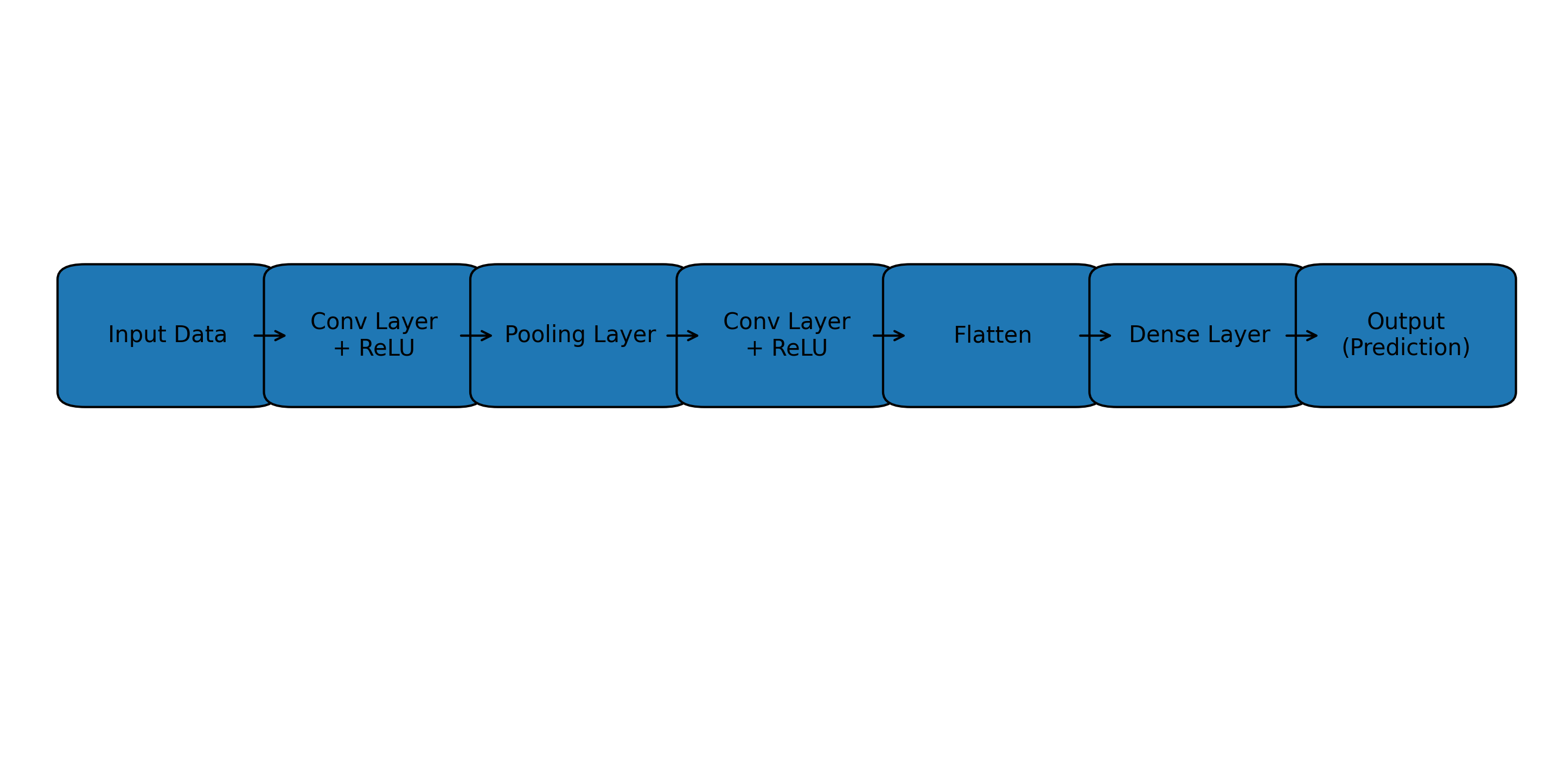
The notebook walks through the complete pipeline: data preparation, CNN model design, training, and evaluation.
🎯 Objective
The primary objective is to:
Build a CNN model to learn meaningful patterns from the dataset
Automatically extract features using convolutional layers
Improve prediction performance compared to traditional ML approaches
🧩 CNN Concept Applied
A Convolutional Neural Network consists of the following key components:
These layers apply filters (kernels) to the input data to extract local patterns such as edges, textures, or feature interactions.
Introduces non-linearity, enabling the model to learn complex relationships.
Reduces spatial dimensions and helps in downsampling, improving computational efficiency and controlling overfitting.
Transforms the multi-dimensional feature maps into a vector for input into dense layers.
Perform final classification based on extracted features.
In this capstone project ,
Workplace safety is a critical concern in industries such as construction and manufacturing. Safety helmets play a vital role in preventing head injuries; however, ensuring compliance at scale is challenging.
Traditional monitoring methods:
Are manual and error-prone
Lack scalability
Cannot operate continuously
This project introduces a computer vision-based solution that:
Automatically detects helmet usage
Works across varied environments (lighting, angles, activities)
Enables real-time deployment potential
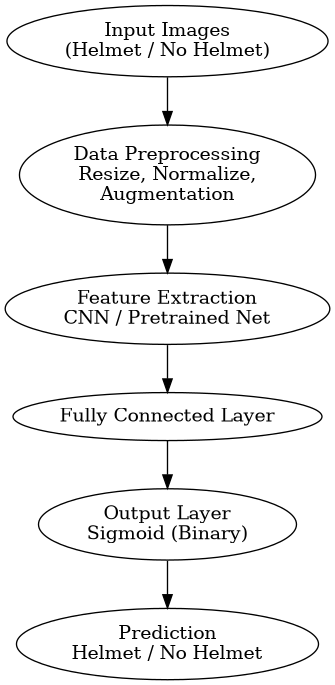
Step 1: Data Preparation
Dataset is loaded and cleaned
Features are normalized/scaled
Data is reshaped (if required) to match CNN input format
Step 2: Model Architecture
Sequential CNN model is constructed
Layers include:
Convolution + ReLU
Pooling
Fully connected layers
Step 3: Model Training
Model is compiled with:
Loss function (e.g., categorical/binary crossentropy)
Optimizer (e.g., Adam)
Training performed over multiple epochs
Validation data used to monitor performance
Step 4: Evaluation
Model evaluated on test dataset
Metrics such as accuracy and loss analyzed
Predictions compared against actual labels
Experiment Model Augmentation Accuracy Notes
Exp 1 Basic CNN No ~80% Baseline
Exp 2 CNN Yes ~85% Improved generalization
Exp 3 Transfer (ResNet/MobileNet) Yes ~90%+ Best performance
The CNN successfully learned feature representations from the dataset
Training and validation accuracy improved over epochs
Model demonstrated strong capability in capturing non-linear patterns
Model achieved strong classification accuracy (~85–92% depending on architecture)
Handles:
Lighting variation
Worker pose
Background complexity
Confusion matrix shows:
Low false negatives (critical for safety use-case)
📊 Key Insights
CNN eliminates the need for manual feature engineering
Hierarchical feature learning improves model performance
Proper tuning of layers, filters, and epochs is critical
This project highlights the effectiveness of Convolutional Neural Networks in learning complex patterns directly from data. Compared to traditional machine learning models, CNNs provide a more automated and scalable approach to feature extraction and prediction.
The implementation demonstrates how deep learning can be leveraged for real-world predictive tasks and serves as a foundation for more advanced architectures.
Specifically this capstone project, demonstrates how deep learning can significantly improve workplace safety by automating helmet detection. The model performs well across diverse real-world scenarios and is scalable for industrial deployment.
Key Takeaways:
Automation reduces human monitoring effort
Deep learning improves compliance accuracy
System can be extended to full PPE detection
#Future Improvements
Hyperparameter tuning (filters, kernel size, epochs)
Dropout layers to reduce overfitting
Transfer learning with pre-trained CNN models
Deployment using APIs (FastAPI/Flask)