



 Certifiedunder the Multi-Agent System module in the Mastering AI Agents program.
AI Project Publication Assistant is a conditional multi-agent system designed to improve how AI and ML projects are presented for public sharing.
In practice, many technically sound AI projects struggle with weak documentation, unclear summaries, and inconsistent structure. This gap often reduces discoverability and limits collaboration. Rather than generating content blindly, this system analyzes an existing GitHub repository and produces grounded, structured suggestions that help improve clarity and completeness.
Unlike single-pass LLM tools that generate outputs in one step, this project adopts a role-based multi-agent architecture using LangGraph. Each agent performs a specialized task, allowing the system to separate analysis, generation, and validation into distinct stages. This separation improves reliability, reduces hallucination risk, and makes the reasoning process easier to inspect.
This system is intended for:
The tool is particularly useful for technical users who value reproducibility, structured evaluation, and explainable agent workflows.
The system requires:
requirements.txtExecution is performed via a single CLI command, making setup lightweight and reproducible.
This system is intentionally scoped to analysis and recommendation, not execution.
It does not modify repositories, generate code, or make claims about project correctness.
Inputs
Outputs
By keeping the scope limited to recommendations, the system remains predictable, auditable, and evaluator-friendly.
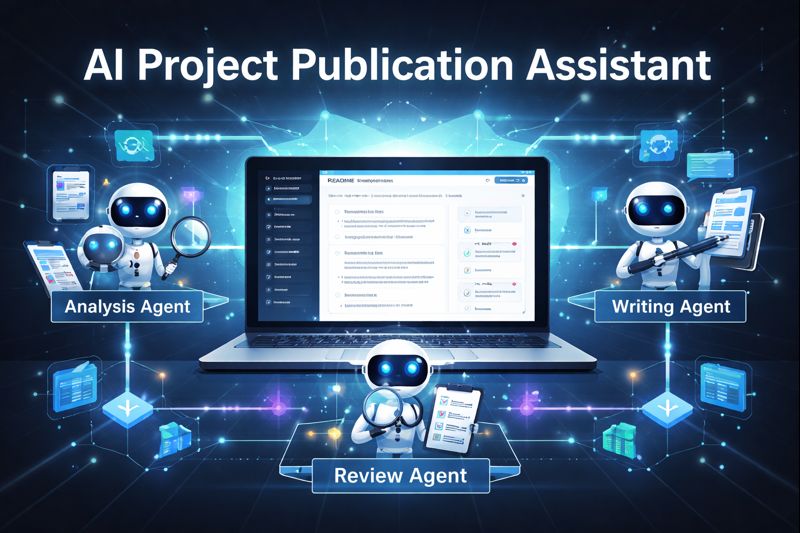
A monolithic LLM workflow is insufficient for tasks that require grounding, validation, and iterative refinement. This system separates responsibilities across three agents:
This separation improves reliability, modularity, and explainability.
LangGraph is used to model the system as a conditional state machine. Agents communicate through shared state, and the reviewer agent acts as a quality gate. If issues are detected, the system retries generation once before terminating. This bounded retry mechanism prevents infinite loops while still allowing quality-driven refinement.
LangGraph enables explicit state transitions, conditional routing, and debuggable agent workflows. This makes agent coordination transparent and avoids implicit control flow commonly found in monolithic agent loops.
At a high level, the system operates as follows:
This step-by-step progression makes the system behavior transparent and easier to reason about compared to implicit agent loops.
Several design choices reduce hallucination and uncontrolled behavior:
These guardrails ensure deterministic and explainable system behavior.
The system integrates multiple tools beyond basic LLM calls:
This tool-augmented approach improves transparency, traceability, and evaluator confidence.
The system operates on publicly available GitHub repositories provided as input by the user. The primary data source is the repository README file.
Processing steps include:
No private or proprietary datasets are used.
The system was evaluated using publicly available GitHub repositories with varying documentation quality and structural completeness. Repositories represented well-structured, partially documented, and minimally documented projects.
Each evaluation run followed a deterministic sequence:
All runs used a single bounded retry mechanism to ensure predictable and reproducible behavior.
As a conceptual baseline, a single-pass LLM workflow without role separation was considered.
Compared to this baseline, the multi-agent architecture provides:
This highlights the practical benefits of agent specialization and conditional orchestration.
Each run produces deterministic, reproducible artifacts summarizing repository understanding, writing suggestions, and review feedback.
The system generates measurable evaluation signals, including:
Rather than optimizing purely for generative fluency, evaluation prioritizes structural correctness, transparency, and reproducibility.
For example, when analyzing a repository with a minimal README containing only installation instructions, the system may:
These recommendations do not overwrite existing content but guide the developer toward improved presentation quality.
The current implementation is designed for local CLI execution. For production deployment, the system could be:
The modular architecture enables deployment flexibility without altering core orchestration logic.
System behavior can be monitored through:
Future maintenance may include refining heuristic scoring rules, expanding supported formats, and introducing logging for deeper agent decision tracing.
The project follows a modular architecture separating agents, tools, and orchestration logic. This design enables:
The conditional state-machine design ensures scalability without sacrificing determinism.
This project illustrates how agentic architectures can be applied beyond conversational AI. By introducing role specialization, conditional control flow, and structured validation, the system demonstrates a practical transition from simple LLM workflows to controlled multi-agent orchestration.
The approach shows how AI systems can assist developers not by replacing authorship, but by augmenting technical communication and documentation quality. This reflects broader trends in applying agent-based design to real-world engineering workflows.
Current analysis focuses primarily on README files and uses heuristic scoring. Future improvements include deeper code analysis, LLM-based semantic review, broader dataset evaluation, and interactive user interfaces.
The system operates exclusively on publicly available GitHub repositories provided by the user. The primary analyzed artifact is the repository README file.
Repositories were selected to represent varying levels of documentation maturity, including:
This diversity ensures that the evaluation reflects realistic documentation variability encountered in open-source ecosystems.
Performance evaluation is based on structural and behavioral signals rather than predictive accuracy. Key metrics include:
Compared to a single-pass LLM baseline, the multi-agent system demonstrated:
These improvements highlight the benefit of role specialization and structured orchestration over monolithic LLM pipelines.
In open-source and AI development ecosystems, project visibility and documentation quality significantly impact adoption and collaboration. This system demonstrates how agentic architectures can assist developers in improving technical communication without replacing human authorship.
The approach is particularly relevant for:
The project is actively maintained and designed with modular extensibility. Future updates may include:
Maintenance primarily involves updating heuristic rules and refining agent role definitions.
The project is distributed under the MIT License, allowing reuse, modification, and redistribution with proper attribution.
For collaboration, questions, or contributions, users may reach out via the associated GitHub repository.
Overall, this project serves both as a practical documentation assistant and as a demonstration of structured agent orchestration principles taught in the Mastering AI Agents program.