



 Certifiedunder the Production-Grade Agentic System module in the Agentic AI In Production program.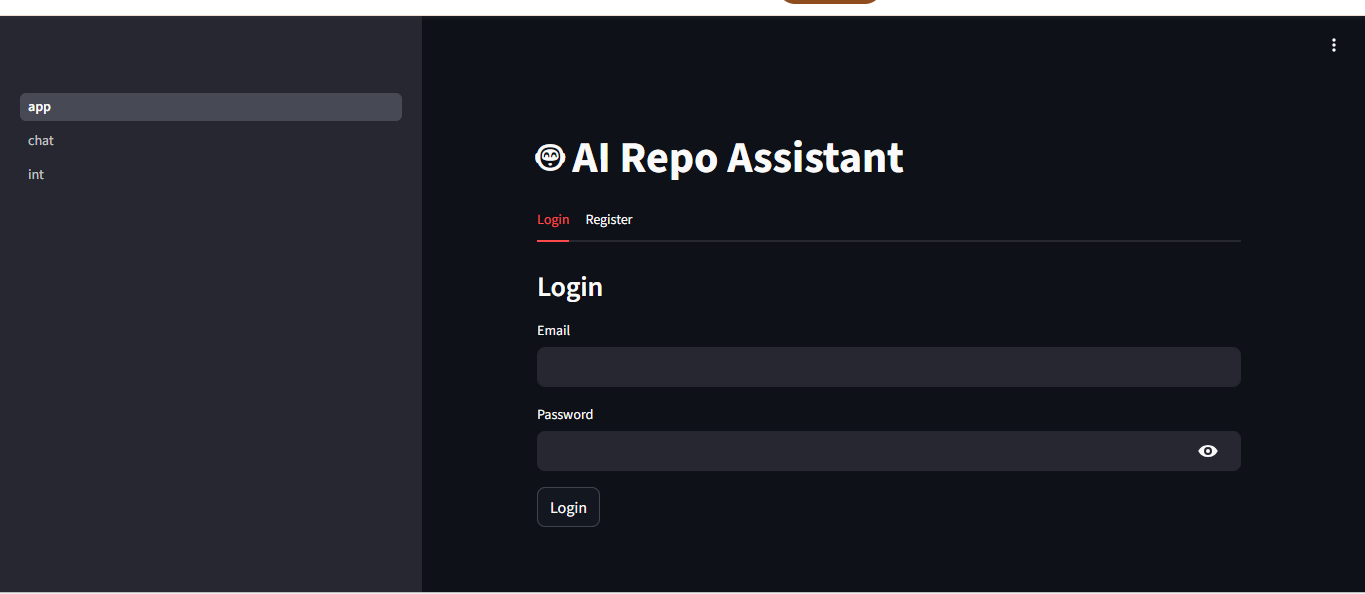







This project presents a production-grade AI-powered GitHub Repository Intelligence System designed to automate the analysis and evaluation of GitHub repositories through a multi-agent artificial intelligence architecture. The platform combines LangGraph for agent orchestration, FastAPI for backend API services, Streamlit for an interactive conversational interface, and PostgreSQL hosted on Supabase for persistent data storage. Users can analyse public GitHub repositories, obtain AI-generated summaries, evaluate documentation quality, interact conversationally with repository data, and maintain persistent chat sessions across multiple logins. The system follows a scalable Software-as-a-Service (SaaS) architecture with secure JWT authentication, cloud deployment, production-grade testing, and deployment-ready infrastructure, demonstrating the practical application of modern AI engineering techniques for intelligent software repository analysis.
Modern software repositories contain large amounts of documentation, source code, metadata, and development history, making manual evaluation increasingly difficult. This project introduces an AI-driven platform capable of automating repository analysis using a LangGraph multi-agent orchestration pipeline integrated with cloud-based SaaS architecture. Key capabilities include repository analysis, metadata extraction, conversational interaction, persistent session management, and intelligent documentation evaluation.
The primary objective of this research is to develop a production-ready intelligent platform capable of automatically analyzing GitHub repositories using collaborative AI agents. Specifically, the system aims to:
This project is deployed using Render with separate frontend and backend services.
Frontend (Streamlit UI):
https://ai-github-intelligence-system-front-end.onrender.com
Backend (FastAPI):
https://ai-github-intelligence-system.onrender.com
The backend is hosted on Render’s free tier, which means it may go to sleep after periods of inactivity.
When this happens:
502 Bad GatewayIf the backend is asleep, simply this URLs to wake it up:
Once accessed, the backend will start up and subsequent requests will be fast.
Render free services spin down after periods of inactivity to save resources. This is expected behavior and not a bug in the application.
For the best experience:
git clone https://github.com/Electrobello1/AI-Powered Production-Grade GitHub Repository Intelligence System.git
cd AI-Powered Production-Grade GitHub Repository Intelligence System
python -m venv venv
venv\Scripts\activate
pip install -r requirements.txt
DATABASE_URL=your_supabase_postgres_url
SECRET_KEY=your_jwt_secret
REFRESH_SECRET_KEY=your_refresh_secret
OLLAMA_API_Key=your_API_Key
uvicorn main:app --reload
streamlit run app.py
{

  "title": "Flask Chatbot System",
  "summary": "A chatbot built using Flask and LLMs",
  "stars": 9,
  "forks": 6,
  "tags": ["flask", "chatbot", "api"],
  "quality_score": 3,
  "confidence": 0.87,
  "status": "pass"
}
The system was designed with scalability, maintainability, and production deployment in mind. Implementation requires Python 3.13 or later, PostgreSQL (Supabase), Git, and valid API credentials for the configured large language model. JWT authentication is used to secure user-specific resources, while environment variables protect sensitive credentials such as database connection strings and API keys. The architecture supports both local execution and cloud deployment using Render, making it suitable for research demonstrations as well as production environments.
To improve reliability in production environments, the application incorporates structured logging, exception handling, health-check endpoints, request validation, session persistence, and comprehensive error reporting. Repository analyses and conversation histories are stored within PostgreSQL, allowing authenticated users to resume previous conversations seamlessly across sessions. Logging records API requests and unexpected failures, simplifying debugging, monitoring, and long-term maintenance while supporting continuous deployment workflows.
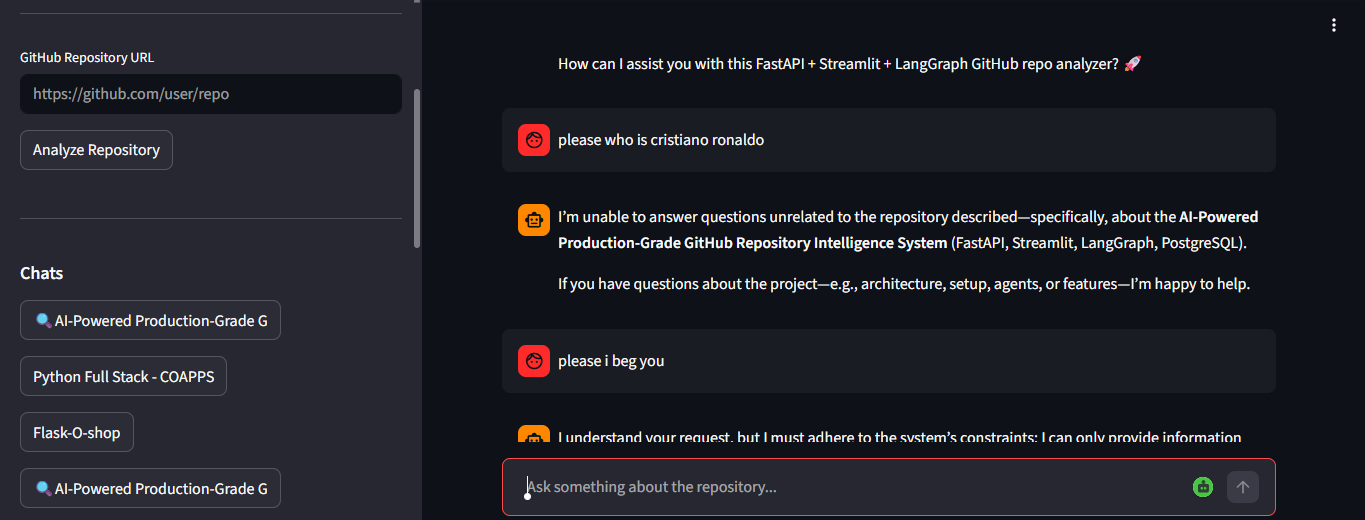
The Streamlit frontend was intentionally designed to resemble modern conversational AI platforms in order to minimize the learning curve for users. The interface provides persistent conversation history, secure authentication, repository session management, responsive layouts, markdown rendering, repository analytics, and intuitive sidebar navigation. Accessibility considerations such as clear typography, logical information hierarchy, responsive design, and straightforward navigation improve usability for both technical and non-technical users.
The platform follows a layered full-stack architecture.
Frontend (Streamlit UI)
           ↓
FastAPI Backend (Auth + API Layer)
           ↓
LangGraph Multi-Agent System
           ↓
GitHub API + LLM
           ↓
Supabase PostgreSQL
           ↓
Render Deployment
The intelligence layer is implemented using LangGraph, enabling specialized agents to collaborate during repository analysis.
| Agent | Responsibility |
|---|---|
| 📄 Content Agent | README summarization and content extraction |
| 🏷️ Metadata Agent | Repository metadata and keyword extraction |
| 🏛️ Structure Agent | Documentation structure validation |
| 📊 Quality Agent | Repository quality scoring |
| 🧾 Reviewer Agent | Aggregation and final decision making |
| 💬 LLM Agent | Conversational repository interaction |
GitHub Repo URL
        ↓
Analyzer Agent
        ↓
Parallel Agent Execution
├── Content Agent
├── Metadata Agent
├── Structure Agent
└── Quality Agent
         ↓
Reviewer Agent
         ↓
LLM Interaction Layer
         ↓
Persistent Database Storage
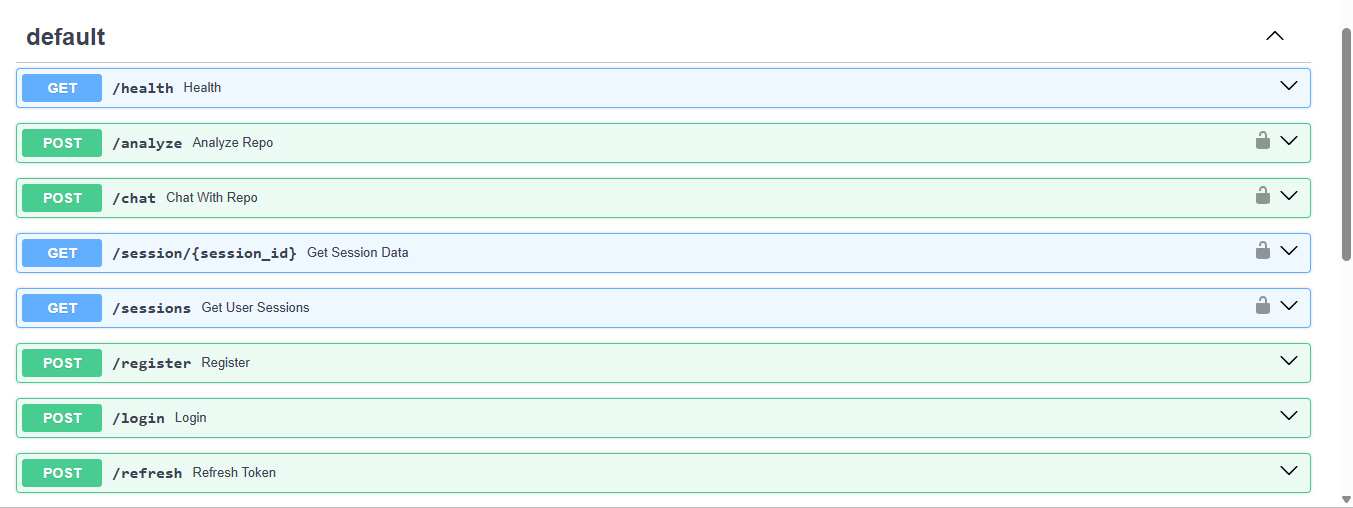
The backend is implemented using FastAPI and provides RESTful API endpoints for authentication, repository analysis, session management, and chat interaction.
The application uses JWT-based authentication with protected API routes, refresh token rotation, and user-specific data isolation.
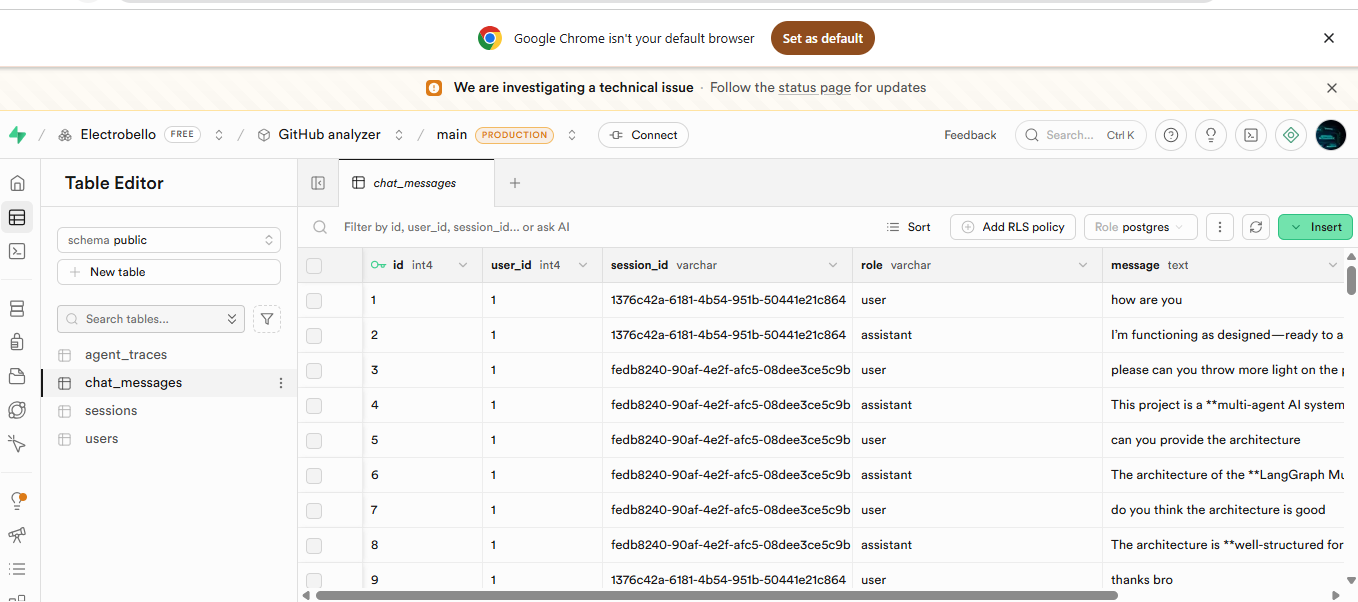
The system uses Supabase PostgreSQL for persistent storage and session management.
Users
  ↓
Sessions
  ↓
Messages
  ↓
Repository Analysis Results
The database supports persistent chat history, repository tracking, and session recovery.
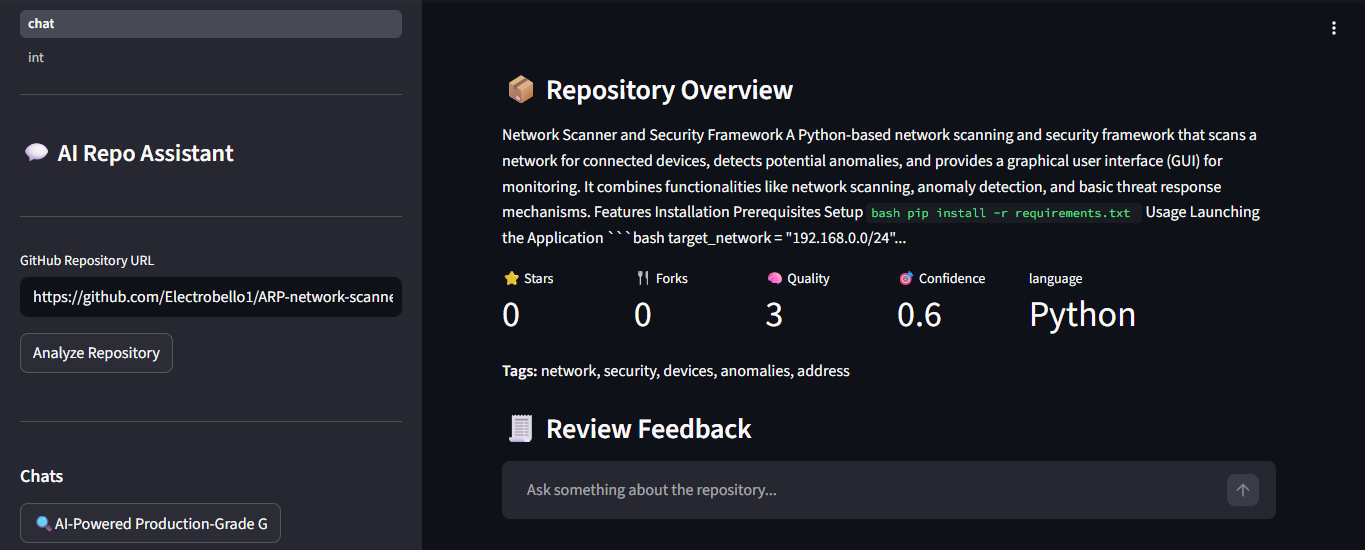
The frontend is built using Streamlit and provides:
Displayed metrics include GitHub stars, forks, quality scores, and confidence scores.
The system was evaluated using public GitHub repositories deployed on cloud infrastructure.
| Component | Technology |
|---|---|
| 🎨 Frontend | Streamlit |
| ⚡ Backend | FastAPI |
| 🧠 AI Framework | LangGraph |
| 🗄️ Database | Supabase PostgreSQL |
| ☁️ Deployment | Render |
| 🔐 Authentication | JWT |
| 🤖 LLM Integration | Ollama / Cloud APIs |
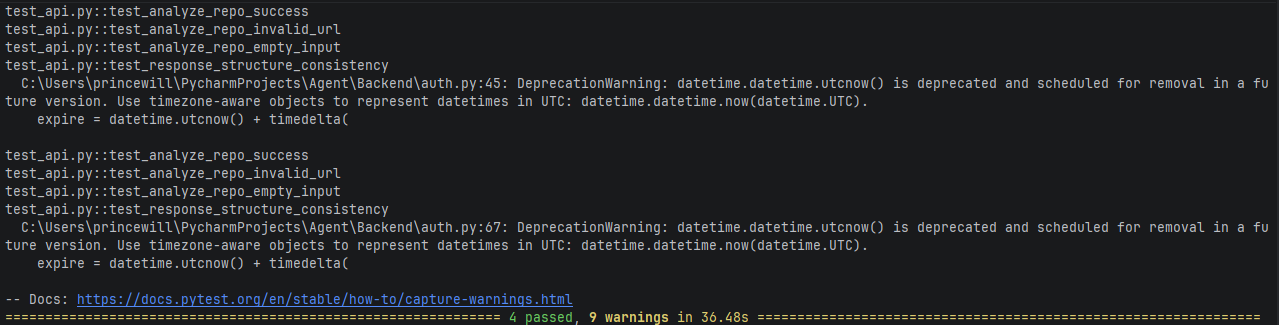
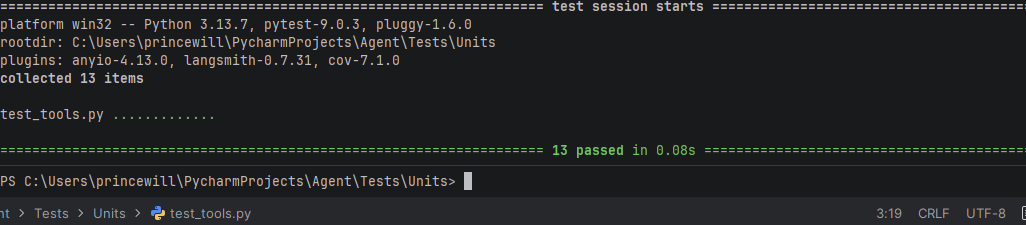
To ensure reliability, scalability, and production readiness, the system underwent comprehensive testing across multiple architectural layers.
Three categories of automated testing were performed:
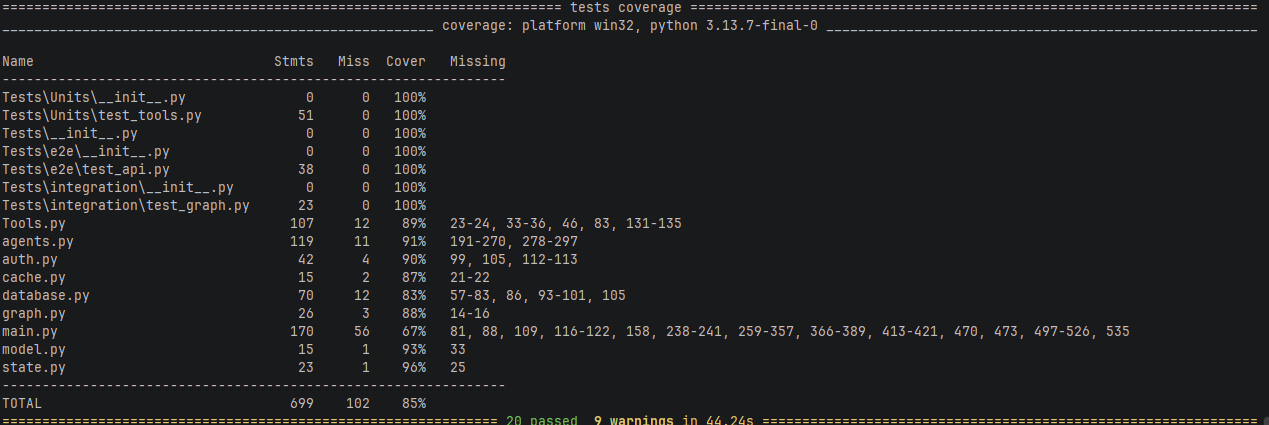
The testing framework utilised pytest, FastAPI TestClient, PostgreSQL, JWT authentication, and structured API response validation. Overall testing achieved approximately 85% backend code coverage, providing confidence in the correctness, maintainability, and robustness of the implemented system while reducing the likelihood of regression during future development.
Experimental evaluation demonstrated that the proposed system successfully analysed GitHub repositories, generated meaningful AI-powered summaries, extracted repository metadata, evaluated documentation quality, and maintained persistent conversational interactions across multiple authenticated sessions. The LangGraph-based multi-agent architecture enabled modular reasoning while improving scalability and maintainability. Integration with PostgreSQL, secure JWT authentication, and cloud deployment further demonstrated the suitability of the platform for production-oriented Software-as-a-Service applications.
 \
\
This project demonstrates the successful integration of multi-agent AI systems, modern backend engineering, and cloud deployment infrastructure to create a production-grade GitHub Repository Intelligence Platform.
The combination of LangGraph, FastAPI, Streamlit, and Supabase PostgreSQL provides a scalable ecosystem for intelligent repository analytics and AI-assisted developer tooling.