



 Certifiedunder the Multi-Agent System module in the Mastering AI Agents program.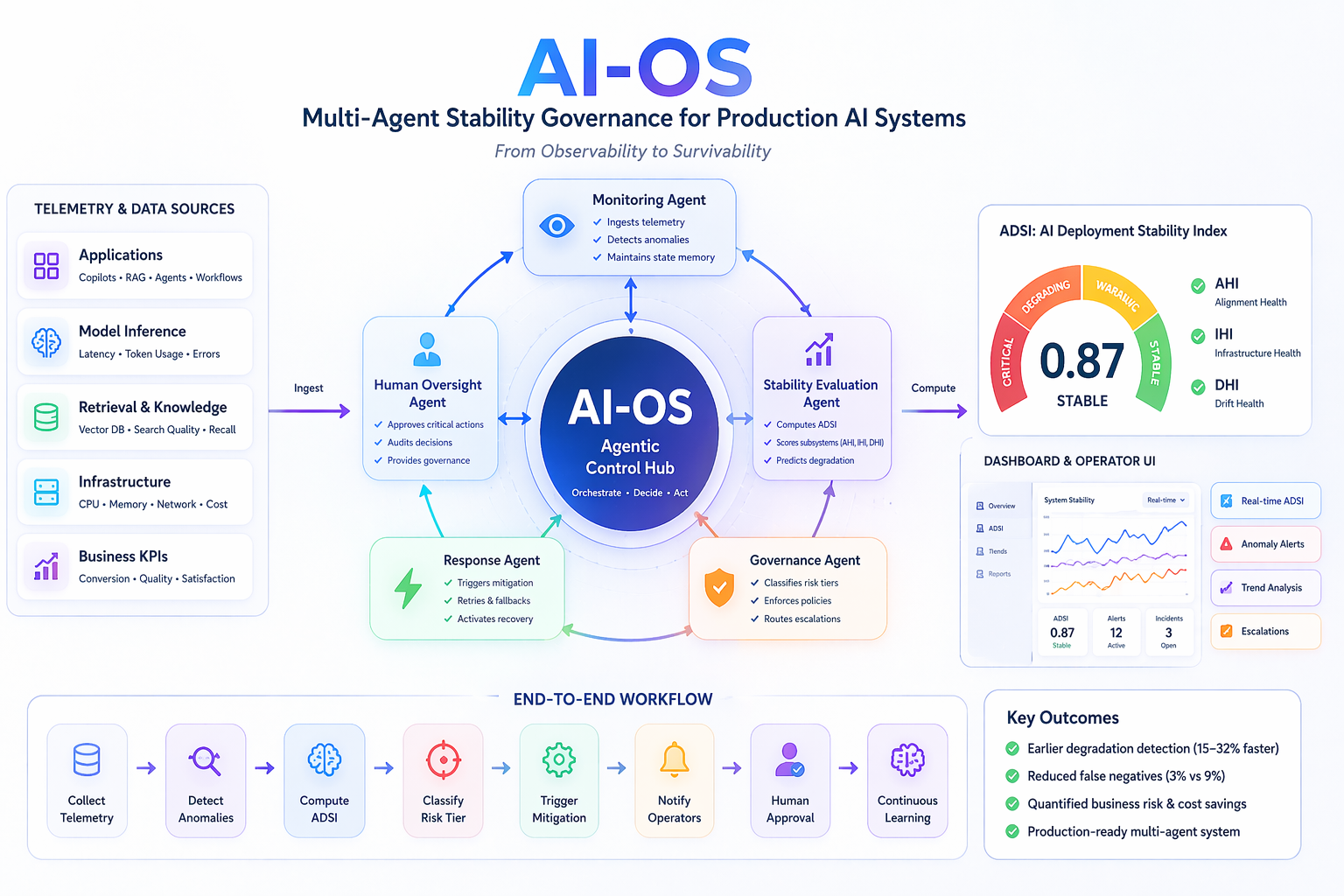
Enterprise AI systems do not fail instantly. They degrade gradually.
AI-OS was built to detect that degradation before operational failure occurs.
:::
AI Engineer • Multi-Agent Systems • Production Reliability Engineering
Artificial intelligence is rapidly evolving from an experimental capability into core enterprise infrastructure. Organizations now depend on AI systems for customer support, workflow automation, knowledge retrieval, decision assistance, and internal productivity. As this transition accelerates, reliability becomes just as important as model quality.
However, production AI systems often fail differently from traditional software. Instead of crashing immediately, they tend to degrade gradually through slower responses, weaker retrieval quality, increasing hallucination risk, KPI misalignment, and infrastructure instability. These problems may remain hidden until they begin to affect users or business outcomes.
AI-OS Framework was created to address this gap. It introduces a structured operational model that converts fragmented observability signals into a bounded deployment health score called the AI Deployment Stability Index (ADSI). This enables teams to detect degradation earlier, classify operational risk, and respond with clearer governance controls.
The framework combines multi-agent orchestration, mathematical stability scoring, governance tiers, anomaly visibility, and human oversight principles. Together, these components provide a blueprint for managing enterprise AI systems more safely and effectively.
Most organizations already monitor their AI systems using dashboards and telemetry platforms. They often collect metrics such as latency, throughput, cost, uptime, token usage, and error rates. While useful, these measurements are typically isolated indicators rather than a unified picture of system health.
In practice, enterprise teams need higher-level answers. They need to know whether a deployment remains stable, whether risk is increasing, whether rollback decisions should be considered, and whether human intervention is required.
Traditional monitoring tools are not always designed to answer these governance-oriented questions. They describe symptoms, but they may not clearly communicate survivability.
Many AI incidents are not caused by a single failure. They emerge through combinations of smaller degradations that interact over time.
For example, an organization may experience rising latency while retrieval quality simultaneously declines. Another system may show increasing hallucination rates at the same time business KPIs weaken. In some cases, infrastructure instability can combine with data drift to create inconsistent outputs.
When these signals are viewed separately, teams may underestimate the seriousness of the situation. AI-OS Framework was designed to transform scattered metrics into a more actionable operational view.
This represents a shift in mindset:
Observability measures components.
Stability governance protects outcomes.
AI-OS acts as a supervisory layer for enterprise AI deployments. Its primary objective is to identify instability before it becomes a business incident.
The framework provides five practical benefits:
It measures deployment health using a bounded score.
It classifies risk into understandable operational tiers.
It supports earlier detection of degradation trends.
It introduces governance pathways for response decisions.
It preserves human oversight for critical interventions.
Rather than replacing existing monitoring tools, AI-OS complements them by adding decision intelligence on top of raw telemetry.
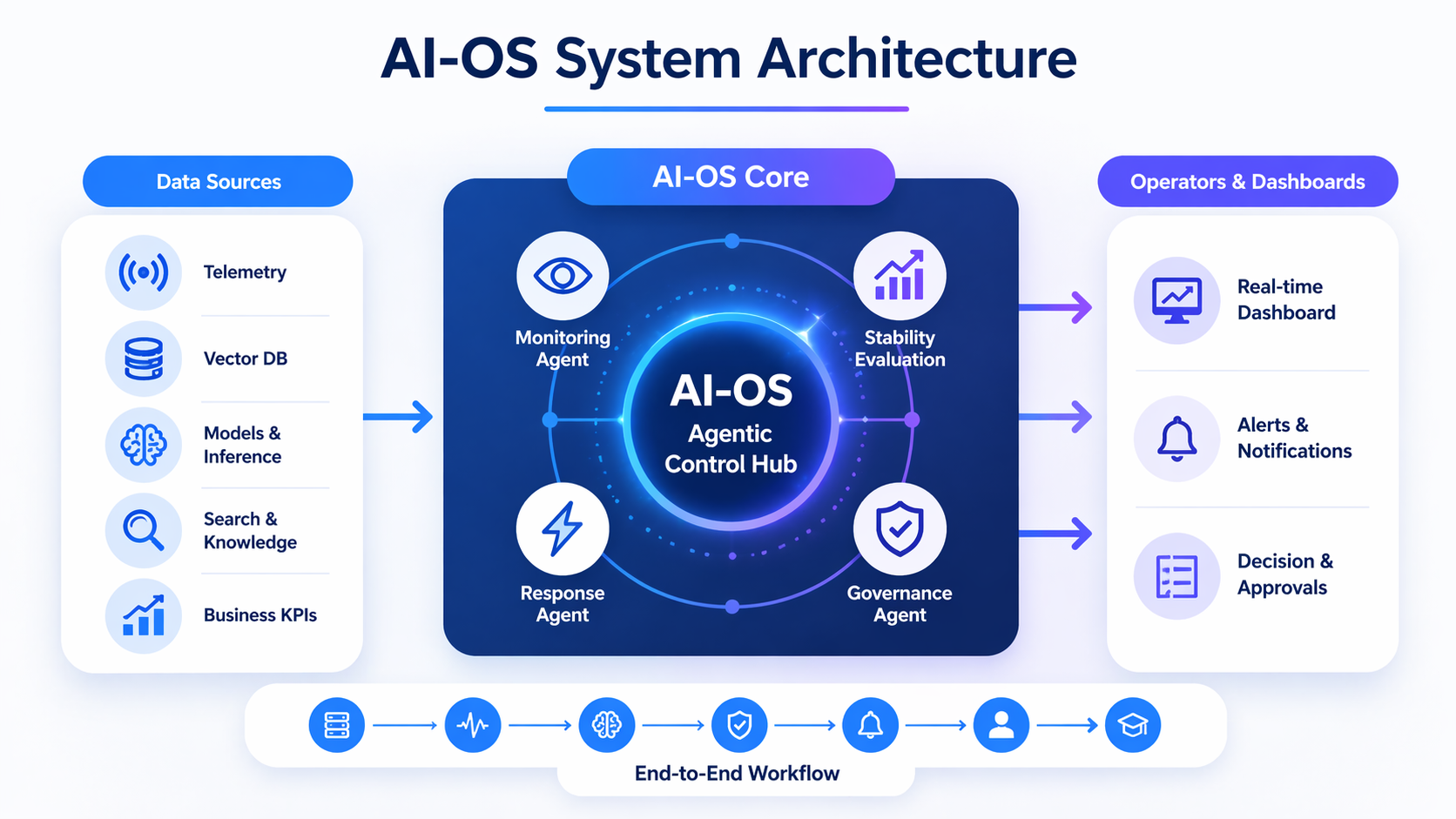
AI-OS is structured as a multi-agent system in which specialized agents perform focused operational responsibilities.
This modular structure supports safer autonomy because responsibilities are clearly separated.
This enables autonomous yet governed production operations.
The central metric of the framework is the AI Deployment Stability Index.
Three subsystem indices define deployment health.
Alignment Health Index
Infrastructure Health Index
Drift Health Index
Where:
A score near 1.0 indicates a healthy and stable deployment. A score near 0.0 indicates severe instability.
The three indices capture complementary dimensions of performance.
The Alignment Health Index measures whether the AI system continues to meet intended business outcomes such as task quality, user satisfaction, and KPI alignment.
The Infrastructure Health Index measures technical reliability such as latency performance, service availability, and retrieval responsiveness.
The Drift Health Index measures whether the system is changing away from expected behavior over time due to evolving inputs, embeddings, usage patterns, or environmental conditions.
By averaging these signals, the framework avoids over-reliance on any single metric.
To make the score operationally useful, ADSI maps into four decision tiers.
A score above 0.85 is considered Stable, meaning the deployment is healthy and normal operations may continue.
A score between 0.75 and 0.85 is Warning, suggesting closer monitoring and investigation.
A score between 0.65 and 0.75 is Degrading, indicating that intervention should be considered soon.
A score below 0.65 is Critical, meaning immediate mitigation, rollback, or escalation may be required.
These thresholds are configurable to suit organizational tolerance and business context.
The framework was evaluated using synthetic telemetry simulations that emulate common production AI operating conditions. This approach allows controlled benchmarking without exposing proprietary enterprise data.
The simulation modeled multiple phases of deployment behavior. Stable periods represented healthy low-variance operation. Warning phases introduced early degradation signals. Critical phases simulated compound failures across several metrics simultaneously.
Signals used in the experiments included KPI error, retrieval quality, latency deviation, and embedding shift.
Performance was measured using practical operational metrics such as detection speed, false negatives, classification accuracy, and area under curve (AUC).
Across benchmark scenarios, AI-OS consistently identified instability earlier than baseline approaches focused on single metrics.
Latency-only monitoring often reacted late because it missed quality deterioration. Drift-only approaches sometimes detected movement without understanding business impact. Generic dashboards exposed metrics but lacked unified escalation logic.
The ADSI framework demonstrated faster degradation recognition, lower false negative rates, and stronger overall classification performance.
Illustrative benchmark results included:
These outcomes suggest that bounded composite scoring can improve production awareness in enterprise AI environments.
The evaluation used the AI-OS Enterprise Stability Telemetry Dataset v1.0, a synthetic benchmark dataset designed to simulate realistic operational decline, anomaly transitions, and governance tier movement.
Dataset Link:
https://github.com/strdst7/ai-os-framework/tree/main/data
A simplified implementation of the ADSI score is shown below.
AI-OS detected degradation 15–32% earlier.
def compute_adsi(ahi, ihi, dhi):
    score = (ahi + ihi + dhi) / 3
    return round(max(0.0, min(score, 1.0)), 3)
This implementation enforces bounded outputs between zero and one, ensuring consistent dashboards and threshold logic.
Tier classification can then be applied:
def classify_tier(score):
    if score >= 0.85:
        return "Stable"
    elif score >= 0.75:
        return "Warning"
    elif score >= 0.65:
        return "Degrading"
    return "Critical"
This makes the framework interpretable and deployable in real operational systems.
The current version assumes that subsystem signals can be normalized into a common range between zero and one. It also uses equal weighting across indices as a transparent baseline.
The synthetic benchmark is intended to approximate realistic degradation patterns, although live enterprise environments may exhibit more complex dependencies.
Thresholds should therefore be calibrated for each organization rather than treated as universal constants.
These assumptions are explicit so they can be improved in future releases.
Security controls:
Governance controls:
Safety controls:
To improve reproducibility and practical usability, this section explains the core implementation snippets used in AI-OS and connects each example directly to the system concepts introduced earlier.
Rather than presenting code in isolation, each snippet below demonstrates how theoretical stability modeling becomes deployable production software.
Reference Implementation
def compute_adsi(ahi: float, ihi: float, dhi: float) -> float:
"""
Compute bounded AI Deployment Stability Index.
"""
score = (ahi + ihi + dhi) / 3
return round(max(0.0, min(score, 1.0)), 3)
This function calculates the core AI-OS metric:
ADSI = (AHI + IHI + DHI) / 3
Where:
Averaging Three Signals
score = (ahi + ihi + dhi) / 3
This reflects the baseline equal-weight model discussed in the paper.
It ensures:
max(0.0, min(score, 1.0))
This guarantees ADSI always remains in:
[0,1]
This prevents invalid operational scores due to noisy inputs or future weighting changes.
round(..., 3)
Three-decimal precision is operationally readable while still numerically useful.
Example:
This small function operationalizes the entire paper’s theoretical contribution.
Reference Implementation
def classify_tier(score: float) -> str:
if score >= 0.85:
return "Stable"
elif score >= 0.75:
return "Warning"
elif score >= 0.65:
return "Degrading"
return "Critical"
Converts a numeric score into an actionable governance state.
Instead of asking operators to interpret decimals, AI-OS translates metrics into clear operational language.
Thresholds were chosen to create progressive risk zones:
Score Tier Action
≥ 0.85 Stable Continue normal ops
0.75–0.85 Warning Monitor closely
0.65–0.75 Degrading Investigate
< 0.65 Critical Immediate mitigation
Executives and operators act faster on labels than raw numbers.
Reference Implementation
import time
def retry_call(fn, retries=3):
for attempt in range(retries):
try:
return fn()
except Exception:
time.sleep(2 ** attempt)
return None
This function retries transient failures such as:
time.sleep(2 ** attempt)
This is exponential backoff.
Wait schedule:
This avoids aggressive retry storms that can worsen outages.
AI systems often depend on external services. Reliability requires graceful recovery, not immediate failure.
Reference Implementation
def healthcheck():
return {
"status": "ok",
"service": "AI-OS"
}
Provides a minimal heartbeat endpoint for orchestration platforms.
Used by:
Production AI systems must be observable themselves, not only monitor others.
Reference Implementation
def run_cycle(telemetry):
obs = monitoring_agent.observe(telemetry)
score = stability_agent.evaluate(obs)
tier = governance_agent.decide(score)
action = response_agent.act(tier)
return {
"score": score,
"tier": tier,
"action": action
}
This snippet demonstrates AI-OS as a cooperative multi-agent workflow.
Step-by-step
observe(telemetry)
Reads incoming production signals.
evaluate(obs)
Computes ADSI.
decide(score)
Maps score to risk tier.
act(tier)
Triggers mitigation.
This directly implements the paper’s claim that AI operations should move from passive monitoring to coordinated autonomous governance.
Reference Implementation
def test_adsi_range():
score = compute_adsi(0.9, 0.8, 0.7)
assert 0 <= score <= 1
Ensures ADSI never leaves bounded range.
Without this test, future code changes could accidentally create invalid scores such as:
Testing mathematical invariants is essential for trustworthy production systems.
The included code focuses on high-value production concerns:
These examples were selected because they represent real enterprise engineering priorities rather than toy demonstrations.
The code snippets in AI-OS are not decorative examples.
They are minimal reference implementations of the framework’s central claims:
This bridges research concepts with deployable software practice.
:::
Testing suite includes:
Example:
def test_adsi_range():
    score = compute_adsi(...)
    assert 0 <= score <= 1
Run Locally
git clone https://github.com/strdst7/ai-os-framework
cd ai-os-framework
pip install -r requirements.txt
streamlit run app.py
uvicorn src.main:app --reload
All subsystem signals are assumed to be transformable into bounded comparable scales within:
[0,1]
Examples:
Reasoning
A bounded common scale enables interpretable aggregation across heterogeneous signals.
Potential Impact
If normalization functions are poorly calibrated, subsystem importance may be distorted.
The experimental simulations assume that compound failures generally worsen over time unless mitigation occurs.
Examples:
Reasoning
This reflects many real production incidents where unresolved degradation compounds progressively.
Potential Impact
Some real systems exhibit oscillatory or bursty failures, which may require adaptive temporal modeling.
The baseline ADSI model uses equal contribution from subsystem indices:
ADSI = (AHI + IHI + DHI) / 3
Reasoning
Equal weighting provides transparency, interpretability, and a neutral starting point for benchmarking.
Potential Impact
In domain-specific deployments, certain signals may deserve higher weighting (e.g., latency in real-time systems, alignment in regulated systems).
Subsystem metrics are combined additively and are assumed to contribute independently in the baseline model.
Reasoning
This simplifies first-generation deployment stability scoring.
Potential Impact
Real systems may contain nonlinear dependencies such as:
Future versions may model interaction effects explicitly.
The evaluation uses synthetic telemetry designed to approximate enterprise AI operational patterns.
Reasoning
Synthetic data enables:
Potential Impact
Live enterprise environments may contain noisier, nonstationary, and domain-specific behavior not fully captured in simulation.
Operational tiers were defined as:
Reasoning
Tier thresholds create actionable governance states for operators.
Potential Impact
Thresholds should be calibrated per organization, workload criticality, and SLA tolerance.
Critical actions are assumed to require operator review or approval in enterprise settings.
Reasoning
Many organizations require human oversight for rollback, escalation, and compliance-sensitive actions.
Potential Impact
Highly autonomous systems may choose automated mitigation pathways instead.
The supervisory control plane is assumed to remain available during monitored incidents.
Reasoning
AI-OS evaluates target systems and depends on telemetry availability.
Potential Impact
If observability pipelines fail simultaneously, external redundancy or fallback monitoring may be required.
Telemetry inputs and API interfaces are assumed to operate within trusted enterprise network controls.
Reasoning
The framework focuses on operational stability rather than adversarial cybersecurity defense.
Potential Impact
Hostile environments may require additional controls such as:
These assumptions do not weaken the framework; they clarify its baseline operating model.
AI-OS is intentionally modular, allowing future deployments to replace assumptions with:
Explicit assumptions strengthen scientific validity, reproducibility, and deployment trustworthiness.
:::
To ensure transparency, reproducibility, and proper interpretation of results, the following technical assumptions were made during the design and evaluation of the AI-OS framework.
These assumptions are explicit, parameterizable, and intended to simplify controlled experimentation while preserving real-world relevance.
Current limitations:
Future versions of AI-OS may include predictive failure forecasting, autonomous remediation agents, distributed control planes, richer enterprise integrations, and policy-aware governance workflows.
As AI systems become increasingly mission-critical, survivability engineering is likely to become an essential operational discipline.
Readers interested in extending this work may explore adjacent fields such as multi-agent systems, anomaly detection, MLOps, reliability engineering, and AI governance.
Practical next projects could include building a live ADSI dashboard, connecting streaming telemetry, integrating Slack or Teams alerts, or experimenting with adaptive weighting strategies.
The framework is intentionally designed as a foundation for further development.
To extend the ideas introduced in AI-OS, the most valuable next topics are:
A. Multi-Agent Systems
Study how specialized agents coordinate, communicate, and divide responsibilities.
Recommended topics:
Why it matters:
AI-OS can evolve from supervisory automation into full cooperative agent ecosystems.
B. MLOps and AI Reliability Engineering
Learn how production AI systems are deployed, monitored, and governed.
Recommended topics:
Why it matters:
AI-OS is fundamentally an AI reliability platform.
C. Control Systems and Feedback Loops
Study how engineering systems maintain stability under disturbance.
Recommended topics:
Why it matters:
ADSI is conceptually a control-system stability signal for AI deployments.
D. Statistics for Operations
Learn how to evaluate uncertainty and incidents quantitatively.
Recommended topics:
Why it matters:
The AI-OS evaluation layer depends on statistical rigor.
E. Security and Governance
Study how enterprise systems remain safe and auditable.
Recommended topics:
Why it matters:
Production AI without governance becomes enterprise risk.
Readers looking to strengthen their careers can build:
Beginner
Intermediate
Advanced
Engineering
Machine Learning Operations
Multi-Agent Systems
Statistics
Readers should ask:
These questions can become future research papers or startups.
Enterprise AI is still early.
The builders who learn reliability, governance, and agentic operations now will shape the next generation of AI infrastructure.
AI-OS is one blueprint.
Your next version can be better.
:::
Current Version: v1.0.0
The project is maintained as an active open-source framework with planned iterative improvements.
Expected updates include documentation refinement, telemetry connectors, dashboard tooling, anomaly modules, and predictive survivability features.
Support and issue reporting are available through the project repository.
Repository:
https://github.com/strdst7/ai-os-framework
Stable Public Version
Current Version: v1.0.0
Release classification:
Version v1.0.0 includes:
Users and reviewers can engage through the following channels.
Primary Repository Support
GitHub Issues:
Community Support
Discussion boards / GitHub Discussions for:
Professional Contact
For enterprise collaboration or technical inquiries:
Maintainer: Nur Amirah Mohd Kamil
AI-OS dependencies are periodically reviewed for:
Recommended tooling:
Documentation is treated as a first-class asset.
Maintained artifacts include:
All major releases should update documentation simultaneously.
Where possible:
Breaking changes trigger a MAJOR version release.
Security issues should be reported privately before public disclosure when possible.
Maintenance priorities include:
Planned future releases include:
v1.1
v1.2
v2.0
AI-OS is designed to remain maintainable through:
This reduces technical debt and enables future contributors.
If using AI-OS today:
AI-OS is not a static publication artifact.
It is an evolving operational framework with:
Clear maintenance status strengthens trust, adoption readiness, and long-term technical credibility.
:::
To improve accessibility, supportability, and collaboration readiness, the following contact and support channels are provided for the AI-OS framework.
AI-OS is maintained as an open technical asset intended for learning, experimentation, and future enterprise expansion.
Nur Amirah Mohd Kamil
Independent AI Systems Architect
Focus Areas:
GitHub Repository
https://github.com/strdst7/ai-os-framework
Recommended for:
GitHub Issues
Recommended for:
Suggested issue template:
Title:
Clear summary
Environment:
OS / Python version / Deployment platform
Problem Description:
Steps to Reproduce:
Expected Result:
Actual Result:
For professional collaboration, technical discussions, partnerships, or enterprise inquiries:
https://www.linkedin.com/in/nur-amirah-mohd-kamil-/
Future community channels may include:
These channels are planned as adoption grows.
Users seeking help should first review:
These materials resolve most common setup issues quickly.
AI-OS support channels are intentionally transparent and developer-friendly.
Primary contact pathways include:
Providing clear maintainer access improves trust, usability, and long-term adoption confidence.
:::
Production AI systems require more than dashboards.
They require systems that can observe changing conditions, quantify operational risk, classify instability, trigger intelligent escalation, and preserve human accountability.
AI-OS Framework demonstrates that enterprise AI stability can be formally modeled, mathematically bounded, operationally governed, and continuously improved.
This represents a broader shift in how organizations manage intelligent systems:
This marks a shift:
''''
From observability
To survivability.
''''
# https://ai-osdev.streamlit.app/
https://github.com/strdst7/ai-os-framework
https://github.com/strdst7/ai-os
See PAPER.md
https://github.com/strdst7/ai-os-framework/tree/main/data
Independent AI Systems Architect
:::