



 Certifiedunder the Multi-Agent System module in the Mastering AI Agents program.
Creating professional presentations is a time-consuming task that requires topic research, structured content writing, visual design, and slide formatting. Automating this process can significantly improve productivity for students, researchers, and professionals.
This project introduces an Agentic AI PowerPoint Builder, a multi-agent system that automatically generates a complete PowerPoint presentation from a user-provided topic. The system uses a coordinated pipeline of AI agents that collaborate to plan slide outlines, perform research, generate slide content, create visual assets, and finally assemble the slides into a .pptx file.
By combining multiple specialized agents with external tools, the system demonstrates how agentic workflows can automate complex creative tasks such as presentation generation.
The system follows a modular multi-agent architecture coordinated by an orchestrator.
Architecture Overview
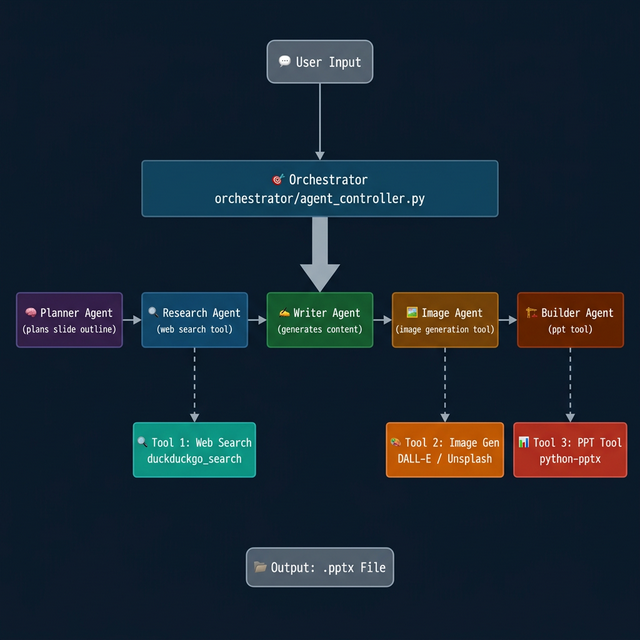
The execution pipeline is:
User Input
Planner Agent
Research Agent
Writer Agent
Image Agent
Builder Agent
Generated PPTX Output
Each agent operates on a shared structured state and updates only the fields it is responsible for.
This separation of concerns ensures:
Clear role specialization
Easier debugging
Better scalability
Future extensibility
The Planner Agent analyzes the user topic and creates a structured outline for the presentation.
Understand user topic
Generate slide titles
Create slide descriptions
Define presentation structure
presentation_outline = [{title, description}]
The Research Agent gathers factual information about each slide topic using a web search tool.
Perform web searches for slide topics
Extract relevant facts
Generate research notes for each slide
This improves factual accuracy and reduces hallucination from the language model.
The Writer Agent converts the slide outline and research notes into structured slide content.
Generate bullet points
Ensure logical flow between slides
Create concise slide explanations
slide_content = [{title, bullet_points}]
The Image Agent generates visual assets for each slide.
Generate image prompts
Retrieve relevant images
Attach images to slide data
This enhances the visual quality of the presentation.
The Builder Agent assembles all generated content into a PowerPoint presentation.
Create slides
Insert text and images
Format the presentation
Export .pptx file
The final presentation is then returned to the user for download.
The system integrates three external tools, which is a key requirement for agentic workflows.
| Tool | Purpose |
|---|---|
| Web Search Tool | Retrieves factual information for slide topics |
| Image Generation Tool | Generates slide visuals |
| PPT Generation Tool | Builds the final PowerPoint presentation |
These tools allow agents to interact with external resources instead of relying only on the language model.
The system is built using LangGraph to orchestrate agent execution. Each agent is implemented as a node in a state graph and operates on a shared AgentState structure.
Orchestration Flow
The orchestrator manages the following sequence:
PlannerAgent → creates presentation outline
ResearchAgent → enriches slides with web-based data
WriterAgent → generates structured bullet content
ImageAgent → generates or fetches visuals
BuilderAgent → compiles final PPT
Each agent is modular and independent, improving maintainability and scalability.
The project supports both:
Streamlit web interface
CLI-based execution
This dual interface demonstrates flexibility in deployment.
To ensure reliability and performance, multiple monitoring mechanisms were implemented.
A centralized logging system tracks:
Agent execution stages
API response times
Errors and retries
Final output generation
This allows better debugging and system transparency.
External API calls use exponential backoff retry logic. If failures occur:
Web search falls back to LLM-generated content
Image generation falls back to alternative sources
Temporary API errors are retried automatically
This improves resilience in real-world conditions.
LLM responses and API outputs are cached to:
Reduce redundant API calls
Improve response time
Maintain consistency during testing
Asynchronous Processing
An optional Redis + RQ job queue enables asynchronous task execution for scalability. If Redis is unavailable, the system automatically falls back to synchronous execution.
The system includes unit and integration tests using pytest, validating:
Individual agent correctness
State transitions
End-to-end pipeline execution
This ensures system robustness and production-readiness.
To run the project locally:
git clone https://github.com/dharamshiyash/agentic-ppt-builder
cd agentic-ppt-builder
pip install -r requirements.txt
Create a .env file and configure the required API keys.
Example:
GROQ_API_KEY=your_key
UNSPLASH_ACCESS_KEY=your_key
OPENAI_API_KEY=your_key
The project supports both Streamlit interface and CLI execution.
Run Web Interface:
streamlit run app.py
Open your browser and enter the presentation topic.
Run Using CLI:
python main.py --topic "Artificial Intelligence in Healthcare"
The system will generate a PowerPoint presentation automatically.
To ensure stable operation, the system implements multiple fallback strategies:
If web search fails → the Writer Agent uses LLM knowledge.
If image generation fails → Unsplash images are used as fallback.
If external API calls fail → retry logic with exponential backoff is applied.
If slide generation fails → the system logs the error and continues execution.
These mechanisms improve system robustness when interacting with external services.
The Agentic AI PowerPoint Builder can be used in many real-world scenarios:
-Student presentations
Research summaries
Business reports
Educational content creation
Automated slide generation for meetings
Developing this multi-agent system provided important insights:
Decomposing complex workflows into agents improves scalability.
Tool integration significantly enhances output quality.
Error handling is critical for production AI systems.
Modular design allows easy extension (e.g., data visualization agents).
This project demonstrates how agentic AI systems can move beyond simple prompt-based automation toward structured, reliable workflows.
This project demonstrates how multi-agent AI systems can automate complex creative workflows. By combining specialized agents, external tools, and an orchestrated workflow, the system can generate structured presentations from a simple user prompt.
The modular architecture also makes the system easily extendable. Future improvements could include advanced slide design, data visualization, and real-time collaborative editing.