 ## Overview
What is the Publication Assistant?
The AAIDC Module 2: Multi-Agent Publication Assistant is a sophisticated, production-ready system that leverages advanced agentic AI patterns to automate the process of analyzing software projects and generating high-quality publication metadata. It represents a complete implementation of multi-agent orchestration principles learned throughout the AAIDC Module 2 curriculum.
Core Problem It Solves
When developers and researchers want to publish their projects on platforms like Ready Tensor, arXiv, or other knowledge-sharing hubs, they face a common challenge:
- Time-consuming manual process: Crafting compelling titles, descriptions, and tags requires deep analysis of the codebase
- Inconsistent quality: Without structured guidance, suggestions vary in quality and completeness
- Lack of standardization: Different repositories use different documentation styles, making it hard to create uniform publication metadata
- Missing improvements: README files often lack visual organization, clear structure, and best practices
The Publication Assistant solves this problem by automating the analysis and suggestion process through a coordinated team of specialized AI agents.
System Architecture at a Glance
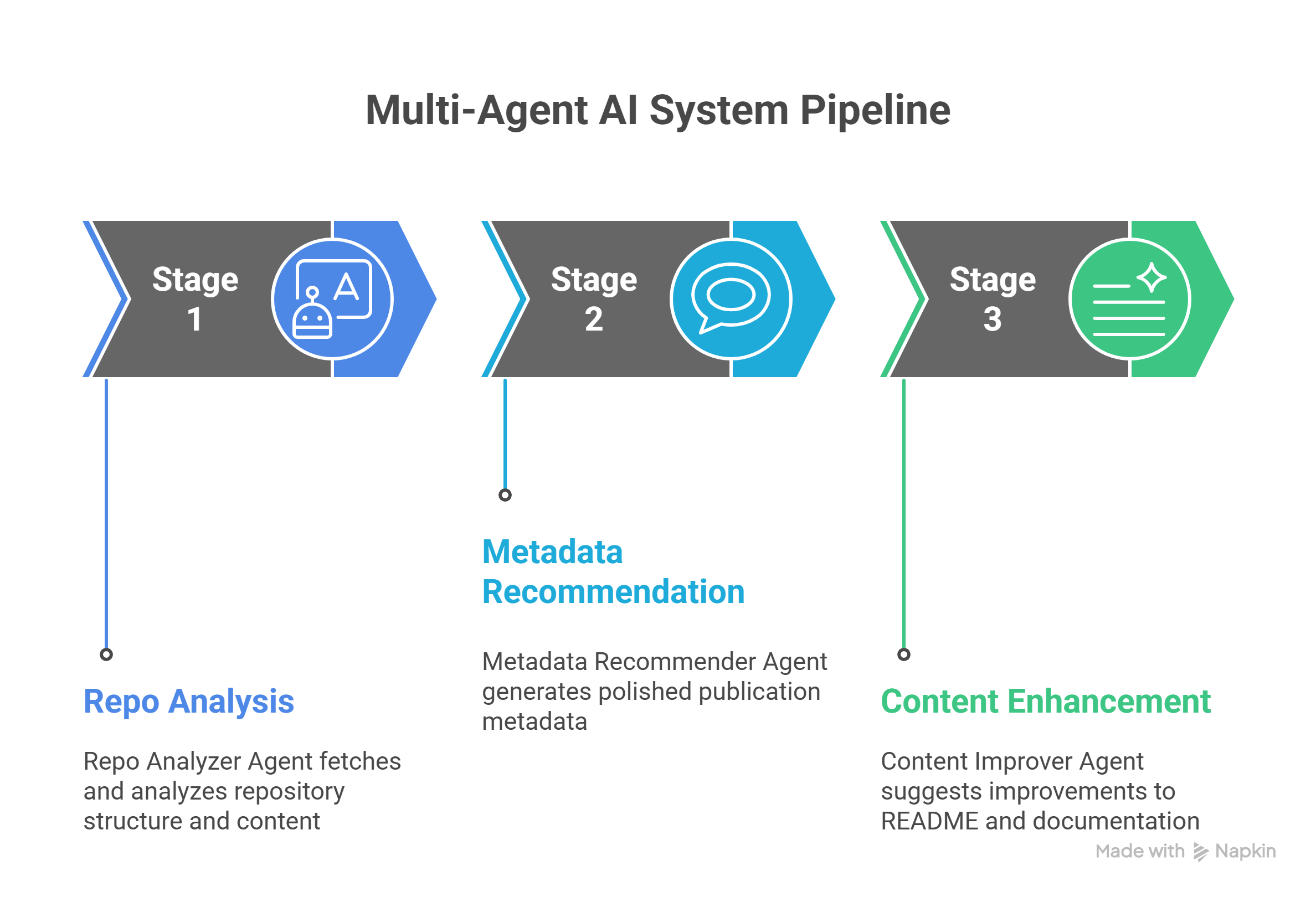
Built on LangGraph, the system implements a three-stage agent pipeline:
- Stage 1 - Analysis: The Repo Analyzer Agent fetches and understands the repository structure and content
- Stage 2 - Recommendation: The Metadata Recommender Agent generates polished publication metadata
- Stage 3 - Enhancement: The Content Improver Agent suggests concrete README improvements
All three agents operate on a shared state, ensuring consistency and enabling each agent to build on the work of its predecessors.
Key Capabilities
Intelligent Repository Analysis
- Automatically fetches README files from any public GitHub repository
- Extracts technical concepts, frameworks, and key features
- Understands project purpose and target audience
- Identifies relevant technologies and methodologies
Smart Metadata Generation
- Generates compelling, SEO-optimized project titles
- Creates concise, informative project descriptions
- Recommends relevant tags for discoverability
- Ensures metadata matches project scope and complexity
Actionable Improvement Suggestions
- Identifies missing sections (Installation, Examples, Contributing, etc.)
- Suggests structural improvements and best practices
- Recommends visual enhancements (diagrams, badges, code examples)
- Provides clarity improvements for technical documentation
Real-World Example
Consider analyzing the LangGraph repository:
Input: https://github.com/langchain-ai/langgraph
Output Generated:
- Title: "LangGraph: Orchestrate Stateful Long-Running AI Agents"
- Description: "LangGraph is a powerful orchestration framework designed for developers to build, manage, and deploy stateful AI agents capable of executing complex workflows safely and durably. With seamless integration into LangChain, it empowers your applications to maintain context and memory through failures."
- Tags:
langgraph, agents, orchestration, langchain, python, ai, workflow-management, durable-execution, memory-management, open-source
- Improvements:
- Add "Quick Start" section with minimal working example
- Include architecture diagram showing LangGraph's place in LangChain ecosystem
- Add "Use Cases" section with real-world examples
- Enhance "Contributing" guidelines
- Add "Comparison" section vs other orchestration frameworks
Why Multi-Agent Architecture?
Rather than building a single monolithic system, we use three specialized agents because:
- Separation of Concerns: Each agent focuses on one specific task
- Maintainability: Easy to update or improve one agent without affecting others
- Scalability: Can add more agents for specialized tasks (e.g., code analyzer, security reviewer)
- Reasoning Quality: LLMs perform better when given focused, specific tasks
- Real-World Simulation: Mirrors how actual teams work (analyzer → recommender → improver)
Technologies Behind the System
LangGraph provides the orchestration layer—managing state flow between agents, routing logic, and error handling.
LangChain provides the LLM integration—allowing each agent to leverage OpenAI's GPT model for intelligent reasoning.
Custom Tools extend agent capabilities—GitHub integration, keyword extraction, content summarization.
OpenAI GPT-4 powers the reasoning—each agent uses GPT-4 for natural language understanding and generation.
Pydantic ensures type safety—the shared state is validated at every step.
Python provides the foundation—clean, maintainable, production-grade implementation.
Design Philosophy
This system embodies key principles from the AAIDC Module 2 curriculum:
From Workflows to Agents: Unlike fixed workflows, this system makes intelligent decisions at each step based on content analysis.
Multi-Agent Collaboration: Three agents work together seamlessly through shared state management.
Tool-Augmented Intelligence: Agents don't just generate text—they use tools to gather real data and insights.
Orchestration Best Practices: LangGraph provides deterministic, inspectable, debuggable execution.
Production Readiness: Proper error handling, state persistence, and clear logging.
Who Benefits from This System?
- Individual Developers: Quickly generate publication-ready descriptions for personal projects
- Open Source Teams: Standardize how multiple projects are presented
- Research Groups: Create consistent metadata for academic papers and tools
- Knowledge Platforms: Automate metadata generation at scale
- Organizations: Maintain brand consistency across project documentation
What Makes It Different
| Aspect | Traditional Approach | Publication Assistant |
|---|
| Speed | Manual (1-2 hours) | Automated (10-15 seconds) |
| Consistency | Variable quality | Standardized output |
| Analysis Depth | Subjective | Data-driven |
| Scalability | Manual effort required | Handles 100s of repos |
| Improvement Suggestions | None | Comprehensive list |
| Technology Stack | Basic tools | Advanced LangGraph + LLM |
Architecture Highlights
The system's strength lies in its modular, state-driven architecture:
Project Links
Built as part of the Agentic AI Developer Certification Program by Ready Tensor