



This study conducts a comparative analysis of four prominent volatility modeling approaches—GARCH, Log-GARCH, FIGARCH, and FI-Log-GARCH—using the rugarch and ufRisk packages in R. The capacity of these models to capture important features of financial time series, like long memory, asymmetry, and volatility clustering, is assessed. Using Mercedes-Benz's daily stock return data from January 3, 2001, to January 30, 2025, the study investigates how each model responds to past volatility patterns in a variety of market regimes, such as crashes and recovery periods. In terms of stationarity, persistence, and asymmetric reaction to market shocks, the theoretical characteristics and mathematical frameworks of each model are described and contrasted.
Financial markets frequently display volatility clustering, in which calmer periods tend to last longer while periods of extreme volatility are likely to be followed by ongoing upheaval. The Generalized Autoregressive Conditional Heteroskedasticity (GARCH) model was created by Bollerslev (1986) as an extension of Engle's (1982) ARCH model to simulate this pattern. This model is a key tool in financial econometrics since it incorporates both historical squared returns and historical conditional variances to capture time-dependent volatility. Financial data, on the other hand, frequently exhibit more complex patterns, which has prompted the creation of various adjustments to increase accuracy (Engle, R. F., 2001). Asymmetric volatility, in which positive and negative shocks have distinct effects on market swings, can be more flexiblely represented by the Log-GARCH model, which adds a logarithmic modification of conditional variance. The Fractionally Integrated GARCH (FIGARCH) model is another significant modification. It adds long memory effects, which means that previous volatility shocks have a lasting impact on future market movements (Feng, Y., & Härdle, W. K., 2021). In order to better capture the persistence and asymmetry seen in actual financial markets, the FI-Log-GARCH model expands on these characteristics by include both fractional integration and log-volatility modifications (Baillie, R. T., Bollerslev, T., & Mikkelsen, H. O., 1996).
In this study, the mathematical structures of the GARCH, Log-GARCH, FIGARCH, and FI-Log- GARCH models are defined, and their theoretical properties such as asymmetry, and risk calculation are compared. Furthermore, we will test these models on actual financial data after implementing them in R using the rugarch and ufRisk packages. The effectiveness of each model in predicting volatility and capturing important financial market characteristics will be assessed empirically. The results will shed light on how sophisticated volatility models might enhance financial risk management and judgment in unpredictable markets.
The purpose of this research is to use daily price data from January 3, 2001, to January 30, 2025, to model the volatility of Mercedes-Benz stock returns. The dataset includes financial data from more than 20 years, including market crashes, economic cycles, and recovery times. We will use the GARCH, Log-GARCH, FIGARCH, and FI-Log-GARCH models to examine how well they represent asymmetry and volatility persistence in the price fluctuations of Mercedes-Benz shares. The mathematical formulations of these models will be presented first, and then their theoretical characteristics such as stationarity, and asymmetry will be compared. We will develop and estimate these models using R's rugarch and ufRisk packages, and then evaluate their empirical performance using goodness-of-fit measures and volatility projections.
Bollerslev (1986) presented the Generalized Autoregressive Conditional Heteroskedasticity (GARCH) model, which is an expansion of Engle's (1982) Autoregressive Conditional Heteroskedasticity (ARCH) model. By combining prior conditional variances and past squared residuals, it is intended to simulate time-varying volatility in financial markets. This paradigm is especially helpful in capturing volatility clustering, a prevalent phenomena in which tiny changes in asset values are often followed by small changes, and large changes are frequently followed by even larger ones (Bollerslev, T., 1986 & Engle, R. F., 1982). Mathematically, the GARCH(p, q) model is defined as:
Where 𝑟𝑡 represents the return series, 𝜎𝑡 is the conditional variance, and 𝑧𝑡 follows a white noise process with zero mean and unit variance, where ∈𝑡 represents previous shocks in returns. The parameters ω is constant and, 𝛼𝑖 𝜖𝑡−𝑖 2 and 𝛽𝑗 𝜎𝑡−𝑗 2 determine the influence of past shocks and historical volatility on the current variance. By incorporating past volatility into its structure, the GARCH model effectively captures volatility persistence, making it a widely used tool in financial risk management and
forecasting. It helps investors and analysts understand market dynamics, estimate risk, and make informed decisions. Given its flexibility, the GARCH model has been extensively applied in asset
pricing, portfolio management, and derivative valuation, proving to be a fundamental tool in financial econometrics (Crouhy, M., Galai, D., & Mark, R., 2013).
The classic GARCH framework is expanded upon in the Log-GARCH model, which gives the conditional variance a logarithmic modification. A major drawback of conventional GARCH models is addressed by this transformation, which guarantees that the variance stays strictly positive. The Log- GARCH approach increases the accuracy of volatility forecasts and provides more flexibility in capturing market movements by modeling volatility in logarithmic form (Bauwens, L., & Laurent, S.,
2005). Mathematically, the model is represented as:
Here also ∈𝑡 represents previous shocks in returns and 𝜎𝑡2 indicates the conditional variance. How previous volatilities and return shocks affect current volatility is determined by the coefficients, 𝛼𝑖 𝜖𝑡−𝑖
and 𝛽𝑗 𝜎2𝑡−𝑗 . The capacity of the Log-GARCH model to capture asymmetry in financial markets is one
of its main benefits. The Log-GARCH model takes leverage effects into account, which means that
negative returns may have a greater influence on volatility than positive returns of the same size(Feng,
Y., & Härdle, W. K., 2021). This is in contrast to normal GARCH models, which assume that positive
and negative shocks have the same effect on volatility(Hull, J. C., 2021). Because of this characteristic, it is very helpful for modeling financial time series data, which frequently exhibits asymmetric reactions to market shocks and nonlinear volatility patterns.
An improvement on the classic GARCH framework, the Fractionally Integrated GARCH (FIGARCH) model adds long-memory qualities to volatility modeling. The FIGARCH model permits a more slow, hyperbolic decay of volatility shocks, in contrast to typical GARCH models that assume an exponential deterioration (Feng, Y., Gries, T., & Letmathe, S., 2023). It is especially helpful for capturing the long-
range reliance seen in financial time series because of this property (Davidson, J., 2004). Mathematically, the FIGARCH model is expressed as:
In this case, L stands for the lag operator, 𝜎2𝑡 is the conditional variance, and 𝜖2𝑡 indicates the previous
squared residuals. The degree of fractional integration is determined by the parameter d, which controls the persistence of volatility shocks and falls between 0 and 1. The FIGARCH model stands out for its capacity to account for long memory in volatility, which means that historical volatility continues to
impact future variation for a considerable amount of time (Davidson, J., 2004). FIGARCH models capture slow decaying volatility patterns, which makes them more appropriate for financial markets with persistent volatility clustering than GARCH models, where the impact of previous shocks fades rather
rapidly. In risk management and financial forecasting, this long-memory trait is essential since it gives
analysts a better understanding of how persistent market movements are. It is particularly pertinent to
portfolio management, option pricing, and asset pricing, where precise modeling of volatility dynamics
is necessary to make wise investment choices. The FIGARCH model is a useful tool for researchers and
practitioners addressing persistent and long-lasting volatility impacts in financial markets because it
incorporates fractional integration, which gives financial time series data a more flexible and realistic
representation (Hull, J. C., 2021).
The long-memory feature of the FIGARCH model and the logarithmic variance transformation of the Log-GARCH model are combined to create the Fractionally Integrated Log-GARCH (FI-Log-GARCH)
model, a complex extension of volatility models (Feng, Y., Gries, T., & Letmathe, S., 2023). The FI-
Log-GARCH model enhances the accuracy and stability of volatility modeling by integrating these
characteristics, which makes it ideal for capturing both persistent and asymmetric volatility patterns seen in financial markets (Engle, R. F., 2001). The model is mathematically defined as:
If the conditional variance is represented by 𝜎2𝑡, the previous squared residuals are indicated by 𝜖2𝑡−𝑖, and the lag operator is L. A gradual and long-lasting decay in the effects of previous volatility shocks is
made possible by the fractional differencing process, which is controlled by the parameter d, which falls
between 0 and 1. The FI-Log-GARCH model's capacity to manage both short-term and long-term
dependencies in financial time series is one of its key benefits. While the fractional integration in FI-
Log-GARCH allows for a more accurate and prolonged influence of previous market movements,
traditional GARCH models frequently anticipate a rapid decrease in volatility effects. One of the
fundamental drawbacks of conventional volatility models is also addressed by the logarithmic
transformation, which guarantees that the conditional variance stays positive. This model is especially useful in financial applications like asset pricing, risk management, and portfolio optimization where volatility shows significant persistence and nonlinearity (Laurent, S., & Peters, J. P., 2006).
Researchers and practitioners investigating market dynamics and volatility behavior can benefit greatly
from the FI-Log-GARCH model, which combines fractional differentiation with log-transformed
variance to provide a strong framework for understanding real-world financial data. These volatility models, which are each designed to reflect distinct market characteristics, represent important advances in financial forecasting. While the Log-GARCH model guarantees positive variance and takes
asymmetry into account, the GARCH model accurately captures volatility clustering (Hull, J. C., 2021).
The historical stock data for Mercedes-Benz Group AG (ticker: MBG.DE) from January 2000 to January
2025 is used in this analysis. It includes 6,411 daily observations with 99% data completeness. The dataset was obtained using R's yfR package. A strong basis for analyzing long-term performance trends, volatility patterns, and market behaviors of this well-known German automaker over a quarter-century period marked by significant technological disruption and economic volatility in the global automotive industry is provided by this extensive financial time series, which includes standard trading metrics such as opening, closing, adjusted closing prices, daily highs and lows, and trading volumes.
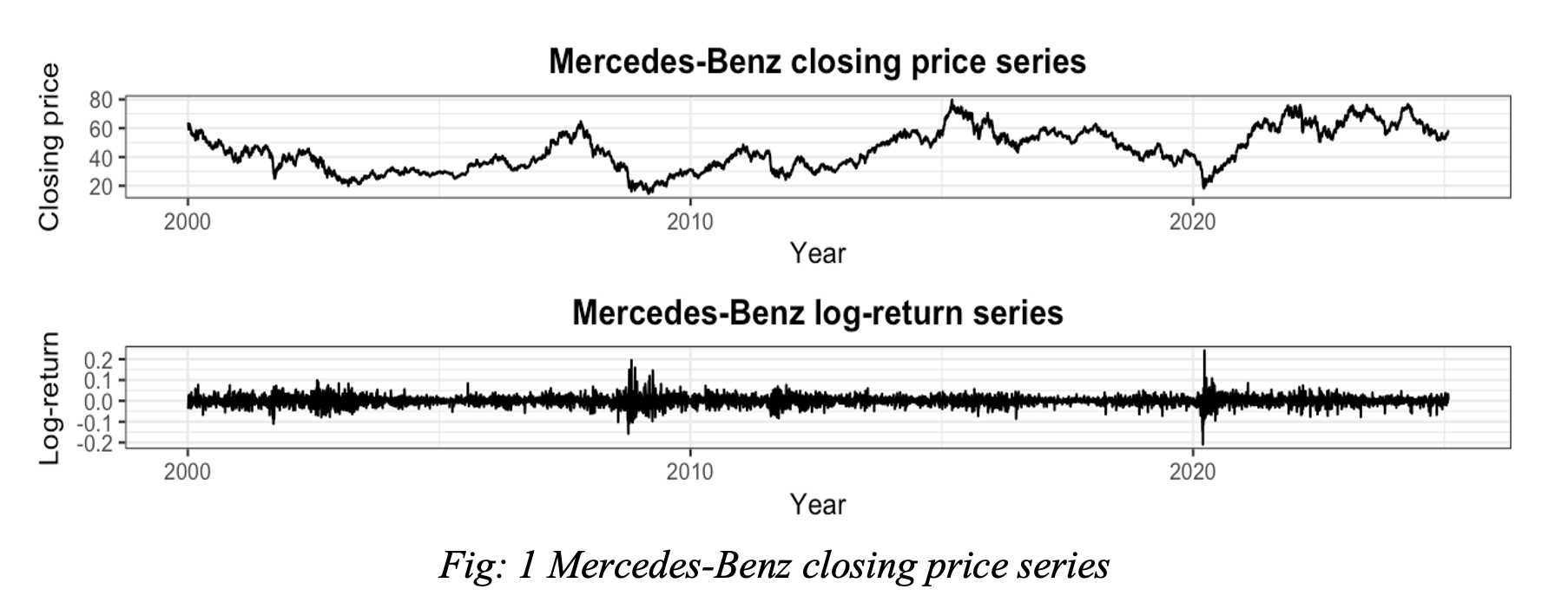
The Mercedes-Benz Group stock's time series graphic shows a shaky but ultimately stable performance trend from 2000 to 2025. The closing price series shows several different market cycles, starting about €60 in 2000 and then seeing sharp declines to about €20 in 2003 and again during the global financial crisis of 2008-2009, when prices fell to about €15. After a sharp decline of €20 in early 2020 due to COVID, further recovery stages culminated in price peaks that approached €80 in 2015–2016 and again in 2021–2022. While the log return series shows daily price changes generally fell within the range of ±5%, the related log-return series shows that high market stress, especially during the 2008 financial crisis and the 2020 pandemic, resulted in extreme volatility, with daily movements exceeding ±20%. Over such a long observation period, the returns are often either not stationary in the variance or there might be long memory in the conditional variances (or both). The log return shows that returns are approximately stationary in the mean. Variation in returns indicates either a changing unconditional variance or long memory.
Four volatility forecast models (Fig
)for Mercedes-Benz stock from February 2024 to January 2025
are displayed in the visualization, each providing a unique viewpoint on the dynamics of market volatility. With volatility estimates ranging from 0.010 to 0.025 and notable increases in June and October 2024, followed by a secondary peak in December, the GARCH(1,1) and FIGARCH models exhibit strikingly comparable patterns. On the other hand, throughout the course of the observation period, both logarithmic variants LogGARCH and FI-LogGARCH predict progressively larger volatility levels (Feng, Y., Gries, T., & Letmathe, S., 2023).
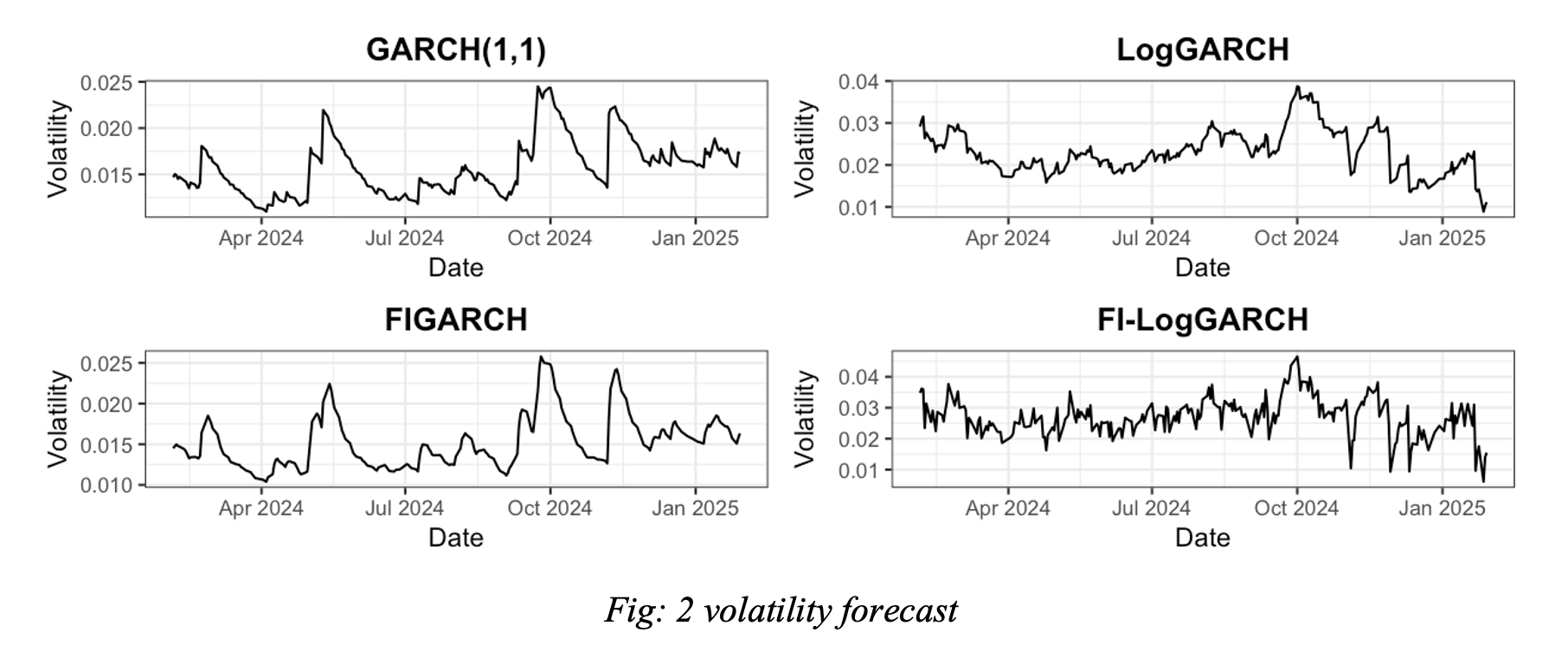
While FI-LogGARCH has the most severe values (0.010-0.045) and the largest overall volatility, with
notable disruptions in October 2024 followed by sharp declines in November and December, LogGARCH estimates range from 0.010 to 0.040. Interestingly, all four models agree that market uncertainty would be high in October 2024, however, to differing degrees, and by January 2025, they all predict a general decline in volatility. The significant distinctions between logarithmic and standard specifications demonstrate how model selection has a significant influence on volatility forecasting for financial risk management of Mercedes-Benz securities (Feng, Y., Gries, T., & Letmathe, S., 2023).
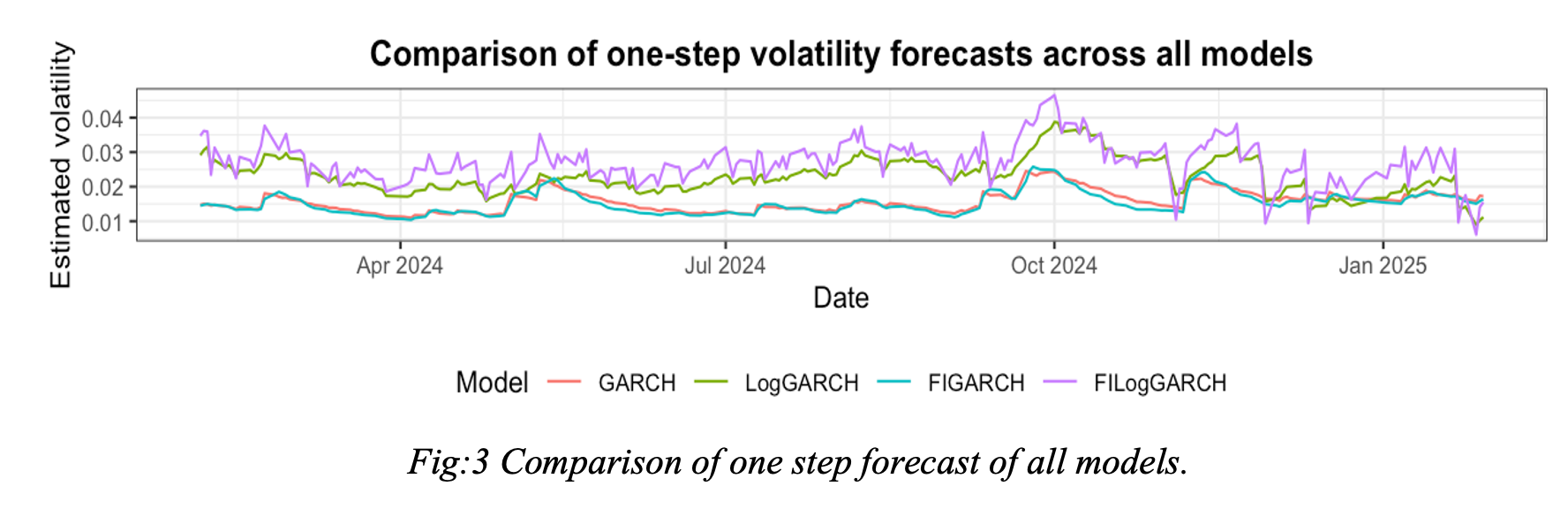
In the graphic compares one-step volatility (Fig
) projections for Mercedes-Benz stock using four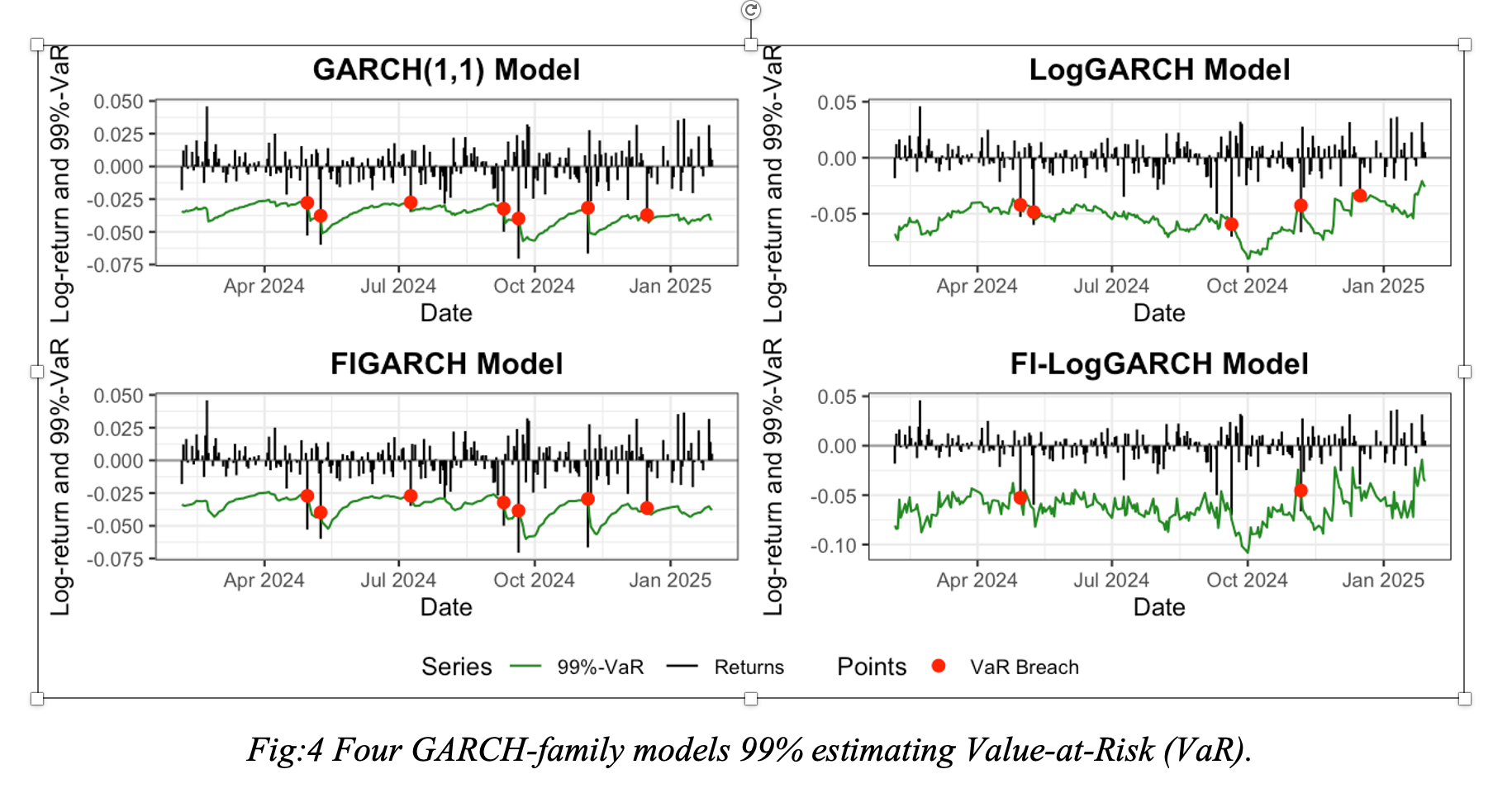
The risk rise in these conventional models is especially noticeable in May and June 2024 and October and November 2024. On the other hand, the logarithmic versions, LogGARCH and FI-LogGARCH,
consistently estimate more conservative risk thresholds. During October 2024, FI-LogGARCH recorded fewer VaR breaches (about three), but also produced the most extreme VaR values, approaching -0.10.
With significant effects for risk management procedures and regulatory compliance, the existence of VaR breaches across all specifications raises the possibility that Mercedes-Benz stock returns over this
time period may not fully reflect tail risk (Feng, Y., Gries, T., & Letmathe, S., 2023). In the figure 5, a comparison of 99% Value-at-Risk (VaR) projections from four distinct financial models GARCH, LogGARCH, FIGARCH, and FILogGARCH over the roughly April 2024 January 2025 timeframe is shown all together in the plot. The graph's main purpose is to show how an asset's log-returns relate to the predicted 99% VaR, or the possible loss that could happen with a 1% chance.
The daily log-returns are represented by the black bars at the top of the figure; they fluctuate about the
zero line to show times of gains and losses. The four models' 99% VaR predictions are shown by the
colored lines below. Interestingly, all four models projected possible losses by consistently predicting
negative VaR values (Beran, J., & Feng, Y., 2001)
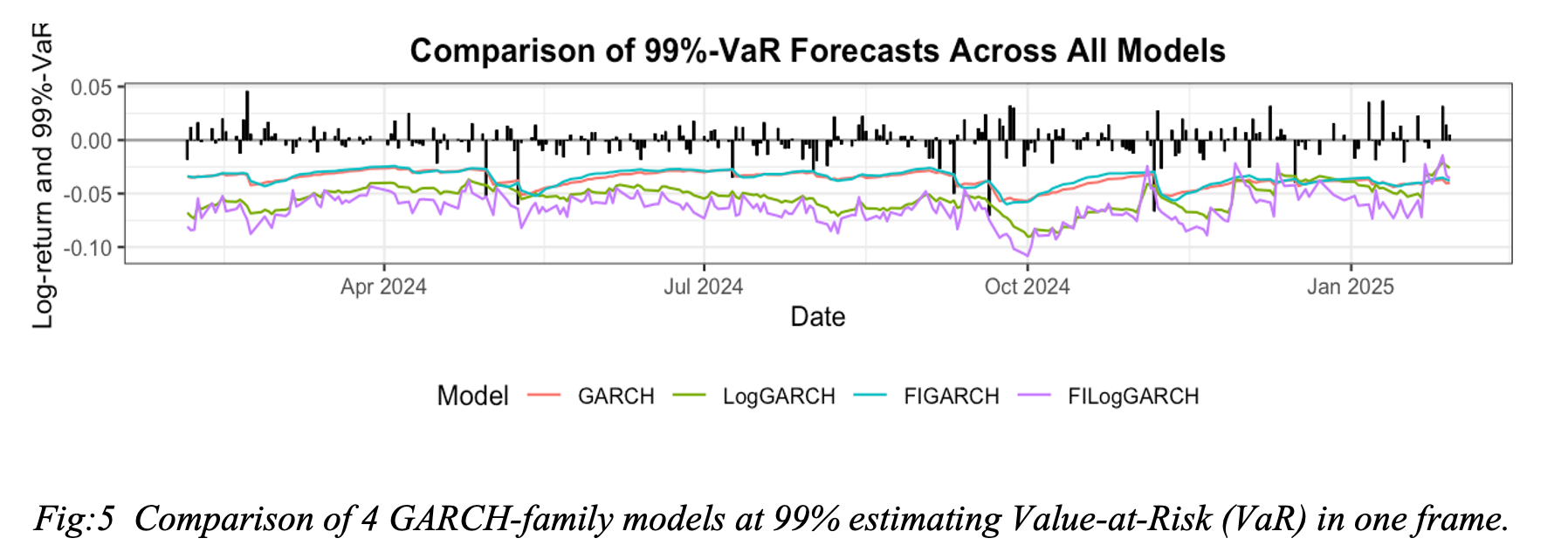
In contrast to the GARCH and LogGARCH models (red and teal lines), which seem to be more cautious,
the FIGARCH and FILogGARCH models (green and purple, respectively) show higher volatility and forecast larger possible losses (lower VaR values). The variations in the VaR projections for each model
point to a dynamic evaluation of risk over time that adapts to the log-return volatility. According to the
graph, the model selection has a major influence on the assessment of possible losses; FIGARCH and
FILogGARCH show a larger risk profile than GARCH and LogGARCH
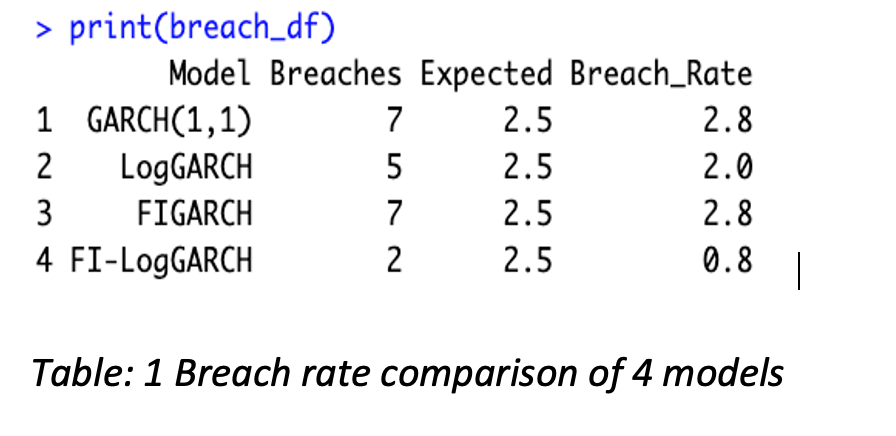
In the framework (Table: 1) of risk assessment, the table displays a breach analysis of the four financial
models, GARCH(1,1), LogGARCH, FIGARCH, and FI-LogGARCH. It contrasts the "Expected Breach_Rate" of 2.5 with the actual number of "Breaches (occurrences where losses were greater than
the model's risk projection). With seven breaches much more than anticipated both the GARCH(1,1)
and FIGARCH models had a Breach_Rate of 2.8. With five breaches, LogGARCH has a Breach_Rate of 2.0, which is higher than expected but closer to it. On the other hand, FI-LogGARCH performed the best in terms of correctly anticipating risk and preventing breaches, as seen by the fact that it had the fewest breaches (2), which translated into a Breach_Rate of 0.8. Because they were able to account for long memory effects, the FIGARCH and FI-Log-GARCH models showed a higher risk profile and predicted larger possible losses (lower VaR values). With comparatively larger VaR values, the GARCH and Log-GARCH models, on the other hand, offered more conservative risk estimates, indicating a more careful approach to risk assessment. This suggests that choosing the right model is essential for estimating the level of anticipated financial risk, particularly in erratic market environments (Beran, J., & Feng, Y., 2001).
The correctness and resilience of these models are further demonstrated by the breach rate study. While
Log-GARCH performed moderately (breach rate of 2.0), more in line with projected risk thresholds,
GARCH(1,1) and FIGARCH had the greatest breach rates (2.8), suggesting they may underestimate
extreme risk events. With the lowest breach rate (0.8), the FI-Log-GARCH model outperformed the
others, indicating better risk estimating skills and a more accurate evaluation of extreme loss scenarios.
In this work, four well-known GARCH-family models GARCH(1,1), Log-GARCH, FIGARCH, and FI-Log-GARCH were used to investigate and compare the volatility dynamics and risk assessment of Mercedes-Benz Group AG (MBG.DE) stock. In order to provide useful insights into financial risk forecasting, these models were assessed according to their capacity to capture persistence, long memory effects, asymmetric volatility responses, and volatility clustering. The results show that the traditional GARCH(1,1) and FIGARCH models may underestimate risk under extreme market conditions, even when they show similar volatility patterns. On the other hand, the Log-GARCH and FI-Log-GARCH models typically yield larger volatility estimates, especially during times of high stress, because they use logarithmic transformations to guarantee positive variance and capture asymmetry. By successfully combining long memory and asymmetric volatility effects, the FI-Log-GARCH model showed the most conservative risk assessment and was especially helpful in recognizing extreme risk scenarios (Crouhy, M., Galai, D., & Mark, R. 2013).
The models' accuracy in predicting excessive losses differed when it came to Value-at-Risk (VaR) analysis. While GARCH (1,1) and FIGARCH had a greater breach rate, indicating that they might understate tail risk, the FI-Log-GARCH model had the fewest breaches, showing a better alignment with projected risk estimates. Underestimating severe losses can result in inadequate capital reserves and subpar risk mitigation techniques, which has important ramifications for financial risk management. The most reliable method for predicting volatility and evaluating risk was the FI-Log-GARCH model, which performed exceptionally well in identifying asymmetric effects and long-term relationships. These results highlight how crucial it is to use the right volatility model depending on the features of the market and the particular risk management goals of investors and financial experts (Bauwens, L., & Laurent, S. 2005). By adding more macroeconomic variables or investigating hybrid strategies that blend machine learning and econometric modeling, future studies could improve these models even further (Beran, J., & Feng, Y., 2001).
The results will give long-term investors and analysts keeping an eye on the stock performance of the automotive industry important information on how well sophisticated volatility models work in financial
risk management and decision-making. The Log-GARCH model offers greater insights into market swings and volatility dynamics and is frequently used in risk management, asset pricing, and financial econometrics because of its increased flexibility and robustness (Feng, Y., & Härdle, W. K., 2021). The FI-Log-GARCH model combines long-memory with a logarithmic transformation for improved stability and accuracy, while the FIGARCH model adds long-memory qualities that permit persistent volatility effects.
Feng, Y., & Härdle, W. K. (2021). A data-driven P-spline smoother and the P-Spline-
GARCH-models.
Feng, Y., Gries, T., & Letmathe, S. (2023). FIEGARCH, modulus asymmetric FILog-GARCH
and trend-stationary dual long memory time series.
Beran, J., & Feng, Y. (2001). Local polynomial estimation with a FARIMA-GARCH error
process.
Baillie, R. T., Bollerslev, T., & Mikkelsen, H. O. (1996). Fractionally integrated generalized
autoregressive conditional heteroskedasticity. Journal of Econometrics, 74(1), 3–30.
https://doi.org/10.1016/S0304-4076(95)01749-6
Bauwens, L., & Laurent, S. (2005). A new class of multivariate skew densities, with application to
generalized autoregressive conditional heteroskedasticity models. Journal of Business & Economic
Statistics, 23(3), 346–354. https://doi.org/10.1198/073500104000000087
Bollerslev, T. (1986). Generalized autoregressive conditional heteroskedasticity. Journal of
Econometrics, 31(3), 307–327. https://doi.org/10.1016/0304-4076(86)90063-1
Crouhy, M., Galai, D., & Mark, R. (2013). The essentials of risk management (2nd ed.). McGraw-Hill
Education.
Davidson, J. (2004). Moment and memory properties of linear conditional heteroscedasticity models,
and a new model. Journal of Business & Economic Statistics, 22(1), 16–29.
https://doi.org/10.1198/073500103288619359
Engle, R. F. (1982). Autoregressive conditional heteroskedasticity with estimates of the variance of
United Kingdom inflation. Econometrica, 50(4), 987–1007. https://doi.org/10.2307/1912773
Engle, R. F. (2001). GARCH 101: The use of ARCH/GARCH models in applied econometrics. Journal of
Economic Perspectives, 15(4), 157–168. https://doi.org/10.1257/jep.15.4.157
Hull, J. C. (2021). Risk management and financial institutions (5th ed.). Wiley.
Laurent, S., & Peters, J. P. (2006). GARCH models and the financial crisis: A review of recent
developments. Econometric Reviews, 25(2–3), 149–191.
https://doi.org/10.1080/07474930600715493
Taylor, S. J. (1986). Modelling financial time series. Wiley.
Data Source: Mercedes-Benz Group AG (MBG.DE). https://finance.yahoo.com/quote/MBG.DE/
rugarch
ugarchspec(), ugarchfit(), ugarchforecast()
ufRisk
riskfit(), VaR(), ES()
Mercedes-Benz stock return data from Yahoo Finance or Bloomberg
Time period: January 3, 2001 – January 30, 2025